
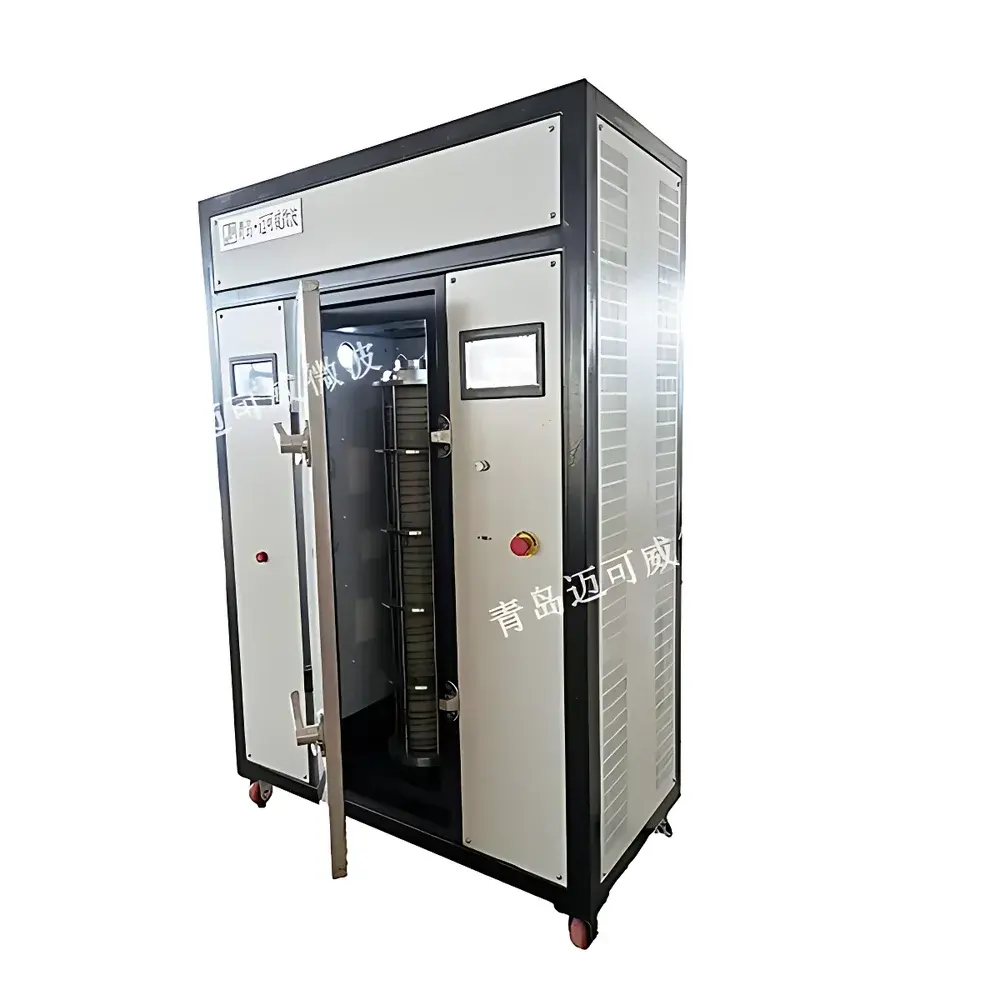
MakeWave MKX-XL10 Large-Volume Sealed Microwave Synthesis Reactor
| Brand | MakeWave |
|---|---|
| Origin | Shandong, China |
| Manufacturer Type | Direct Manufacturer |
| Country of Origin | China |
| Model | MKX-XL10 |
| Usable Volume | Large (8 L) |
| Construction Material | 304 Stainless Steel |
| Operating Pressure | Medium-Pressure (up to 3 MPa) |
| Vacuum Capability | 3 MPa |
| Rated Microwave Power | 8000 W (2450 MHz, continuous non-pulsed output) |
| Max. Temperature | 220 °C |
| Max. Pressure | 3 MPa |
| Control System | PLC-based with touchscreen HMI |
| Safety Compliance | Microwave leakage < 5 mW/cm² (exceeding GB standard) |
| Weight | 120 kg |
| Dimensions (W×H×D) | 1100 × 1800 × 600 mm |
| Power Supply | 380 VAC / 50 Hz |
| Total Power Consumption | 15 kW |
| Certifications | ISO 9001 |
Overview
The MakeWave MKX-XL10 is a large-volume, sealed microwave synthesis reactor engineered for high-integrity, medium-pressure chemical processing under controlled microwave irradiation. It operates on the principle of dielectric heating—where polar molecules and ionic species absorb 2450 MHz microwave energy, enabling rapid, volumetric, and selective thermal activation of reaction mixtures. Unlike conventional conductive heating, this mechanism delivers uniform internal energy deposition, significantly accelerating reaction kinetics while suppressing thermal gradients and side reactions. Designed specifically for closed-vessel chemistry, the MKX-XL10 supports reproducible synthesis, extraction, and catalytic transformations in environments requiring precise pressure containment up to 3 MPa and temperatures up to 220 °C. Its 8 L working capacity accommodates scalable batch processes relevant to process development, pre-pilot synthesis, and materials precursor preparation—making it suitable for laboratories transitioning from bench-scale discovery to applied reaction engineering.
Key Features
- Robust 304 stainless steel cavity (≈100 L internal volume), fully welded and internally coated with multi-layer PTFE for corrosion resistance against aggressive reagents (e.g., HF, HNO₃, aqua regia) and long-term thermal stability at elevated temperatures.
- Sealed 8 L PTFE-lined high-pressure reaction vessel with integrated fiber-optic temperature sensing (insertion type) and piezoresistive pressure transduction—ensuring real-time, drift-free monitoring without electromagnetic interference.
- Continuous, non-pulsed 8000 W microwave power delivery at 2450 MHz, enabling stable energy input across extended reaction durations (up to several hours) without duty-cycle limitations.
- PLC-based control architecture with industrial-grade touchscreen HMI: enables simultaneous closed-loop regulation of temperature, pressure, and microwave power; supports up to 20 customizable multistep programs with ramp/hold profiles.
- Dual safety interlock system: door-mounted mechanical and electrical interlocks cut microwave power instantly upon door opening; λ/4 choke structure suppresses microwave leakage to <5 mW/cm² (measured per IEC 61000-4-3 and GB 10436-2008).
- Integrated magnetic stirring with PTFE-coated stir bar and variable-speed drive (0–1200 rpm), ensuring homogeneous mixing under pressurized conditions without shaft penetration or seal degradation.
Sample Compatibility & Compliance
The MKX-XL10 accommodates a broad spectrum of sample types—including aqueous, organic, and mixed-phase systems—within its chemically inert PTFE reaction vessel. It complies with ISO 9001 quality management standards and meets structural and electromagnetic safety requirements defined in GB 10436-2008 (Microwave Leakage Limits) and IEC 61000-6-4 (EMC Emission Standard). While not inherently compliant with FDA 21 CFR Part 11, its data logging architecture (timestamped, user-annotated, exportable CSV/TXT files) supports audit-ready documentation when deployed within GLP/GMP-aligned workflows. The reactor is routinely validated for use in ASTM D7213 (microwave-assisted digestion) and USP heavy metal testing protocols where sealed-vessel mineralization is required.
Software & Data Management
All operational parameters—including real-time temperature, pressure, microwave power, and time—are continuously logged and displayed as synchronized curves on the 10.1″ capacitive touchscreen interface. Data are stored internally (≥10,000 cycles) and exportable via USB port in comma-separated format for post-processing in MATLAB, Origin, or LIMS platforms. The system supports optional Ethernet connectivity for remote monitoring and integration into centralized lab automation frameworks. Audit trails include operator ID, program name, start/stop timestamps, and deviation alerts—facilitating traceability in regulated environments. No cloud dependency or proprietary software installation is required.
Applications
The MKX-XL10 serves cross-disciplinary research and development needs: in organic synthesis, it enables rapid Suzuki couplings, esterifications, and heterocycle formations under milder conditions than oil-bath reflux; in inorganic chemistry, it supports hydrothermal synthesis of MOFs, quantum dots, and doped metal oxides; in pharmaceutical R&D, it accelerates API crystallization screening and polymorph control studies; in environmental analysis, it performs high-efficiency microwave-assisted extraction (MAE) of PAHs, PCBs, and microplastics from soil/sediment matrices; and in materials science, it facilitates scalable solvothermal synthesis of battery cathode precursors (e.g., NMC, LFP) with improved phase purity and particle size distribution.
FAQ
What is the maximum allowable working pressure and temperature for routine operation?
The recommended operating envelope is 0–2.5 MPa and 0–210 °C for daily use; the absolute limits are 3 MPa and 220 °C, reserved for short-duration validation runs.
Can the reactor be used for acid digestion of biological tissue samples?
Yes—its PTFE vessel and corrosion-resistant cavity support EPA Method 3052 and ISO 15587-2 compliant digestions using HNO₃/HF/H₂O₂ mixtures under sealed conditions.
Is external cooling required during extended microwave exposure?
No—the unit integrates an internal forced-air cooling circuit and exhaust fan; however, ambient room temperature should remain ≤25 °C for sustained 8-hour operation at full power.
Does the system support third-party sensor integration (e.g., pH, conductivity)?
Not natively—but the PLC I/O module provides 4 analog inputs (0–10 V / 4–20 mA) for optional external sensor retrofitting with custom firmware configuration.
What maintenance intervals are recommended for long-term reliability?
PTFE gaskets should be inspected and replaced every 12 months or after 200 pressurized cycles; microwave waveguide and magnetron performance should be verified annually using calibrated field probes.



