
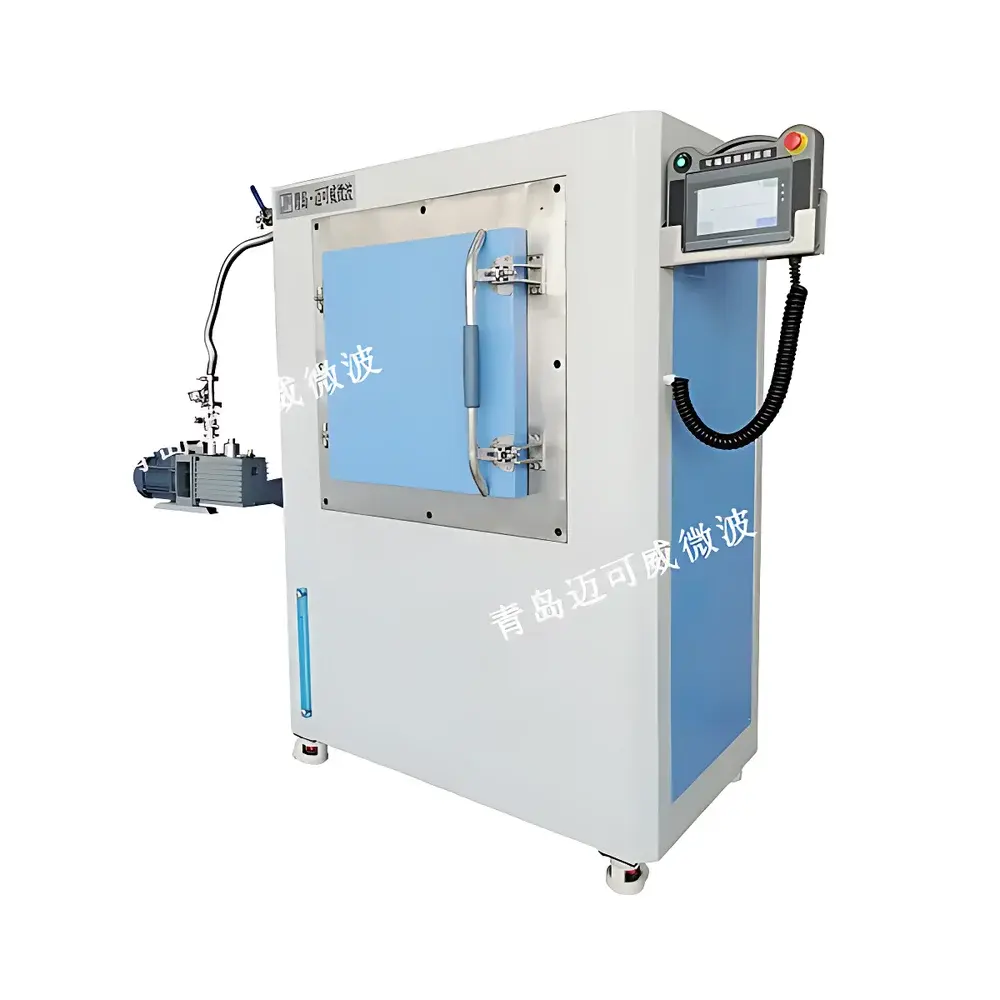
MakeWave MKZ-T6B Microwave Vacuum High-Temperature Box Furnace
| Brand | MakeWave |
|---|---|
| Origin | Shandong, China |
| Manufacturer Type | Direct Manufacturer |
| Product Category | Domestic |
| Model | MKZ-T6B |
| Instrument Type | Box-Type Furnace |
| Maximum Temperature | 1600 °C |
| Temperature Control Accuracy | ±1 °C |
| Rated Microwave Power | 4800 W |
| Heating Rate to Max Temperature | ~40 min |
| Heating Method | 2450 MHz Continuous Non-Pulsed Microwave |
| Internal Cavity Volume | ~8 L |
| Power Supply | 380 V AC / 50 Hz |
| Total System Power Consumption | 8500 W |
| Net Weight | 150 kg |
| Vacuum Range | 0 to –0.099 MPa (absolute) |
| Microwave Leakage | <5 mW/cm² |
Overview
The MakeWave MKZ-T6B Microwave Vacuum High-Temperature Box Furnace is an integrated thermal processing platform engineered for advanced materials synthesis and high-temperature treatment under controlled vacuum or reactive atmospheres. Unlike conventional resistance-heated muffle furnaces, the MKZ-T6B employs 2450 MHz continuous non-pulsed microwave energy to induce volumetric heating within dielectric and semi-conductive samples—enabling rapid, uniform temperature rise with minimal thermal lag. Its fully sealed 304 stainless steel cavity supports sustained operation up to 1600 °C while maintaining vacuum integrity down to –0.099 MPa (absolute), making it suitable for sintering of advanced ceramics, graphitization of carbon precursors, reduction of metal oxides, and vacuum-assisted solid-state reactions. The system’s design conforms to fundamental requirements of ISO 9001-certified manufacturing and integrates mechanical vacuum pumping, water-cooled magnetron operation, and infrared-based non-contact temperature monitoring—ensuring reproducibility and traceability in research and pilot-scale production environments.
Key Features
- 4800 W continuous-wave microwave source with water-cooled magnetron and λ/4 choke-backed door structure, delivering <5 mW/cm² microwave leakage (exceeding IEC 61000-3-2 and GB 10436 safety limits)
- Monolithic 304 stainless steel vacuum chamber with full-welded construction and hermetic sealing; optimized for long-term thermal cycling and vacuum integrity at elevated temperatures
- Multi-layer embedded insulation using low-εr ceramic fiber composites (thermal conductivity ≈ 0.226 W/m·K), minimizing radial heat loss and enhancing energy efficiency during high-temperature holds
- Non-contact infrared pyrometry calibrated for emissivity-adjusted real-time measurement of sample surface temperature—critical for process validation and thermal profile mapping
- Modular gas handling system supporting up to three independent mass flow-controlled inlet lines, enabling precise atmosphere composition (e.g., Ar, N2, H2, forming gas) and dynamic pressure regulation
- PLC-based control architecture with 7-inch resistive touchscreen interface; stores up to 20 programmable thermal profiles with time-temperature-power logging and CSV export capability
Sample Compatibility & Compliance
The MKZ-T6B accommodates crucible-based sample configurations up to 150 × 150 mm, compatible with alumina, silicon carbide, graphite, and molybdenum disilicide (MoSi2) crucibles. Its 8 L internal volume supports batch processing of powders, green bodies, and pre-sintered compacts used in oxide and non-oxide ceramic development. The furnace meets structural and operational prerequisites for ASTM C1171 (standard test method for flexural strength of advanced ceramics), ISO 2738 (sintered metal materials—determination of density, apparent porosity and open porosity), and USP (thermal analysis of pharmaceutical excipients). Vacuum and atmosphere control functions are designed to support GLP-compliant documentation workflows, including audit-trail-enabled parameter logging and user-access-level authentication.
Software & Data Management
The integrated control system records timestamped data for temperature, microwave power output, vacuum pressure, and gas flow rates at user-defined intervals (1–60 s resolution). All datasets are stored locally on industrial-grade SD card storage and exportable via USB port in comma-separated value (CSV) format for post-processing in MATLAB, Python (Pandas), or commercial statistical software. Optional OPC UA integration enables seamless connection to laboratory information management systems (LIMS) and SCADA platforms. Firmware supports firmware-over-the-air (FOTA) updates through secure Ethernet interface, ensuring long-term compatibility with evolving regulatory reporting standards including FDA 21 CFR Part 11 requirements for electronic records and signatures.
Applications
- Vacuum sintering of zirconia, alumina, silicon nitride, and silicon carbide ceramics with reduced grain growth and enhanced densification kinetics
- Graphene oxide reduction and carbon nanotube synthesis under inert or reducing atmospheres
- Thermal decomposition of metal-organic frameworks (MOFs) and precursor-derived ceramics
- Rapid annealing of thin-film solar absorbers (e.g., CZTS, perovskites) with minimized interdiffusion and phase segregation
- High-temperature activation of catalyst supports (e.g., γ-Al2O3, TiO2) under controlled oxygen partial pressure
- Lab-scale development of solid-state battery cathode materials (e.g., NMC, LFP) with precise thermal ramping and dwell control
FAQ
What vacuum level can the MKZ-T6B achieve, and is a cold trap included?
The system achieves a base vacuum of 0 to –0.099 MPa (absolute) using a two-stage rotary vane mechanical pump. A condensate-capturing cold trap and particulate filtration unit are available as optional accessories for volatile byproduct management.
Can the furnace operate under hydrogen or ammonia atmospheres?
Yes—provided appropriate gas line materials (e.g., SS316 tubing), leak-tested fittings, and explosion-proof ventilation are implemented per local safety codes. The multi-channel mass flow controller supports H2, NH3, and other reactive gases when configured with compatible seals and purge protocols.
Is infrared temperature calibration traceable to NIST standards?
The built-in pyrometer is factory-calibrated against blackbody reference sources. Users may perform field verification using certified thermocouple probes (Type S or B) inserted into auxiliary ports, with calibration reports issued upon request.
What is the expected service life of the magnetron under continuous 1600 °C operation?
With proper water cooling (flow rate ≥ 3 L/min, inlet temperature ≤ 25 °C) and routine maintenance (including waveguide desiccant replacement every 6 months), the magnetron maintains rated output for ≥ 5000 hours of cumulative operation.
Does the system comply with electromagnetic compatibility (EMC) directives for EU laboratories?
Yes—the enclosure meets EN 61000-6-3 (emission) and EN 61000-6-2 (immunity) requirements. CE marking documentation, including DoC and technical file summaries, is supplied with each unit.



