
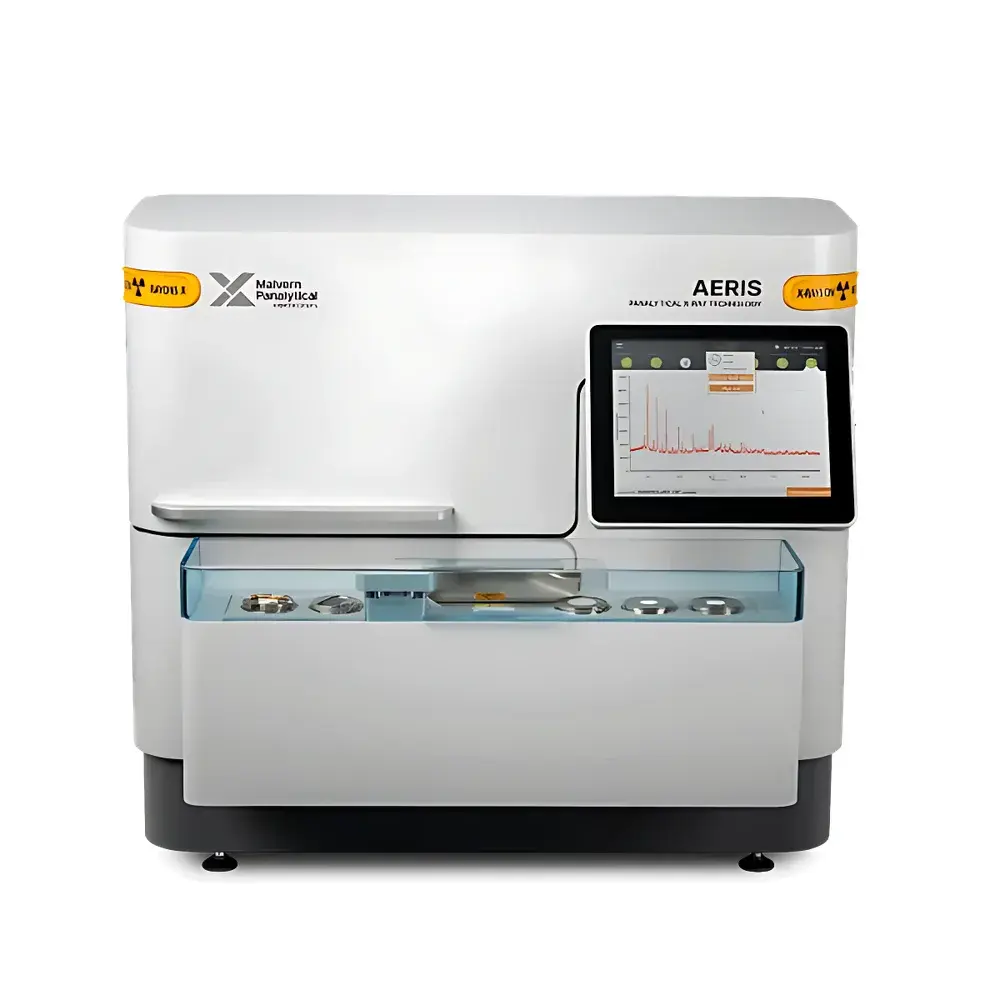
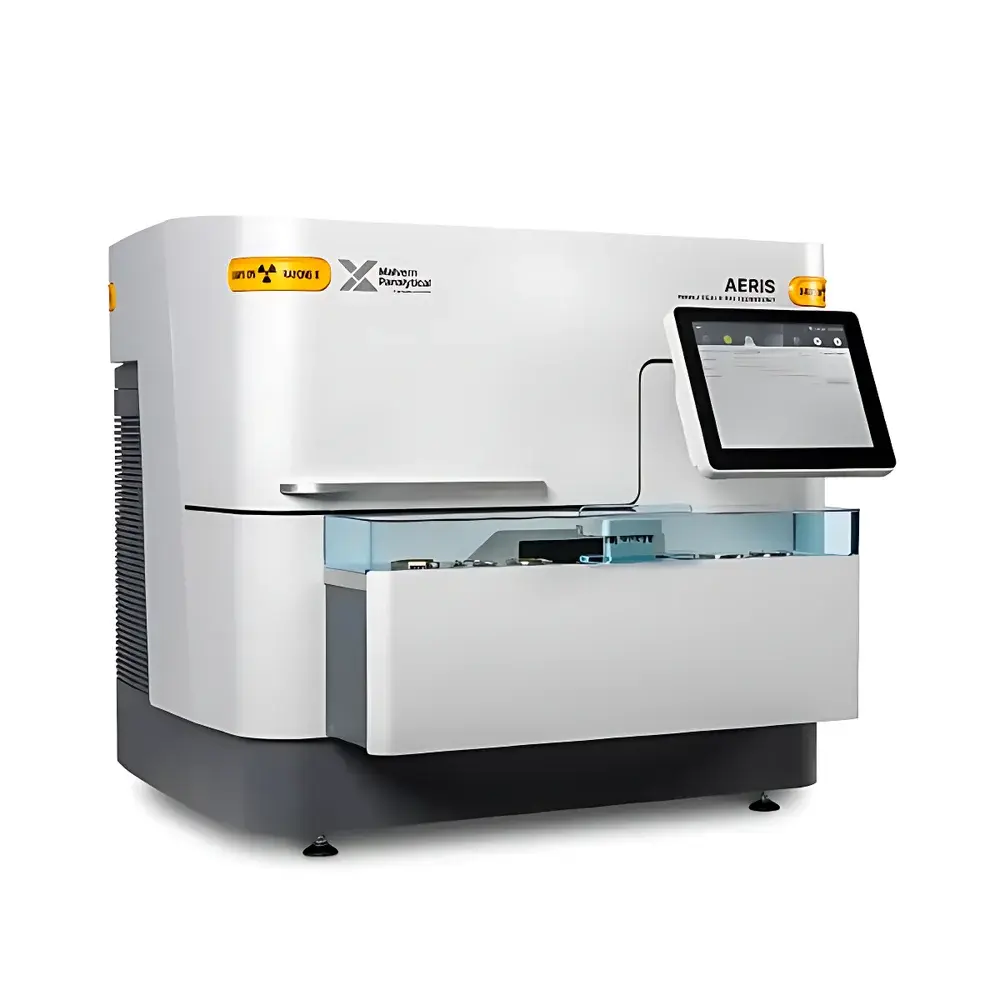
Malvern Panalytical Aeris Benchtop X-ray Diffractometer
| Brand | Malvern Panalytical |
|---|---|
| Origin | Netherlands |
| Manufacturer Type | Original Equipment Manufacturer (OEM) |
| Product Origin | Imported |
| Model | Aeris |
| Instrument Type | Powder X-ray Diffractometer |
| Form Factor | Benchtop |
| Power Stability | < 0.0001 (unitless relative stability, typical for high-stability X-ray tube voltage/current regulation) |
Overview
The Malvern Panalytical Aeris Benchtop X-ray Diffractometer is a compact, high-performance powder X-ray diffractometer engineered for precision phase identification, quantitative phase analysis (QPA), crystallite size determination, and lattice parameter refinement. Based on Bragg’s law and utilizing Cu Kα radiation (λ = 1.5418 Å), the Aeris employs a fixed-θ/θ goniometer architecture with a sealed-tube X-ray source and a silicon-strip detector (SSD) to deliver laboratory-grade diffraction data—previously attainable only on floor-standing, high-power systems. Its benchtop footprint (≈ 60 × 60 × 65 cm) integrates a robust mechanical design, thermal stabilization, and vibration-damping chassis to ensure long-term angular reproducibility (< 0.002° 2θ drift over 8 h). Designed for routine operation in QC labs, R&D centers, and production environments, the Aeris delivers high signal-to-noise diffraction patterns with minimal operator intervention and no requirement for liquid nitrogen or external water cooling.
Key Features
- Compact benchtop form factor with full XRD functionality—no dedicated shielding room required under standard local radiation safety regulations (compliant with IEC 61010-1 and IEC 62471)
- Integrated touchscreen interface with intuitive, icon-driven software navigation—enabling one-button measurement initiation from sample loading to report generation
- Fixed-geometry θ/θ goniometer with high-precision stepper motor control and optical encoder feedback for angular accuracy ≤ ±0.01° 2θ
- Sealed Cu anode X-ray tube (40 kV / 15 mA nominal), optimized for low thermal drift and stable intensity output (power regulation stability < 0.0001)
- High-efficiency silicon-strip detector (SSD) with 128-channel resolution and real-time background subtraction
- Modular platform supporting four application-specific configurations: Research, Cement, Minerals, and Metals—each pre-calibrated and validated against industry reference standards (e.g., NIST SRM 640e, IUCr Quartz Standard)
- Optional automation integration via robotic sample changers (up to 36 positions) and PLC-compatible digital I/O for inline process monitoring
Sample Compatibility & Compliance
The Aeris accepts standard 25 mm or 32 mm diameter powder holders (zero-background silicon or glass), capillary tubes (0.3–1.0 mm ID), and flat-plate specimens. It supports both air and helium purge environments for moisture-sensitive or low-Z materials. All versions comply with ISO 17873:2015 (XRD quantitative phase analysis), ASTM E975 (standard practice for XRD residual stress measurement), and EN 196-2 (cement testing). The Cement and Minerals editions include pre-loaded calibration curves traceable to CRM databases (e.g., BAM, NIST) and support automated reporting aligned with ISO 29581-2 (cement mineralogical analysis). The Metals version enables rapid residual austenite quantification per ASTM E975 and ISO 20832, with built-in Rietveld refinement workflows validated for Fe–C systems.
Software & Data Management
The Aeris operates natively with Malvern Panalytical’s HighScore Plus software suite—licensed per instrument and compliant with FDA 21 CFR Part 11 requirements when configured with audit trail, electronic signature, and role-based access control. Data acquisition, phase identification (via ICDD PDF-4+ database), QPA (Rietveld and Reference Intensity Ratio methods), and crystallite size analysis (Scherrer and Williamson–Hall) are fully integrated. Raw .raw and processed .csv/.xy files are exportable in vendor-neutral formats. Optional connectivity includes OPC UA server integration for MES/SCADA systems and secure REST API endpoints for LIMS interoperability. All software modules undergo annual GLP/GMP validation support packages, including IQ/OQ documentation templates.
Applications
- Research & Academia: Polymorph screening of active pharmaceutical ingredients (APIs), in-situ reaction monitoring, teaching fundamental XRD principles to undergraduate and graduate students
- Cement Industry: Real-time quantification of alite (C3S), belite (C2S), tricalcium aluminate (C3A), and free lime in raw meal, clinker, and blended cements; optimization of alternative fuel substitution strategies
- Minerals & Mining: Ore grade control via modal mineralogy (e.g., hematite vs. goethite, clay speciation), leach feed characterization for hydrometallurgical modeling, tailings mineralogical compliance reporting
- Metals & Alloys: Residual austenite measurement in carburized steels, phase fraction analysis in DRI (Direct Reduced Iron), detection of intermetallic phases in aluminum alloys and nickel superalloys
FAQ
Is the Aeris suitable for regulatory-compliant quality control in GMP environments?
Yes—the instrument supports 21 CFR Part 11-compliant operation when deployed with HighScore Plus v5.0+ and validated user access controls, electronic signatures, and full audit trail logging.
Can Aeris perform in-situ or time-resolved XRD measurements?
While not designed for high-speed synchrotron-style kinetics, the Aeris supports sequential step-scanning with ≥1 s/step acquisition and optional temperature-controlled stages (−10 °C to +600 °C) for limited in-situ thermal studies.
What maintenance is required for the X-ray tube?
The sealed Cu tube has a rated lifetime of ≥2 years at nominal operating conditions; no filament replacement or vacuum reconditioning is required during normal use.
Does Aeris support third-party database integration beyond ICDD?
Yes—HighScore Plus allows import of custom crystallographic databases in CIF format and supports user-defined search-match libraries with configurable weighting and exclusion rules.
How is angular calibration verified and maintained?
Each Aeris undergoes factory calibration using NIST-traceable quartz and silicon standards; users can execute automated calibration verification routines monthly using supplied reference samples and generate ISO/IEC 17025-aligned calibration certificates.
Related Products





