
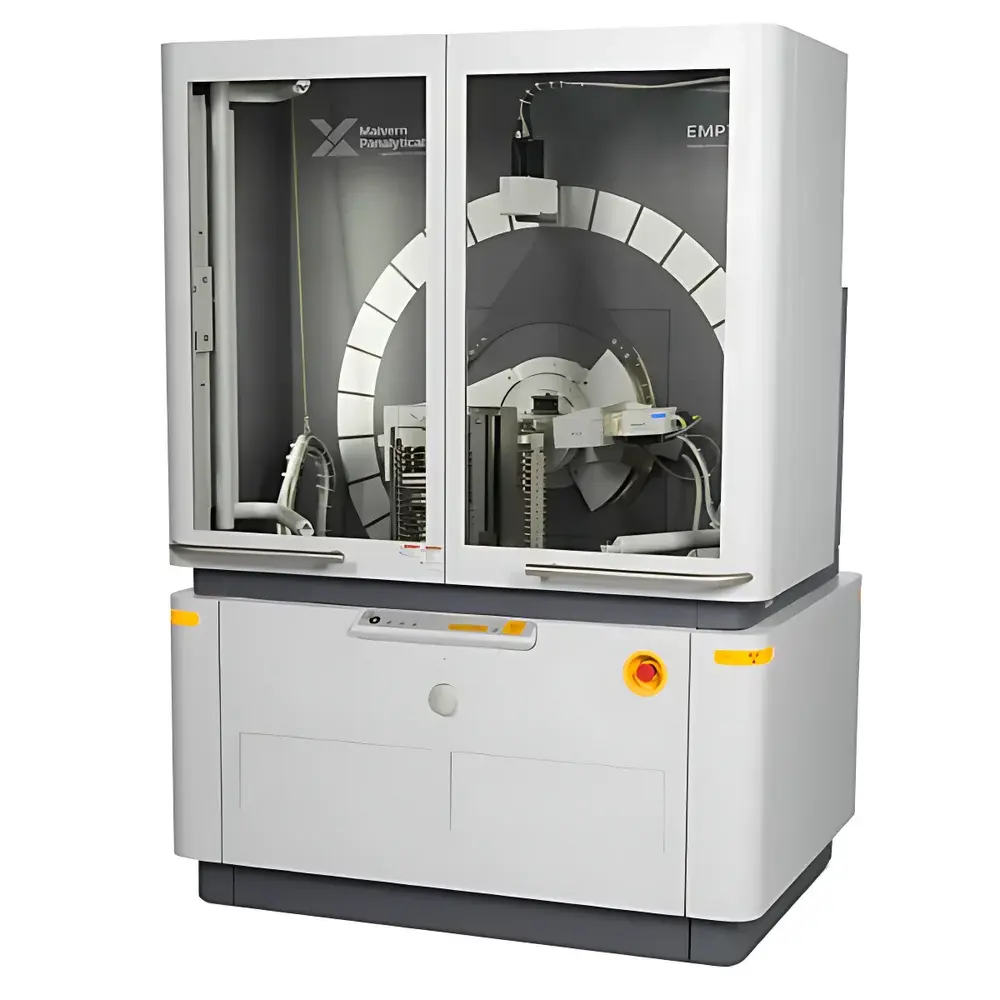
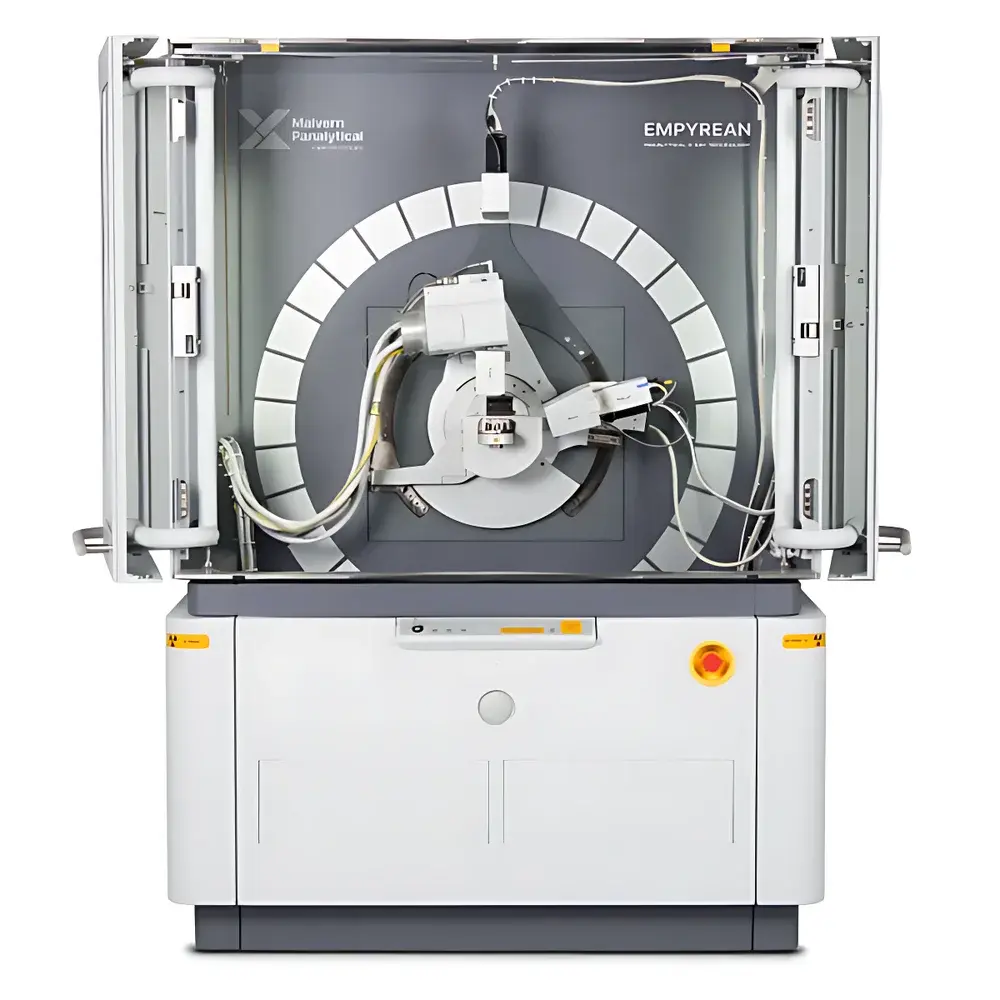
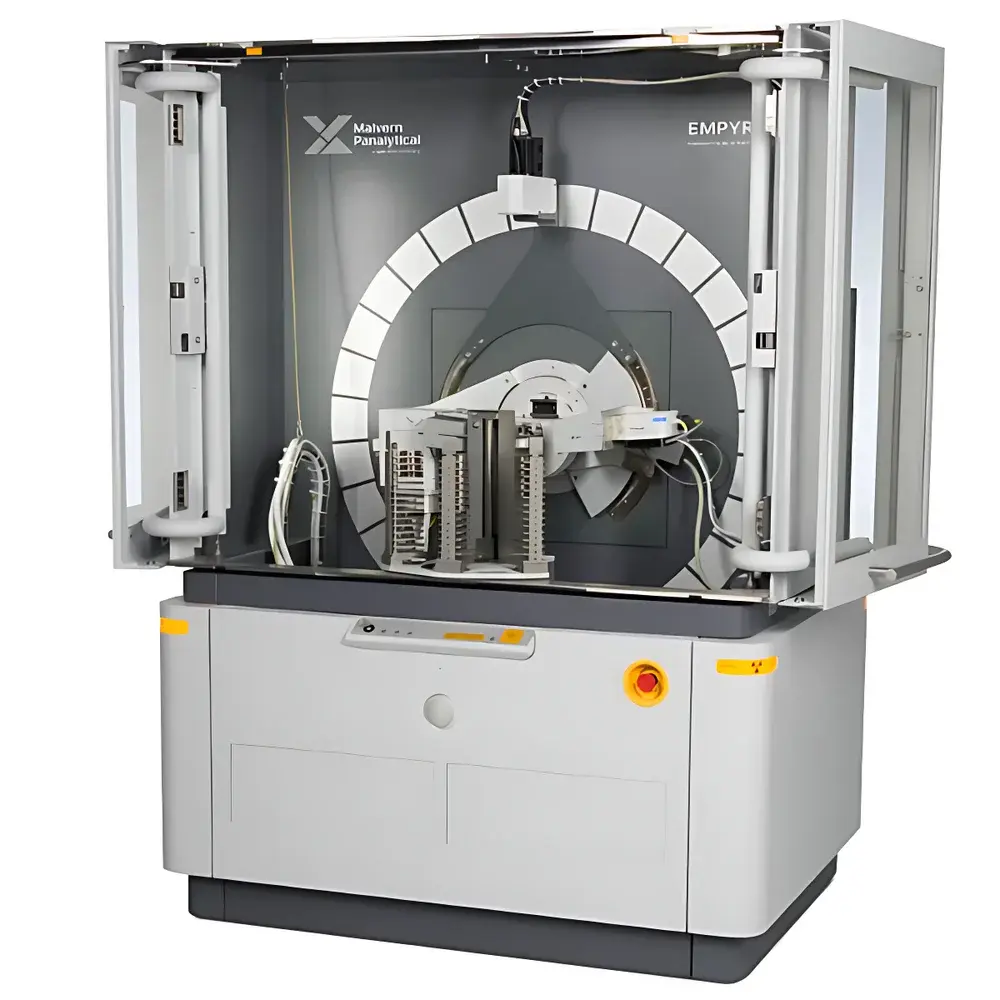
Malvern Panalytical Empyrean Multi-Core X-ray Diffractometer
| Brand | Malvern Panalytical |
|---|---|
| Country of Origin | Netherlands |
| Manufacturer Type | Original Equipment Manufacturer (OEM) |
| Origin Category | Imported |
| Model | Empyrean |
| Instrument Type | Powder X-ray Diffractometer |
| Configuration | Floor-Standing |
| Power Consumption | 0.0001 kW |
Overview
The Malvern Panalytical Empyrean is a third-generation, floor-standing multi-purpose X-ray diffractometer engineered for high-precision structural characterization across diverse material classes. Based on Bragg’s law and powder X-ray diffraction (XRD) principles, the Empyrean delivers quantitative phase identification, crystallite size analysis, microstrain evaluation, Rietveld refinement, and thin-film texture analysis — all within a single platform. Its core innovation lies in the MultiCore Optics architecture, which decouples incident-beam (iCore) and diffracted-beam (dCore) optical paths, enabling automated, reproducible reconfiguration between measurement geometries without manual realignment or recalibration. Designed for research laboratories requiring flexibility without compromise, the Empyrean supports both routine QC workflows and advanced synchrotron preparatory studies, offering data quality consistent with beamline-grade standards.
Key Features
- MultiCore Optics System: Integrates iCore (incident-beam optics module) and dCore (detector-side optics module), enabling fully automated switching between Bragg–Brentano, parallel-beam, grazing-incidence (GID), and capillary geometries — all with sub-micron positional repeatability.
- PreFIX Modular Platform: Utilizes precision-machined, kinematic mounting interfaces for optics, sample stages, and detectors, allowing tool-free reconfiguration in under five minutes while maintaining traceable alignment and metrological integrity.
- Hybrid Pixel Detector Technology: Compatible with PIXcel3D and GaliPIX3D detectors — featuring zero-background silicon sensor arrays, high dynamic range (>10⁶), and true photon-counting capability for optimal signal-to-noise ratio in low-intensity or time-resolved measurements.
- GLP-Compliant Automation: Embedded instrument control software supports audit-trail logging, user-access levels, electronic signatures, and 21 CFR Part 11–ready operation when integrated with optional compliance packages.
- Scalable Architecture: Supports incremental upgrades — from basic powder diffraction to high-resolution strain mapping, in situ heating/cooling stages (up to 1600 °C), humidity-controlled cells, and motorized XYZθφ sample manipulators.
Sample Compatibility & Compliance
The Empyrean accommodates a broad spectrum of sample forms: free-flowing powders (including air-sensitive materials via glovebox integration), polycrystalline thin films (1 nm–5 µm), bulk solids, nanomaterials, fibers, and amorphous–crystalline composites. Sample handling options include standard zero-background silicon holders, capillary mounts, reflection/transmission stages, and custom-engineered fixtures. All optical modules and detector configurations comply with IEC 61000-6-3 (EMC) and IEC 61010-1 (safety). The system meets ISO 17025 requirements for accredited testing laboratories when operated with documented SOPs and calibrated reference standards (e.g., NIST SRM 660c, 640e). Optional validation packages support IQ/OQ/PQ protocols aligned with pharmaceutical GMP and academic GLP frameworks.
Software & Data Management
Controlled by Malvern Panalytical’s HighScore Plus suite, the Empyrean provides integrated acquisition, processing, and reporting functionality. The software includes automated phase identification against ICDD PDF-4+ database, whole-pattern fitting (WPF), quantitative Rietveld analysis, crystallite size/strain modeling (using Williamson–Hall and Warren–Averbach methods), and thin-film reflectivity modeling (PARS). Data files are stored in vendor-neutral CIF and XYE formats; metadata embedding follows NeXus/HDF5 conventions for FAIR (Findable, Accessible, Interoperable, Reusable) data management. Remote monitoring, batch processing, and API-driven scripting (Python SDK) enable integration into laboratory information management systems (LIMS) and automated analytical workflows.
Applications
- Pharmaceutical solid-form screening and polymorph stability assessment per USP and ICH Q5A guidelines
- Geological mineral phase quantification and clay speciation in soil/sediment matrices
- Metallurgical phase evolution during heat treatment and additive manufacturing process development
- Nanoparticle crystallinity and lattice parameter tracking in battery cathode materials (e.g., NMC, LFP)
- In situ/operando XRD for catalytic reaction monitoring under controlled gas atmospheres and thermal ramps
- Thin-film epitaxy analysis in semiconductor and optoelectronic device R&D
FAQ
Is the Empyrean suitable for regulatory-compliant environments such as pharmaceutical QA/QC labs?
Yes — when configured with HighScore Plus Compliance Edition and paired with documented calibration procedures, it supports 21 CFR Part 11 compliance, including electronic records, audit trails, and role-based access control.
Can the system perform both powder XRD and thin-film XRD without hardware reconfiguration?
Yes — the MultiCore Optics architecture enables automatic switching between powder and thin-film modes via software command; no manual optic changes or realignment are required.
What detector options are supported, and how do they affect data acquisition speed?
The Empyrean natively supports PIXcel3D (1D strip) and GaliPIX3D (2D pixel array); GaliPIX3D enables simultaneous collection over 2θ ranges up to 60°, reducing scan time by up to 90% compared to point detectors.
Does Malvern Panalytical provide application-specific method development support?
Yes — application scientists offer remote and on-site method optimization, reference material selection, SOP drafting, and staff training as part of the Empyrean deployment package.
How is long-term measurement reproducibility ensured across different operators and time points?
PreFIX modules eliminate mechanical drift through kinematic mounting and factory-certified alignment; combined with automated calibration routines and reference standard checks, inter-operator RSD remains below 0.5% for lattice parameter measurements over 12-month intervals.





