
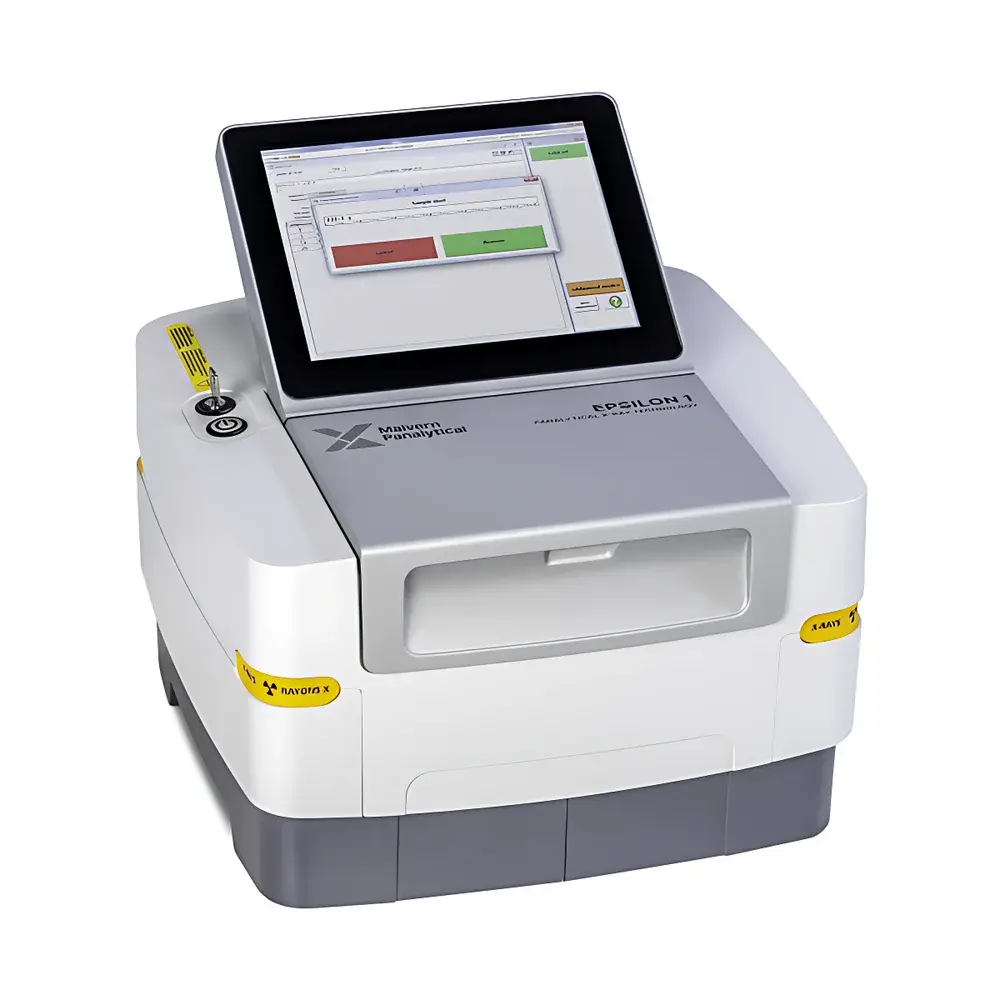
Malvern Panalytical Epsilon1 Benchtop Energy Dispersive X-Ray Fluorescence Spectrometer
| Brand | Malvern Panalytical |
|---|---|
| Origin | Netherlands |
| Manufacturer Type | Original Equipment Manufacturer (OEM) |
| Import Status | Imported |
| Model | Epsilon1 |
| Form Factor | Benchtop |
| Industry Application | Energy & Chemicals |
| Elemental Range | Na (Z=11) to Am (Z=95) |
| Quantification Range | 1 ppm to 100% w/w |
| Energy Resolution | <145 eV at Mn Kα (5.9 keV, 1000 cps) |
| Repeatability | Concentration-dependent, compliant with ISO 8258 and ASTM E1621 for precision validation |
Overview
The Malvern Panalytical Epsilon1 is a fully integrated benchtop energy dispersive X-ray fluorescence (ED-XRF) spectrometer engineered for routine elemental analysis across industrial, regulatory, and academic laboratories. Based on fundamental principles of X-ray fluorescence—where primary X-rays excite atoms in a sample, inducing emission of characteristic secondary (fluorescent) X-rays—the Epsilon1 delivers quantitative and semi-quantitative composition data without destructive sample preparation. Its compact architecture integrates the X-ray tube, detector, optical path, touchscreen interface, and embedded Windows-based software into a single self-contained unit. Designed for operational simplicity and analytical robustness, the Epsilon1 replaces labor-intensive wet chemistry methods (e.g., AAS, ICP-OES) and mitigates safety and regulatory risks associated with handheld XRF devices—offering laboratory-grade performance in a footprint under 0.5 m².
Key Features
- Non-destructive, minimal-prep analysis: Enables direct measurement of solids, powders, liquids, and thin films with no digestion, fusion, or dilution required—preserving sample integrity for downstream techniques.
- High-sensitivity excitation source: Features a custom-designed, thin-window silver anode X-ray tube rated to 50 kV, optimized for efficient excitation of heavy elements (e.g., Pb, U, Hg) while maintaining sufficient flux for light elements (Na–S).
- Atmospheric compensation: Built-in temperature and barometric pressure sensors automatically correct spectral drift caused by ambient fluctuations—critical for accurate quantification of low-Z elements (Na, Mg, Al, Si, P, S) in variable environmental conditions.
- Spill protection system: A replaceable polymer barrier film shields the detector window and sample chamber from accidental liquid ingress, minimizing downtime and service exposure.
- Connectivity & integration: Equipped with Gigabit Ethernet and USB 3.0 ports for remote instrument control, automated reporting, LIMS interfacing, and third-party application development via COM/ActiveX APIs.
Sample Compatibility & Compliance
The Epsilon1 accommodates heterogeneous samples up to 100 mm in diameter and 50 mm in height—including irregular rocks, pressed pellets, fused beads, filters, coatings, and packaged polymers. Its vacuum-compatible sample chamber supports analysis under air, helium, or vacuum modes to enhance sensitivity for light elements. The system complies with IEC 61000-6-3 (EMC), IEC 61000-6-4 (emissions), and IEC 62471 (photobiological safety). For regulated environments, optional “Enhanced Data Security” software enables full audit trail logging, electronic signatures, role-based user permissions, and 21 CFR Part 11 compliance—including electronic record retention, change control, and operator action timestamps—supporting GLP, GMP, and ISO/IEC 17025 quality systems.
Software & Data Management
The Epsilon1 operates exclusively with Malvern Panalytical’s proprietary Omnian and StratOS software suites. Omnian provides factory-preloaded, matrix-independent quantification using fundamental parameters (FP) algorithms—ideal for rapid screening of unknown materials without calibration standards. StratOS delivers multi-layer thin-film analysis (e.g., plating thickness, alloy composition) with certified uncertainty propagation per ISO 14707. All data are stored in structured SQLite databases with automatic backup, versioned method files, and export to CSV, PDF, or XML formats. Raw spectra support post-acquisition reprocessing, peak deconvolution, and inter-laboratory comparison via standardized .rtd files.
Applications
- Mining & Geology: Direct quantification of ores, drill cores, and tailings; mineral fingerprinting using multivariate clustering; compliance with ISO 12844 and ASTM D5630 for exploration-grade assays.
- Petrochemicals: Certified sulfur-in-fuel analysis per ASTM D4294, ISO 8754, and IP 336; lubricant additive profiling per ASTM D6481; catalyst metal monitoring in refinery streams.
- Pharmaceuticals: Elemental impurity screening per ICH Q3D guidelines; residual catalyst detection in active pharmaceutical ingredients (APIs); raw material verification with IQ/OQ documentation packages.
- Environmental Monitoring: Soil heavy metal screening (Pb, As, Cd, Cr) per EPA Method 6200; airborne particulate analysis on NIOSH 7300 filters; wastewater sludge characterization.
- Materials Compliance: RoHS-3 and REACH screening per ASTM F2617; restricted substance verification in plastics, electronics, and packaging; additive quantification in polyolefins using CRM-matched calibrations.
FAQ
What regulatory standards does the Epsilon1 support for elemental impurity testing in pharmaceuticals?
The Epsilon1 meets ICH Q3D requirements when used with validated methods and Enhanced Data Security software, enabling full 21 CFR Part 11 compliance for electronic records and signatures in GMP environments.
Can the Epsilon1 analyze light elements such as sodium and magnesium in ambient air?
Yes—its atmospheric compensation algorithm and optional helium purge mode ensure stable, reproducible quantification of Na–S in air, eliminating need for vacuum for many routine applications.
Is method transfer possible between Epsilon1 and larger floor-standing XRF systems?
Quantitative methods developed on Epsilon1 are transferable to other Malvern Panalytical ED-XRF platforms (e.g., Epsilon4, Zetium) using shared FP libraries and identical spectral processing engines.
Does the system require external cooling or compressed air?
No—the Epsilon1 uses thermoelectrically cooled silicon drift detector (SDD) and solid-state power supply, requiring only standard 100–240 V AC input and ambient lab ventilation.
How is calibration traceability maintained for ISO/IEC 17025 accreditation?
Calibration is traceable to NIST SRM reference materials (e.g., SRM 2782, 2783), with documented uncertainty budgets, stability monitoring, and annual verification reports available through Malvern Panalytical’s metrology services.





