
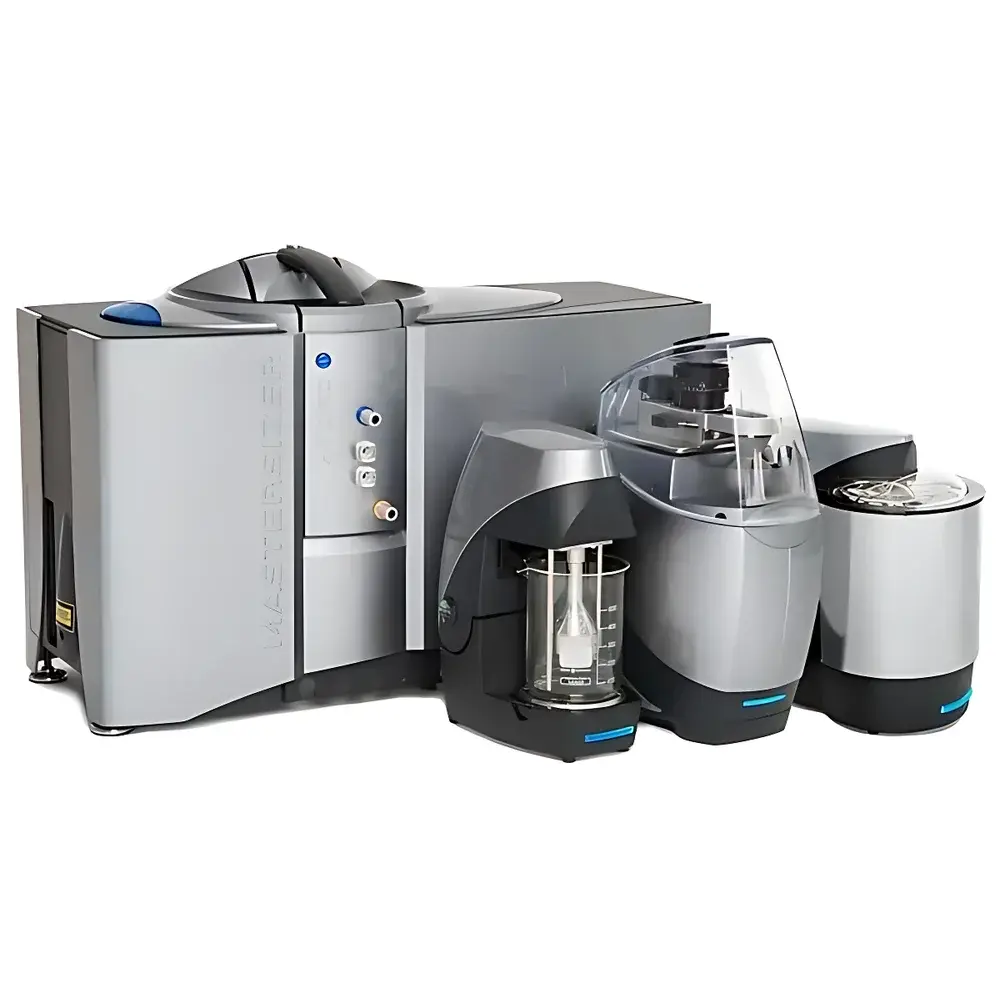
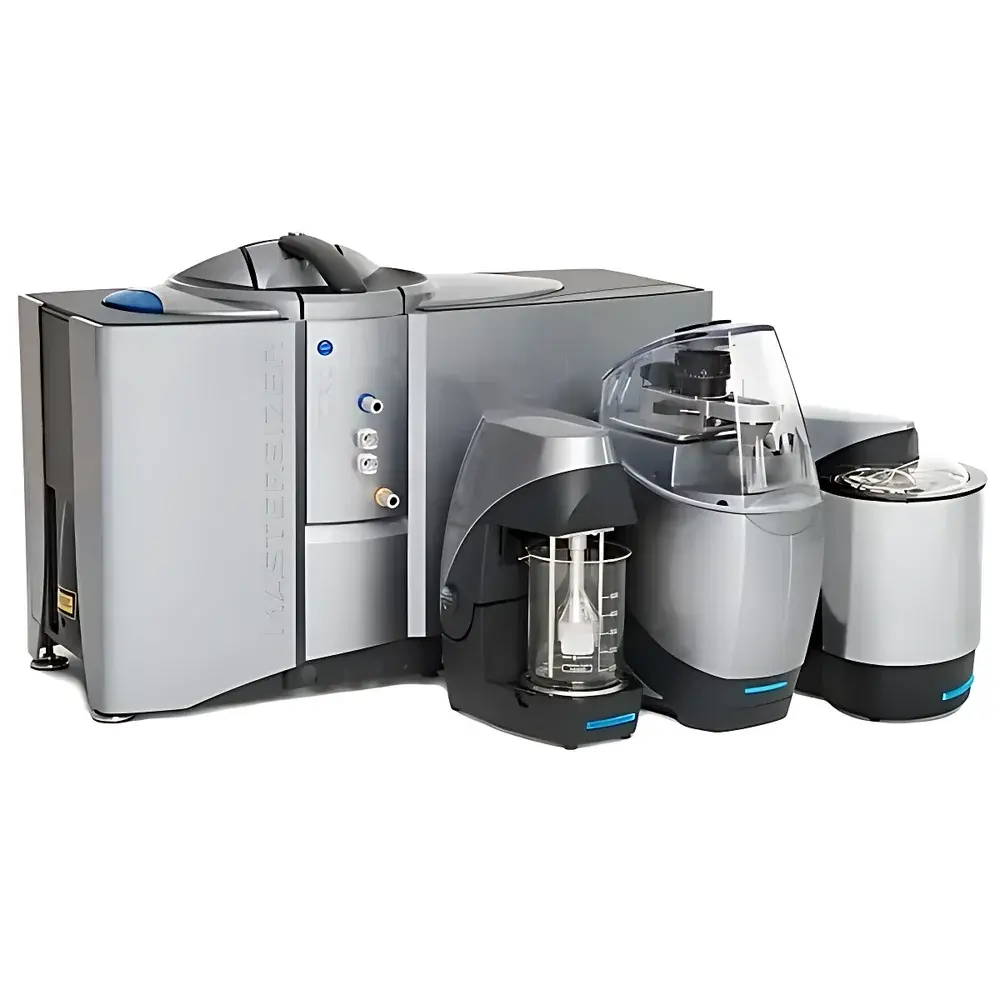
Malvern Panalytical Mastersizer 3000 Laser Diffraction Particle Size Analyzer
| Brand | Malvern Panalytical |
|---|---|
| Origin | United Kingdom |
| Manufacturer Type | Original Equipment Manufacturer (OEM) |
| Import Status | Imported |
| Model | Mastersizer 3000 |
| Dispersion Method | Dry & Wet Dispersion |
| Instrument Type | Laboratory Laser Diffraction Analyzer |
| Measurement Range | 0.01–3500 µm |
| Repeatability | <1% RSD |
Overview
The Malvern Panalytical Mastersizer 3000 is a high-performance laboratory laser diffraction particle size analyzer engineered for precision, reproducibility, and operational robustness across diverse industrial and research environments. It operates on the fundamental principle of Mie and Fraunhofer light scattering theory: when a collimated laser beam—comprising dual-wavelength red (633 nm) and blue (470 nm) sources—interacts with a dispersed particulate sample, the angular intensity distribution of the scattered light is captured by a multi-element silicon photodiode array spanning up to 175 detection angles. This raw scattering pattern is then inverted using rigorous optical models and constrained regularization algorithms to compute volumetric particle size distribution (PSD), reporting results in accordance with ISO 13320:2020, USP , and Ph. Eur. 2.9.31. The system’s folded, fully sealed optical path minimizes environmental interference, eliminates alignment drift, and ensures long-term stability without routine recalibration.
Key Features
- Wide dynamic measurement range from 0.01 µm to 3500 µm in a single measurement—no lens swapping or hardware reconfiguration required.
- Real-time data acquisition at up to 10,000 measurements per second, enabling high-fidelity capture of transient dispersion events and rapid method optimization.
- Integrated dry dispersion unit (Aero S) and wet dispersion module (Hydro EV or Hydro LV) with programmable sonication, stirring, and flow control for reproducible deagglomeration across cohesive, fragile, or high-density materials.
- Compact, space-efficient footprint (<0.5 m²) with ergonomic sample handling and tool-free access to optical components for maintenance.
- Intelligent software guidance—including real-time signal quality metrics, auto-optimization of obscuration and pump speed, and built-in diagnostic alerts—reduces operator dependency and enhances method transferability.
Sample Compatibility & Compliance
The Mastersizer 3000 accommodates a broad spectrum of sample types: suspensions (aqueous and organic), emulsions, sprays, dry powders, and aerosols. Its dispersion systems support regulatory-compliant workflows under GLP and GMP frameworks. Data integrity is maintained via full audit trail functionality aligned with FDA 21 CFR Part 11 requirements—including electronic signatures, user-level permissions, and immutable record retention. All reported distributions adhere to ISO 13320 validation criteria for resolution, repeatability, and traceability. Optional IQ/OQ documentation packages are available to support instrument qualification in pharmaceutical, biotech, and advanced materials manufacturing settings.
Software & Data Management
Mastersizer 3000 is operated via Malvern Panalytical’s proprietary Mastersizer Software v4.x—a validated, multi-language platform supporting both Windows OS and networked deployment. The interface enables customizable method templates, automated report generation (PDF/CSV/XLSX), and batch processing of historical datasets. Advanced analysis modules include comparative overlay, statistical trend tracking, and D10/D50/D90 confidence interval estimation. Raw scattering patterns and intermediate inversion matrices are stored alongside metadata (operator ID, timestamp, dispersion parameters), ensuring full traceability for internal review or external audit. Exported data comply with ASTM E2918 and ISO/IEC 17025 reporting standards.
Applications
This instrument serves critical quality control and R&D functions across multiple sectors: in pharmaceuticals, it supports formulation development of inhalable dry powders, injectable suspensions, and tablet excipients; in battery materials, it characterizes cathode/anode active materials and conductive additives for consistency in slurry rheology and electrode coating uniformity; in catalyst manufacturing, it verifies pore structure proxies and attrition resistance; in food science, it monitors starch granule swelling, dairy protein aggregation, and cocoa powder flow behavior; and in environmental testing, it quantifies sediment grain size distributions for regulatory compliance and hydrological modeling.
FAQ
What optical principles underpin the Mastersizer 3000’s measurement accuracy?
It applies combined Mie theory (for particles comparable to or smaller than the incident wavelength) and Fraunhofer approximation (for larger particles), validated against NIST-traceable reference standards.
Can the system be qualified for regulated environments?
Yes—through optional IQ/OQ/PQ protocols, electronic audit trails, and 21 CFR Part 11-compliant user management.
Is method transfer between instruments feasible?
Yes—via standardized SOPs, identical dispersion parameters, and cross-instrument calibration using certified reference materials.
How does the system handle highly polydisperse or irregularly shaped particles?
Its dual-wavelength optics and extended angular detection enhance sensitivity to fine and coarse fractions simultaneously, while shape-insensitive volumetric reporting remains valid per ISO 13320 guidelines.
What maintenance is required to sustain optical performance?
Annual verification using PSN-1000 polystyrene nanolatex standards is recommended; the sealed optical path eliminates daily alignment needs.



