
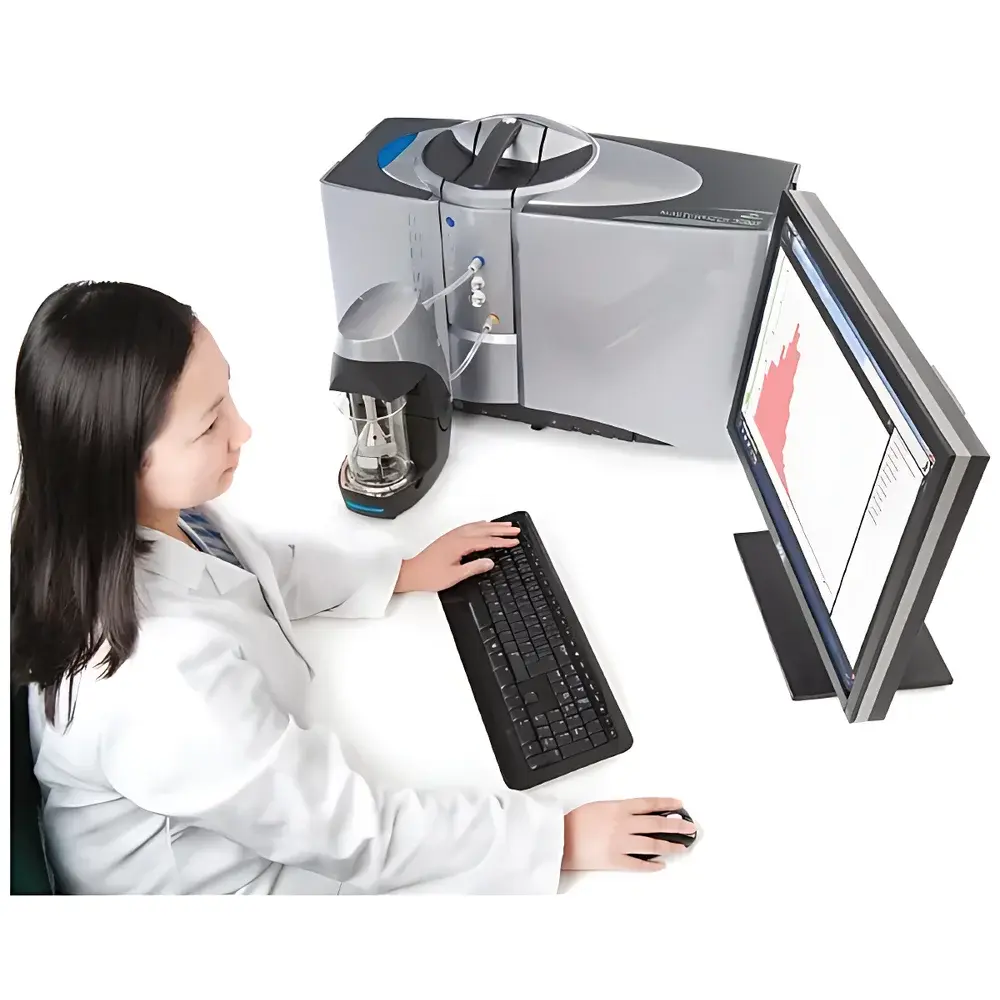
Malvern PANalytical Mastersizer 3000E Laser Particle Size Analyzer
| Brand | Malvern PANalytical |
|---|---|
| Origin | United Kingdom |
| Manufacturer Type | Original Equipment Manufacturer (OEM) |
| Instrument Type | Laboratory Laser Diffraction Particle Size Analyzer |
| Measurement Range | 0.1–1000 µm |
| Repeatability | <1% RSD |
| Measurement Time | <10 seconds per analysis |
| Dispersion Method | Dry and Wet Dispersion |
| Data Acquisition Rate | 10 kHz |
| Laser Source | Stabilized He-Ne Laser (632.8 nm) |
Overview
The Malvern PANalytical Mastersizer 3000E is a laboratory-grade laser diffraction particle size analyzer engineered for precision, robustness, and operational efficiency in routine quality control and research environments. Based on the proven optical architecture of the Mastersizer 3000 platform, the 3000E delivers validated measurement performance across a broad dynamic range—from 0.1 µm to 1000 µm—using Mie theory-based inversion algorithms. Its core measurement principle relies on quantifying the angular intensity distribution of laser light scattered by particles suspended or dispersed in a carrier medium. A stabilized helium-neon (He-Ne) laser operating at 632.8 nm illuminates the sample within a sealed, dust-resistant optical path; scattered light is captured by a high-resolution, non-uniform, cross-compensated 3D detector array covering angles from <0.02° to 140°. This configuration enables accurate detection of both fine and coarse fractions without lens exchange, ensuring consistent calibration traceability and minimizing operator intervention.
Key Features
- Single-wavelength He-Ne laser source with long-term power and pointing stability, supporting ISO 13320-compliant diffraction measurements
- Patented non-uniform, cross-compensated 3D detector system enabling high-fidelity angular scattering capture across ultra-wide detection angles
- Hermetically sealed optical bench with integrated environmental shielding—designed to maintain alignment integrity and reduce maintenance frequency
- 10 kHz real-time data acquisition engine, capturing up to 10,000 scattering patterns per second to enhance statistical confidence for polydisperse or irregular samples
- Dual-mode dispersion compatibility: fully integrated wet dispersion unit with programmable ultrasonic probe (20–50 W), variable-volume disperser (300–500 mL), and high-shear centrifugal pump; plus optional dry powder dispersion module with controlled air pressure, venturi acceleration, and vortex de-agglomeration
- Modular optical cell design—co-axial, confocal dry/wet measurement zone allows rapid interchange between dispersion systems without realignment
Sample Compatibility & Compliance
The Mastersizer 3000E accommodates diverse particulate materials—including crystalline APIs, ceramic powders, metal alloys, emulsions, suspensions, and spray-dried excipients—across pharmaceutical, chemical, battery materials, and advanced ceramics sectors. Its dispersion flexibility supports ISO 13320:2020 requirements for laser diffraction methodology validation, and its software architecture complies with data integrity expectations under FDA 21 CFR Part 11 (audit trail, electronic signatures, user access controls). The instrument meets CE marking requirements and conforms to IEC 61000-4 electromagnetic compatibility standards. Routine verification protocols align with ASTM D4294 and USP guidance for particle size distribution reporting in regulated environments.
Software & Data Management
Mastersizer 3000E operates via Malvern PANalytical’s unified software platform, which provides full instrument control, automated method setup, and ISO/USP-compliant reporting templates. The software includes built-in validation tools for optical alignment verification, background subtraction diagnostics, and signal-to-noise ratio monitoring. All raw scattering data are stored in proprietary but exportable binary formats (.msr), with ASCII-compatible CSV outputs for third-party statistical analysis. Audit trails record every parameter change, measurement event, and user action with timestamp, operator ID, and reason-for-change annotation—fully traceable for GLP/GMP audits. Batch processing, trend analysis, and SPC charting modules support continuous process verification workflows.
Applications
This system is routinely deployed for: monitoring milling and micronization endpoints in pharmaceutical solid dosage development; characterizing cathode/anode active materials in lithium-ion battery R&D; validating pigment dispersion stability in coatings and inks; assessing agglomeration behavior of nanoscale catalysts; and verifying batch-to-batch consistency of food-grade starches or dairy powders. Its speed (<10 s/analysis), repeatability (<1% RSD), and wide dynamic range make it suitable for both incoming raw material screening and final product release testing where regulatory documentation is required.
FAQ
Does the Mastersizer 3000E support compliance with FDA 21 CFR Part 11?
Yes—the software includes role-based user authentication, electronic signature capability, and immutable audit trails with full metadata capture.
Can the system measure sub-micron particles down to 0.1 µm with reliable resolution?
Yes—its optimized He-Ne laser wavelength, low-noise detector electronics, and Mie theory-based inversion with refractive index input enable robust submicron sizing when appropriate dispersion and optical parameters are applied.
Is hardware upgrade from the basic to extended configuration possible post-purchase?
Yes—Mastersizer 3000E is designed with field-upgradable modules, including enhanced dispersion units, additional detectors, and advanced software licenses.
What dispersion media are compatible with the wet module?
Aqueous and organic solvents (e.g., water, ethanol, isopropanol, toluene) are supported, provided refractive index and viscosity fall within specified operational limits for pump and ultrasonic transducer safety.
How is optical alignment verified during routine operation?
The system performs automated alignment checks using internal reference scatterers and laser beam profiling routines; results are logged and reportable as part of IQ/OQ documentation.



