
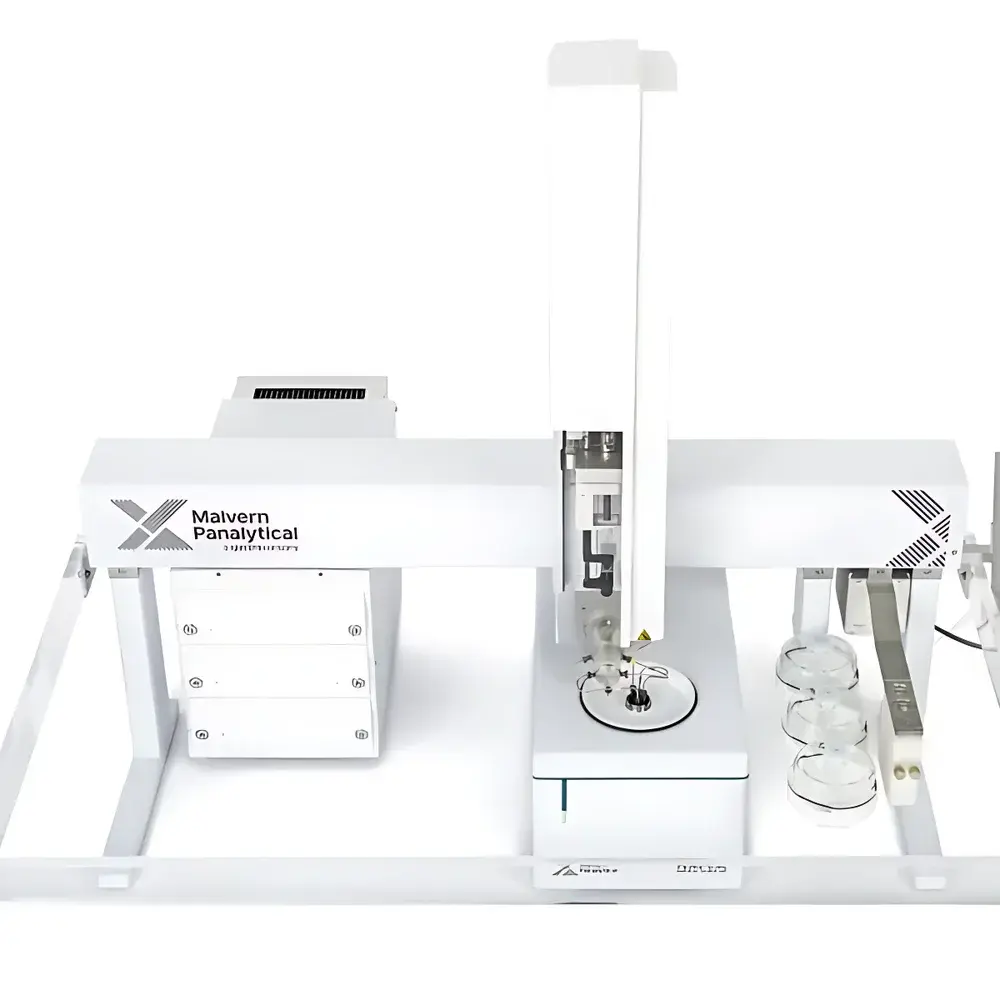
Malvern PANalytical MicroCal PEAQ-DSC Automated Differential Scanning Calorimeter
| Brand | Malvern PANalytical |
|---|---|
| Origin | USA |
| Manufacturer Type | Original Equipment Manufacturer (OEM) |
| Origin Category | Imported |
| Model | MicroCal PEAQ-DSC Automated |
| Sample Throughput | Up to 50 samples per unattended run |
| Instrument Type | Differential Scanning Calorimeter (DSC) |
| Temperature Range | –10 °C to 130 °C (expandable) |
| Sample Format | Standard 96-well microplate compatibility |
| Regulatory Compliance | Designed for 21 CFR Part 11 and EU GMP Annex 11 compliance support |
Overview
The Malvern PANalytical MicroCal PEAQ-DSC Automated is a fully integrated, high-sensitivity differential scanning calorimeter engineered specifically for the thermal stability characterization of proteins and other biomacromolecules in solution. Operating on the fundamental principle of heat-flux DSC, the system precisely measures the differential heat flow between a sample and reference cell as both are subjected to a controlled linear temperature ramp. This enables direct, label-free quantification of thermodynamic parameters—including melting temperature (Tm), enthalpy change (ΔH), and transition cooperativity—under native physiological or formulation-relevant conditions. Unlike spectroscopic or chromatographic methods, DSC provides an orthogonal, solution-phase stability assessment that reflects intrinsic conformational integrity without requiring covalent modification or immobilization. The PEAQ-DSC Automated platform extends this capability with robust automation architecture, enabling reproducible, operator-independent acquisition of thermograms across extended unattended operation cycles—critical for biopharmaceutical comparability studies, formulation screening, and process development workflows.
Key Features
- Fully automated sample handling: Integrated robotic autosampler supports up to six 96-well plates (576 wells total) with ambient or refrigerated storage (4–10 °C), enabling true walk-away operation for up to 50 samples per batch.
- Ultra-low sample consumption: Typical analysis requires only 10–50 µL per injection, preserving precious biologics such as monoclonal antibodies, fusion proteins, and viral vectors.
- High-precision thermal control: Dual-zone temperature regulation ensures ±0.01 °C stability and <0.05 °C baseline repeatability over the full –10 °C to 130 °C operating range.
- Automated cell cleaning and rinsing: Programmable wash protocols eliminate carryover risk and ensure consistent thermal contact between runs.
- Enhanced detection sensitivity: Optimized sensor design and noise-reduction algorithms enable reliable detection of subtle transitions—including minor domain unfolding events and weak ligand-induced stabilization effects.
- Scalable throughput architecture: Modular software licensing allows progressive activation of advanced analytical modules without hardware modification.
Sample Compatibility & Compliance
The PEAQ-DSC Automated accommodates aqueous buffers, excipient formulations, and complex biological matrices—including serum-containing media and clarified cell culture harvests—without requiring derivatization or dilution beyond standard assay preparation. All sample cells are constructed from high-purity gold-plated copper with chemically inert wetted surfaces, minimizing adsorption artifacts and enabling rigorous cleaning validation. The system meets the instrumental performance criteria outlined in ICH Q5C (Stability Testing of Biotechnological/Biological Products) and supports method validation per ICH Q2(R2). Its software framework implements role-based access control, electronic signature enforcement, audit trail logging, and data integrity safeguards aligned with FDA 21 CFR Part 11 and EU GMP Annex 11 requirements. Full traceability—from raw thermogram acquisition through peak deconvolution and report generation—is maintained via immutable timestamped records.
Software & Data Management
The MicroCal PEAQ-DSC software suite comprises five interoperable modules: PEAQ-Compliance (for SOP-enforced workflow governance), PEAQ-Performance (automated system suitability verification), PEAQ-Smart (including PEAQ-Finder for objective peak identification and shoulder resolution), PEAQ-Compare (quantitative overlay and statistical comparison of thermograms), and PEAQ-Connect (API-enabled integration with LIMS, ELN, and enterprise data lakes). All modules operate within a single GUI environment with customizable reporting templates compliant with ALCOA+ principles. Raw data files (.dsc) are stored in vendor-neutral HDF5 format with embedded metadata, supporting long-term archival and third-party reanalysis. Email notification triggers and real-time instrument status dashboards facilitate remote monitoring and resource scheduling across distributed lab networks.
Applications
- Biopharmaceutical developability assessment: Ranking candidate molecules by thermal midpoint (Tm) and ΔH to prioritize leads with enhanced conformational stability.
- Formulation optimization: Screening pH, ionic strength, and excipient combinations to maximize Tm and minimize aggregation onset temperatures.
- Comparability studies: Quantifying thermal profile equivalence between pre-change and post-change manufacturing processes per ICH Q5E guidelines.
- Biosimilarity evaluation: Demonstrating structural similarity between biosimilar and reference products using multivariate DSC fingerprinting.
- Ligand binding thermodynamics: Deriving apparent binding constants (Ka) up to 1020 M−1 via thermal shift assays under equilibrium conditions.
- Quality control release testing: Validated DSC assays for lot-to-lot consistency monitoring in GMP environments.
FAQ
What sample volume is required per analysis?
Typical analyses use 10–50 µL of protein solution at concentrations ranging from 0.1–10 mg/mL, depending on molecular weight and expected transition enthalpy.
Can the system analyze membrane proteins or aggregates?
Yes—when solubilized in appropriate detergents or nanodiscs, membrane proteins yield interpretable thermograms; aggregated species often exhibit broadened or shifted transitions indicative of heterogeneity.
Is method transfer possible between manual and automated PEAQ-DSC systems?
Yes—identical cell geometry, thermal calibration protocols, and software algorithms ensure full method equivalency across manual and automated configurations.
How does the system handle buffer-matching requirements?
The integrated fluidic system performs automated buffer matching via programmable dilution and exchange steps, minimizing baseline drift and ensuring accurate ΔH calculation.
Does the software support multi-domain protein deconvolution?
PEAQ-Smart includes advanced fitting algorithms capable of resolving overlapping transitions using constrained Gaussian or asymmetric peak models, supported by statistical F-test validation.



