
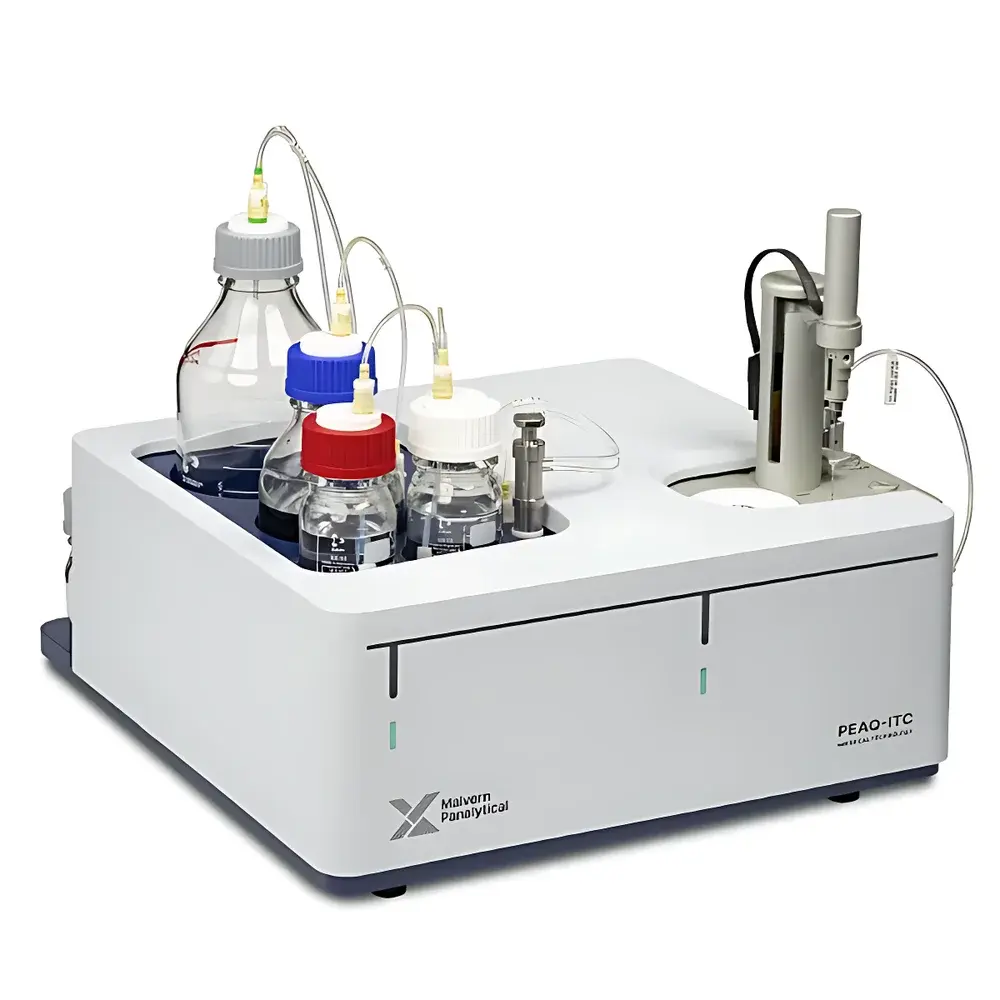
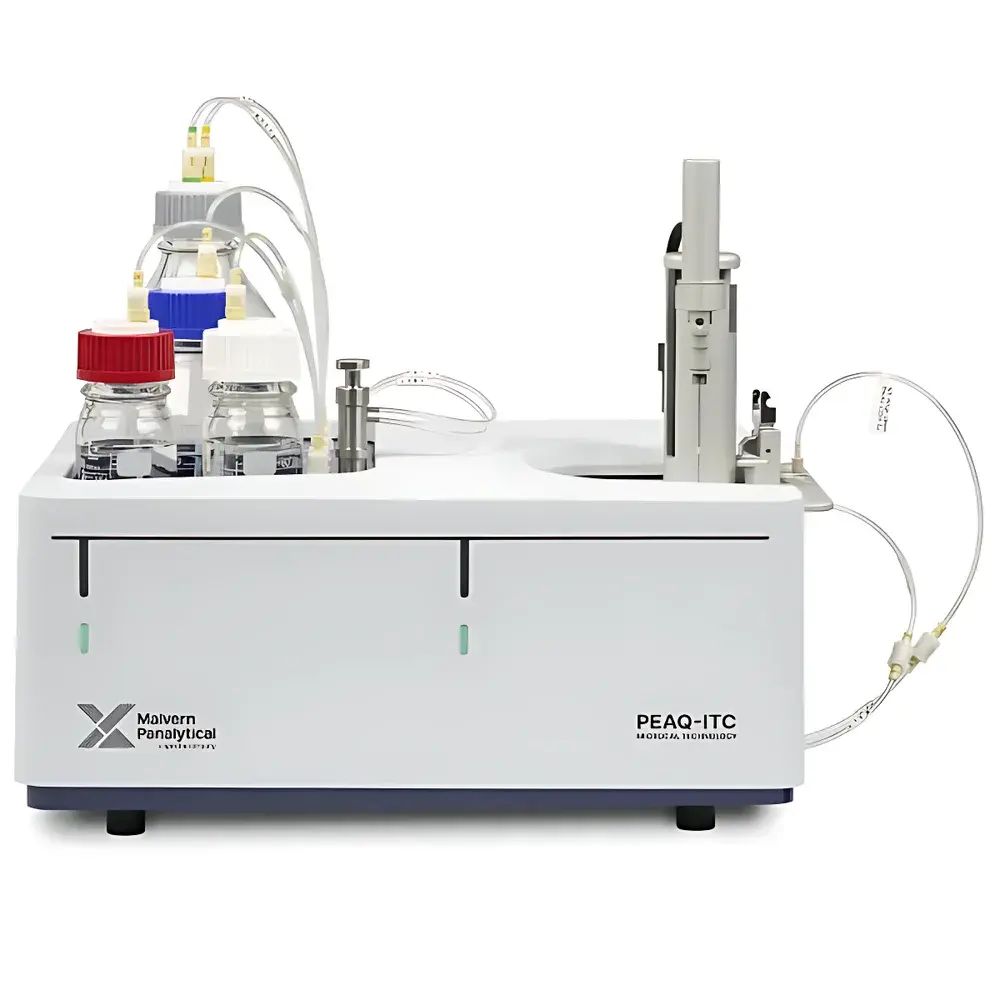
Malvern PANalytical MicroCal PEAQ-ITC Isothermal Titration Calorimeter
| Brand | Malvern PANalytical |
|---|---|
| Origin | USA |
| Manufacturer Type | Original Equipment Manufacturer (OEM) |
| Origin Category | Imported Instrument |
| Model | MicroCal PEAQ-ITC |
| Measurement Mode | Isothermal Titration Calorimetry (ITC) |
| Temperature Range | 2 °C to 80 °C |
| Sample Consumption | As low as 10 µg protein per experiment |
| Affinity Range | 10² M⁻¹ to 10¹² M⁻¹ (K<sub>D</sub> = 10⁻² to 10⁻¹² M) |
| Compatibility | Aqueous and non-aqueous solvents |
| Cell Material | Chemically resistant nickel-based alloy |
| Upgrade Path | Compatible with MicroCal PEAQ-ITC Automated platform |
Overview
The Malvern PANalytical MicroCal PEAQ-ITC is a high-sensitivity, low-volume isothermal titration calorimeter engineered for label-free, solution-phase characterization of biomolecular interactions in native conditions. Operating on the fundamental principle of isothermal titration calorimetry, the instrument directly measures the heat absorbed or released during molecular binding events—enabling quantitative determination of thermodynamic parameters without immobilization, labeling, or size constraints. Each titration experiment yields a complete thermodynamic profile: binding affinity (KD), stoichiometry (n), enthalpy change (ΔH), and entropy change (ΔS). With a temperature control range from 2 °C to 80 °C and sub-microliter injection precision, the PEAQ-ITC supports rigorous thermal stability studies and kinetic profiling across diverse biological systems—including proteins, antibodies, nucleic acids, lipids, carbohydrates, and small-molecule ligands.
Key Features
- Ultra-low sample consumption: Quantitative analysis achievable with ≤10 µg of purified protein per experiment—critical for scarce or difficult-to-express targets.
- Broad affinity coverage: Direct measurement of KD values spanning 10⁻² to 10⁻⁹ M; extended quantification down to 10⁻¹² M via competitive ITC protocols.
- Chemically inert cell architecture: Nickel-based alloy sample and syringe cells ensure compatibility with aggressive buffers, denaturants, organic co-solvents (e.g., DMSO, ethanol), and reducing agents.
- Reduced operator dependency: Semi-automated priming, calibration, and cleaning routines minimize manual intervention while maintaining experimental reproducibility.
- Modular scalability: Hardware and software architecture supports seamless upgrade to the fully automated MicroCal PEAQ-ITC Automated platform—preserving method continuity and data traceability.
- High signal-to-noise ratio: Optimized thermal design and real-time baseline correction yield robust thermograms suitable for rigorous statistical evaluation and publication-grade reporting.
Sample Compatibility & Compliance
The PEAQ-ITC accommodates a wide range of sample matrices, including aqueous buffers (Tris, HEPES, phosphate), detergent-containing formulations (e.g., DDM, CHAPS), glycerol-stabilized preparations, and mixed aqueous–organic systems up to 20% v/v organic solvent. Its non-reactive cell materials eliminate metal-catalyzed oxidation or adsorption artifacts common in stainless-steel or glass systems. From a regulatory standpoint, the platform supports GLP- and GMP-aligned workflows: audit trails, electronic signatures, and user-access controls are natively embedded in the PEAQ-ITC Analysis Software. Data files comply with ASTM E2539 and ISO/IEC 17025 documentation requirements, and raw thermogram archives meet FDA 21 CFR Part 11 criteria for electronic records retention when deployed on validated IT infrastructure.
Software & Data Management
MicroCal PEAQ-ITC Analysis Software provides an integrated environment for experimental design, acquisition, processing, and reporting. Built-in simulation tools allow users to model expected thermograms prior to experimentation—optimizing concentration ratios, injection volumes, and temperature settings. Batch processing enables concurrent evaluation of dozens of datasets using identical fitting models (e.g., one-site, two-site, sequential binding, or enzymatic inhibition). Automated quality metrics—such as baseline drift, injection variance, and χ² residuals—are calculated and flagged in real time. The interface includes contextual tooltips, embedded video tutorials for maintenance procedures (cell cleaning, syringe priming, leak testing), and export options compliant with FAIR data principles (CSV, PDF, PNG, and vendor-neutral .itc format). Multi-session project files support side-by-side comparison of replicates, mutants, or condition variants within a single workspace.
Applications
- Characterization of protein–ligand, protein–protein, protein–nucleic acid, and antibody–antigen interactions under physiologically relevant conditions.
- Thermodynamic dissection of allostery, cooperativity, and conformational selection mechanisms.
- Fragment-based drug discovery (FBDD): Hit validation, SAR expansion, and binding mode discrimination via ΔH/ΔS signature analysis.
- Enzyme kinetics: Determination of KM, kcat, and inhibition constants (Ki) through substrate or inhibitor titrations coupled with calorimetric rate profiling.
- Excipient screening: Quantification of stabilizing or destabilizing effects of formulation components on target protein thermodynamics.
- Comparative biophysics: Assessment of biosimilarity, mutational impact, or post-translational modification effects on binding energetics.
FAQ
What thermodynamic parameters can be determined in a single ITC experiment?
Binding affinity (KD), stoichiometry (n), enthalpy change (ΔH), and entropy change (ΔS)—all derived directly from the raw heat flow data without assumptions or secondary assays.
Can the PEAQ-ITC operate with non-aqueous solvents?
Yes—the nickel alloy cell and syringe are compatible with common organic co-solvents (e.g., DMSO, methanol, ethanol) at concentrations up to 20% v/v, provided viscosity and vapor pressure remain within operational limits.
Is method transfer possible between the semi-automated PEAQ-ITC and the fully automated PEAQ-ITC Automated system?
Yes—method files, calibration profiles, and analysis templates are fully interoperable, enabling consistent data generation across both platforms without revalidation.
How does the system ensure data integrity for regulated environments?
The software implements role-based access control, immutable audit trails, electronic signatures, and automatic backup of raw thermograms and processed results—fully aligned with 21 CFR Part 11 and ISO 17025 requirements.
What sample volume is required for a typical experiment?
The sample cell holds 200 µL; the syringe holds up to 40 µL. Total protein consumption ranges from 5–15 µg depending on concentration and binding stoichiometry.



