
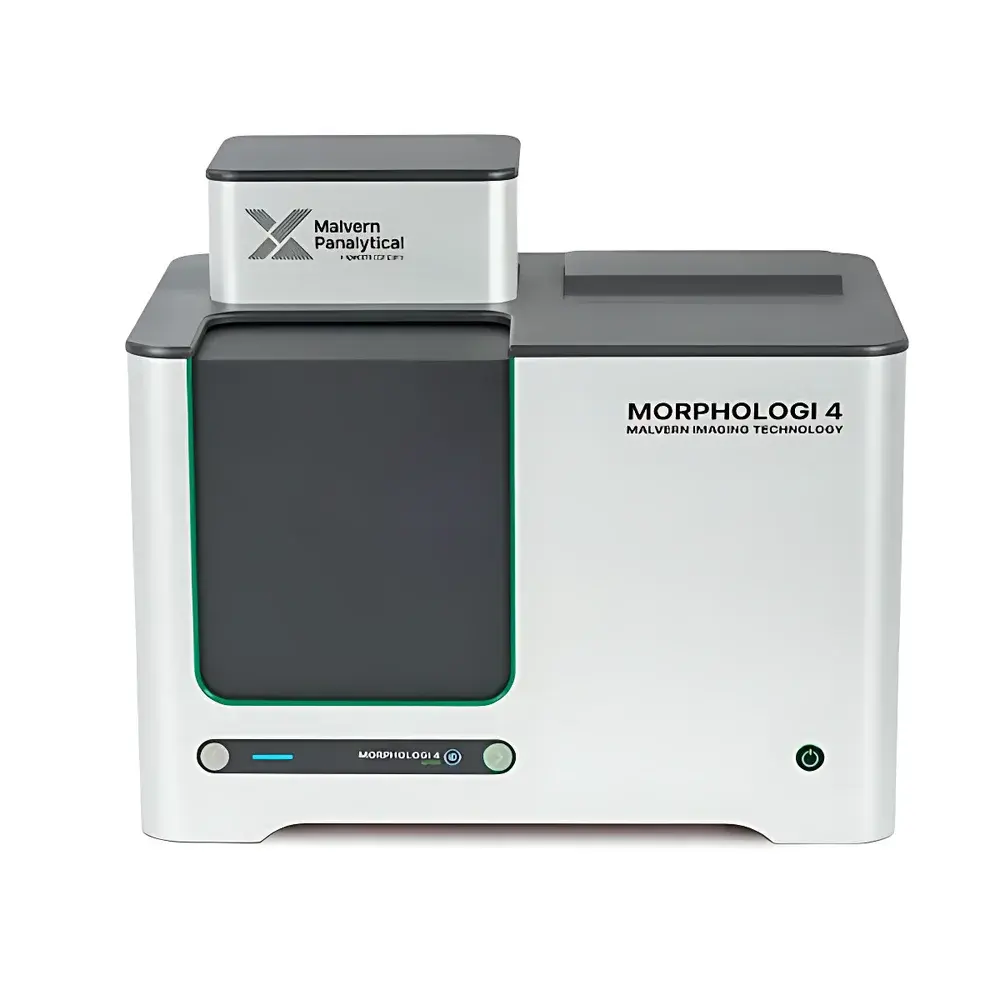
Malvern PANalytical Morphologi 4 Automated Static Image Analysis System
| Brand | Malvern PANalytical |
|---|---|
| Origin | United Kingdom |
| Manufacturer Type | Original Equipment Manufacturer (OEM) |
| Import Status | Imported |
| Model | Morphologi 4 |
| Instrument Type | Static Image-Based Particle Analyzer |
| Lens Count | 5 |
| Measurement Range | 0.5 µm – 1300 µm |
| Sample Dispersion Methods | Dry Powder Dispersion and Wet Dispersion |
| Image Resolution | 18 MP |
| Measured Morphological Parameters | Aspect Ratio, Circularity, Convexity, Extent, Hardness |
Overview
The Malvern PANalytical Morphologi 4 is a fully automated static image analysis system engineered for high-fidelity particle size and shape characterization across diverse sample types—including dry powders, liquid suspensions, and particles captured on filtration membranes. It operates on the principle of digital microscopy coupled with deterministic edge-detection algorithms, enabling quantitative morphometric analysis at single-particle resolution. Unlike dynamic or ensemble-averaging techniques (e.g., laser diffraction), Morphologi 4 captures and analyzes individual particle silhouettes under controlled optical conditions, delivering statistically robust distributions for both dimensional and shape descriptors. Designed for R&D, quality control, and regulatory-compliant environments—particularly in pharmaceutical development—the system replaces labor-intensive manual microscopy while maintaining traceable, auditable measurement workflows aligned with GLP and GMP expectations.
Key Features
- Automated end-to-end workflow—from sample dispersion to statistical reporting—controlled via user-defined Standard Operating Procedures (SOPs)
- Integrated dry powder disperser with adjustable energy input, enabling gentle yet effective deagglomeration without mechanical damage to fragile particles
- Dual illumination mode (transmitted and reflected light) with real-time brightness control for optimal contrast across low- and high-refractive-index materials
- Five-objective turret supporting seamless magnification switching (from 2× to 100×), ensuring accurate sizing across the full 0.5 µm – 1300 µm range
- “Sharp Edge” segmentation algorithm optimized for low-contrast particles, supplemented by manual threshold adjustment for challenging samples
- High-resolution 18-megapixel monochrome camera capturing grayscale images with pixel-level fidelity for rigorous morphological quantification
- Full particle image archiving: every analyzed particle is stored as a calibrated grayscale image, enabling retrospective validation and qualitative corroboration of quantitative outputs
- Manual microscope mode with live focus control and particle “revisit” functionality for targeted investigation of outliers or atypical morphologies
Sample Compatibility & Compliance
The Morphologi 4 accommodates heterogeneous sample formats through purpose-built accessories: a dry dispersion module for free-flowing and cohesive powders; a wet cell for suspension analysis; and membrane-mounting stages for filter-captured particulates (e.g., environmental filters or process stream monitoring). All dispersion protocols are SOP-referenced and parameter-locked to ensure inter-operator reproducibility. The system complies with ISO 13322-1:2020 (static image analysis) and supports alignment with USP , EP 2.9.31, and ASTM E2457 standards for particle characterization. Optional 21 CFR Part 11 software enables electronic signatures, audit trails, and role-based access control—essential for regulated pharmaceutical and biologics manufacturing environments subject to FDA inspection.
Software & Data Management
Morphologi 4 software provides an integrated environment for acquisition, processing, visualization, and export. It calculates over 20 morphological parameters—including aspect ratio, circularity, convexity, extent, and hardness—each derived from mathematically defined geometric properties of the particle silhouette. Statistical outputs include cumulative distributions, percentile values (D10, D50, D90), and multivariate scatter plots (e.g., circularity vs. aspect ratio) for population sub-classification. Raw data and metadata (including instrument settings, SOP version, operator ID, timestamp) are stored in a secure relational database. Export options include CSV, PDF reports, and structured XML for LIMS integration. Batch processing, custom report templates, and scripting via Python API support high-throughput labs and method transfer across sites.
Applications
- Pharmaceutical solid dosage form development: correlating granule morphology with flowability, compressibility, and dissolution behavior
- Biopharmaceutical particulate assessment: detecting protein aggregates, silicone oil droplets, or glass delamination fragments in vials and syringes
- Inhalation product characterization: aerodynamic diameter estimation via shape-corrected equivalent spherical diameters
- Chemical catalyst and pigment optimization: linking surface roughness and sphericity to reactivity and dispersion stability
- Environmental and forensic analysis: morphological fingerprinting of airborne particulates or microplastics on filters
- Quality assurance of excipients and APIs: verifying batch-to-batch consistency in particle architecture per ICH Q5A and Q6A guidelines
FAQ
What sample preparation methods does Morphologi 4 support?
Dry powder dispersion using the integrated vibratory disperser, wet suspension analysis in disposable cuvettes, and direct imaging of particles collected on polycarbonate or mixed-cellulose ester membranes.
Can Morphologi 4 distinguish between primary particles and agglomerates?
Yes—via spatial separation during dispersion and algorithmic detection of touching particles using watershed segmentation and intensity gradient analysis.
Is calibration traceable to national standards?
Yes—system calibration includes NIST-traceable stage micrometers and certified reference particles (e.g., NIST SRM 1963), with documented uncertainty budgets per ISO/IEC 17025 requirements.
How does the system handle transparent or low-contrast particles?
Through dual-mode illumination (brightfield/darkfield), adjustable LED intensity, and the adaptive “Sharp Edge” algorithm that enhances boundary detection without user intervention.
Does the software support multi-user environments with audit trail capabilities?
Yes—the optional 21 CFR Part 11 compliant software module provides electronic signatures, immutable audit logs, and hierarchical user permissions for regulated laboratories.



