
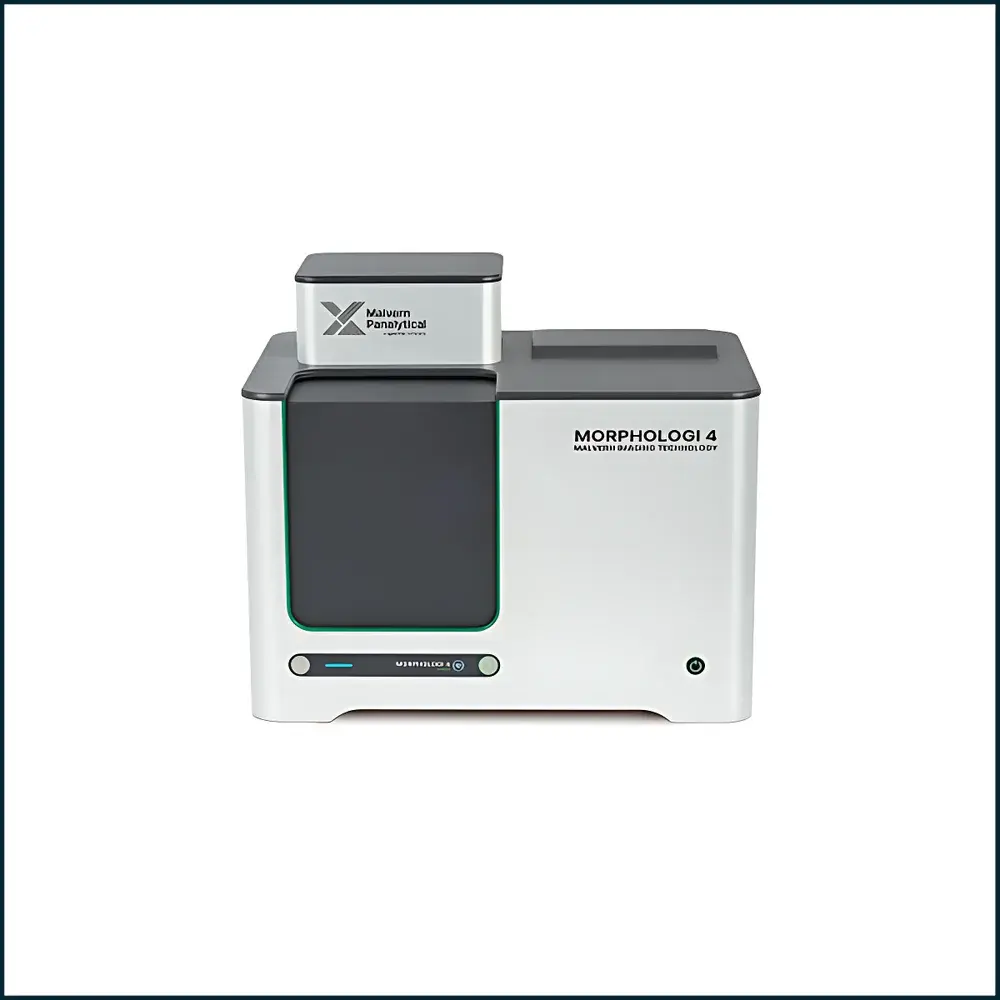
Malvern PANalytical Morphologi 4-ID Static Image-Based Particle Size and Shape Analyzer with Integrated Raman Spectroscopy
| Brand | Malvern PANalytical |
|---|---|
| Origin | United Kingdom |
| Manufacturer Type | Original Equipment Manufacturer (OEM) |
| Import Status | Imported |
| Model | Morphologi 4-ID |
| Application Sector | Pharmaceutical |
| Instrument Type | Static Imaging Analyzer |
| Number of Objective Lenses | 5 |
| Measurement Range | 0.5 µm – 1300 µm |
| Dispersion Methods | Dry Powder Dispersion and Wet Dispersion |
| Image Resolution | 18 Megapixels |
| Measured Morphological Parameters | Aspect Ratio, Circularity, Convexity, Elongation, Hardness |
Overview
The Malvern PANalytical Morphologi 4-ID is a fully automated static image-based particle characterization system engineered for simultaneous morphological and chemical analysis at the single-particle level. Unlike conventional ensemble techniques such as laser diffraction or dynamic light scattering, the Morphologi 4-ID employs high-resolution optical microscopy coupled with digital image analysis to quantify size, shape, and spatial distribution of individual particles across a broad dynamic range (0.5–1300 µm). Its defining innovation lies in the integration of Microscopy-Directed Raman Spectroscopy (MDRS), enabling label-free, non-destructive chemical identification of selected particles directly within the imaging workflow. This dual-mode architecture—combining ISO 13322-1 compliant static image analysis with ASTM E1840-aligned Raman spectral acquisition—delivers orthogonal physical and chemical datasets that are intrinsically correlated by particle identity. Designed for regulated environments, the system supports method-driven operation, audit-trail-enabled data handling, and full traceability from raw image to spectral assignment.
Key Features
- Integrated MDRS module with motorized Raman probe positioning synchronized to particle coordinates identified during image analysis
- Five-objective turret with automatic magnification switching, enabling seamless multi-scale imaging without manual intervention
- Dual illumination mode (transmitted and reflected) with adjustable intensity control for optimal contrast across opaque, translucent, and reflective particulates
- Automated dry dispersion unit with programmable vibration energy and aspiration flow rate, ensuring reproducible de-agglomeration of cohesive powders
- Wet dispersion compatibility via interchangeable sample holders—including filtration mounts and suspension cuvettes—designed for direct integration into the motorized stage
- 18 MP monochrome CMOS sensor optimized for high signal-to-noise ratio and pixel-level geometric fidelity
- Comprehensive morphological parameter set calculated per particle: aspect ratio, circularity, convexity, elongation, and hardness (derived from grayscale intensity gradient analysis)
- Full 21 CFR Part 11 compliance option with electronic signatures, role-based access control, and immutable audit trails for GxP environments
Sample Compatibility & Compliance
The Morphologi 4-ID accommodates diverse sample types including active pharmaceutical ingredients (APIs), excipients, catalysts, pigments, and composite powders. Dry dispersion is suitable for free-flowing and moderately cohesive materials; wet dispersion supports suspensions in aqueous or organic media, with optional filtration protocols for residual solvent removal. All measurement workflows adhere to ISO 13322-1 (particle size and shape analysis by image analysis) and support alignment with USP , EP 2.9.31, and ICH Q5A guidelines for particulate characterization in biopharmaceuticals. The MDRS module complies with ASTM E1840 (standard practice for Raman microscopy) and enables identification against commercial spectral libraries (e.g., KnowItAll®, Bio-Rad KnowItAll®) in .SPA or .JDX format. System validation documentation includes IQ/OQ/PQ templates aligned with FDA and MHRA expectations.
Software & Data Management
The Morphologi software platform provides a unified interface for method creation, acquisition control, image segmentation, morphological classification, Raman targeting, spectral processing, and reporting. SOP-driven workflows ensure consistent execution across operators and shifts. Particle selection for Raman analysis can be performed manually (via image click-selection) or automatically using morphology-based filters (e.g., “circularity 50 µm²”). Spectral acquisition parameters—including laser power (0.1–100 mW), integration time (10 ms–10 s), and number of accumulations—are dynamically optimized per particle class to prevent thermal degradation or fluorescence interference. All spectra are stored with metadata linking them to original particle images, coordinates, and morphological descriptors. Export options include CSV for statistical analysis, PDF reports with embedded interactive charts, and spectral files compatible with third-party chemometric tools (e.g., MATLAB, Unscrambler X). Audit logs record user actions, parameter changes, and result modifications with timestamps and operator IDs.
Applications
- Pharmaceutical solid dosage development: Correlating API crystallinity (via Raman) with dissolution-relevant morphology (e.g., aspect ratio, surface roughness)
- Excipient functionality assessment: Identifying polymorphic contamination in lactose or mannitol batches and quantifying its morphological impact
- Process-induced transformation monitoring: Detecting amorphization or hydration state changes during milling, granulation, or drying
- Contaminant identification in sterile manufacturing: Localizing and chemically characterizing foreign particulates in vials or syringes
- Formulation stability studies: Tracking co-crystal dissociation or phase segregation over time using morphology-anchored spectral clustering
- Regulatory submission support: Generating GLP-compliant datasets for CMC sections of IND/NDA filings
FAQ
How does MDRS differ from conventional bulk Raman spectroscopy?
MDRS performs Raman acquisition on individual particles pre-selected based on morphology or spatial location—enabling heterogeneous sample interrogation without ensemble averaging.
Can the system analyze particles smaller than 0.5 µm?
While the optical resolution limit restricts reliable morphological quantification below ~0.5 µm, sub-micron particles may be detected and tentatively classified if sufficient contrast and signal-to-noise permit segmentation.
Is wet dispersion compatible with volatile solvents?
Yes—sealed cuvette configurations and temperature-controlled stage options minimize evaporation; recommended solvents include ethanol, isopropanol, and chloroform under appropriate ventilation and safety protocols.
Does the software support multivariate spectral analysis?
Yes—integrated principal component analysis (PCA) and hierarchical cluster analysis (HCA) modules allow unsupervised grouping of spectra by chemical similarity, with overlay onto morphological scatter plots.
What validation documentation is provided?
Standard delivery includes instrument qualification templates (IQ/OQ), software verification reports, and a traceable calibration certificate for stage movement, magnification, and laser wavelength accuracy.
Related Products



