
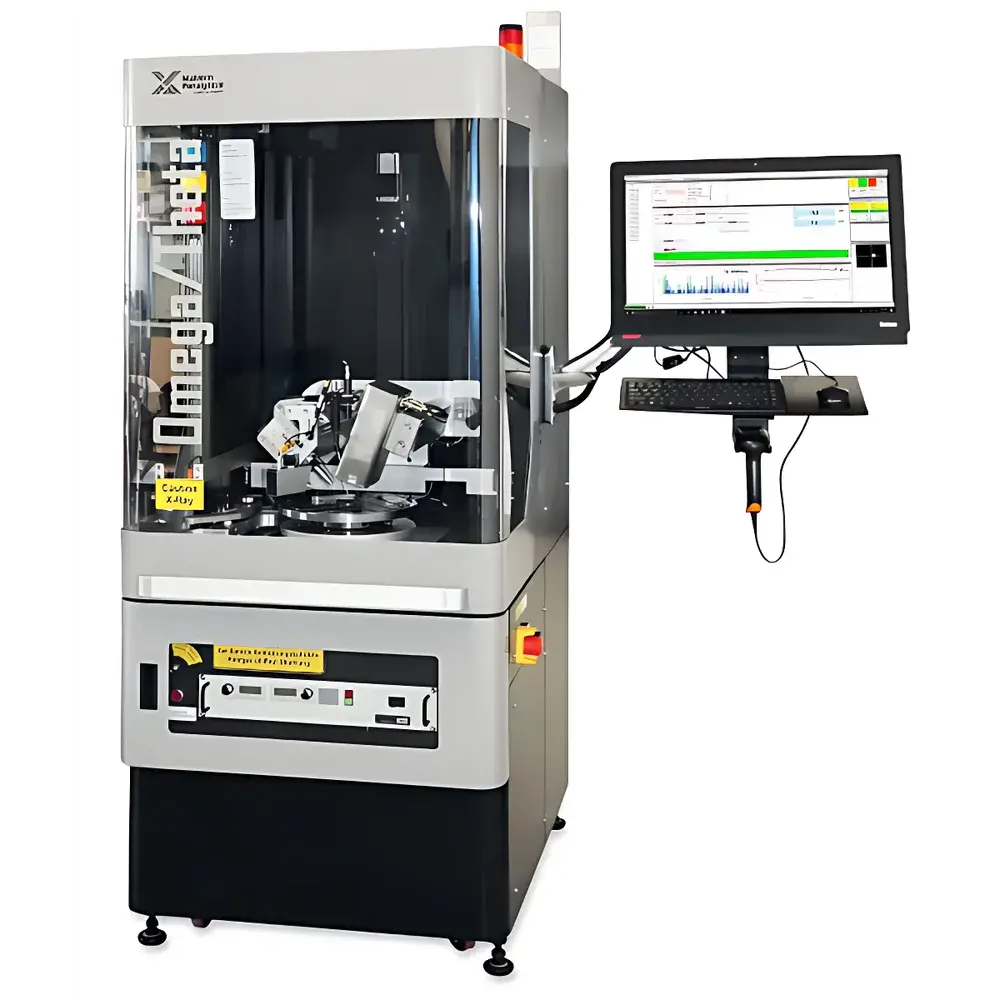
Malvern Panalytical Omega/Theta Single-Crystal X-ray Diffractometer
| Brand | Malvern Panalytical |
|---|---|
| Origin | Netherlands |
| Manufacturer Type | Original Equipment Manufacturer (OEM) |
| Product Category | Imported Instrument |
| Model | Omega/Theta |
| Instrument Type | Single-Crystal X-ray Diffractometer |
| Orientation Accuracy (1σ) | <0.003° (rocking angle), <0.03° (in-plane direction) |
| Measurement Time | ≤10 s per orientation determination |
| Maximum Sample Weight | 30 kg |
| Maximum Sample Length | 450 mm |
| Goniometer Configuration | Omega/Theta (θ–2θ coupled or independent scanning) |
Overview
The Malvern Panalytical Omega/Theta Single-Crystal X-ray Diffractometer is a high-precision, motorized goniometric system engineered for rapid and accurate crystallographic orientation mapping of single-crystal materials. Based on Bragg’s law and θ–2θ or independent omega/theta angular scanning geometry, the instrument enables deterministic indexing of crystal lattices by measuring diffraction peaks from known or unknown crystal planes under controlled Cu Kα or Mo Kα radiation. Its core application lies in industrial metrology workflows—particularly semiconductor wafer manufacturing, compound semiconductor substrate preparation (e.g., GaN, SiC, GaAs), and precision optical crystal processing—where traceable, sub-arcsecond orientation data must be transferred directly to downstream fabrication tools such as epitaxial reactors, ion implanters, or dicing saws. The system operates via a fixed-anode sealed-tube X-ray source, a high-resolution silicon strip detector or scintillation counter, and a fully programmable four-circle or five-circle goniometer capable of precise ω (sample rotation) and θ (detector rotation) motion control.
Key Features
- Sub-10-second crystal orientation determination with statistical repeatability better than 0.003° (1σ) in rocking angle and 0.03° (1σ) in in-plane azimuthal alignment
- Modular goniometer architecture supporting both standard single-axis ω scans and full Eulerian angle acquisition for complete 3D lattice vector reconstruction
- Integrated barcode reader interface enabling automated sample ID recognition and recipe-based measurement sequencing
- Heavy-duty sample stage accommodating specimens up to 30 kg and 450 mm in length—compatible with custom holders for boules, wafers, and irregularly shaped ingots
- Low-power consumption design with air-cooled X-ray tube and optimized detector electronics, reducing operational cost and thermal drift over extended runs
- Factory-calibrated angular encoders with real-time feedback compensation, ensuring long-term angular stability without periodic recalibration
- Optional V-groove and flat-edge optical alignment modules for hybrid X-ray/optical referencing—critical for mask alignment in lithography tool integration
Sample Compatibility & Compliance
The Omega/Theta XRD accommodates a broad range of crystalline materials including silicon, sapphire, quartz, lithium niobate, gallium arsenide, silicon carbide, and zinc oxide. Sample mounting options include kinematic chucks, vacuum clamps, and magnetic fixtures compatible with ISO 10110 optical surface standards and SEMI MF1530 wafer handling protocols. All mechanical and electrical subsystems conform to CE marking requirements (2014/30/EU EMC Directive and 2014/35/EU Low Voltage Directive). Software operation supports audit trail generation and electronic signature capability compliant with FDA 21 CFR Part 11 when deployed in regulated manufacturing environments. Routine performance verification follows ASTM E975 (Standard Practice for X-ray Diffraction Crystallographic Analysis) and ISO 17892-12 (Geotechnical investigation and testing — Laboratory testing of soil — Part 12: Determination of crystallographic composition).
Software & Data Management
Operation is managed through Malvern Panalytical’s proprietary X’Pert Epitaxy software suite, which provides guided workflow templates for orientation mapping, rocking curve acquisition, pole figure generation, and misorientation analysis. Raw diffraction data are stored in vendor-neutral .udf (Universal Diffraction Format) files, fully compatible with third-party crystallography platforms including GSAS-II, Maud, and CrysTBox. The software supports automated report generation in PDF or Excel formats—including annotated orientation matrices, confidence ellipsoids, and deviation heatmaps—with configurable metadata fields for LIMS integration. All user actions—including parameter changes, calibration events, and measurement exports—are logged with timestamps, operator IDs, and IP addresses to satisfy GLP/GMP documentation requirements.
Applications
- Crystallographic orientation verification prior to epitaxial growth in MBE and MOCVD systems
- Quality assurance of off-angle substrates used in high-electron-mobility transistor (HEMT) fabrication
- Post-processing validation of wafer thinning, polishing, and etching steps affecting lattice tilt
- Reference standard certification for metrology labs accredited to ISO/IEC 17025
- Research-scale lattice strain profiling in ferroelectric and piezoelectric single crystals
- Automated feed-forward control in closed-loop crystal slicing and grinding lines
FAQ
What crystal systems can the Omega/Theta XRD characterize?
It supports all seven crystal systems (cubic, tetragonal, orthorhombic, monoclinic, triclinic, hexagonal, and rhombohedral) provided the unit cell parameters are known or derivable from initial peak indexing.
Is the system suitable for in-line integration with semiconductor fab tools?
Yes—its compact footprint, Ethernet/IP communication protocol support, and SECS/GEM-compatible API enable direct integration into factory automation systems.
Can it measure rocking curves on thick bulk crystals?
Yes—the goniometer’s ±100° ω range and high-torque stepper motors allow stable low-speed scanning across full rocking curves, even for high-aspect-ratio samples.
Does the software support batch processing of multiple wafers?
Yes—via scriptable macros and folder-watch triggers, users can queue orientation measurements across hundreds of wafers with auto-naming based on barcode input.
How is angular accuracy verified and maintained?
Traceable calibration uses NIST-traceable Si (111) and Al2O3 (0006) reference standards; angular reproducibility is monitored daily using internal stability checks embedded in the control firmware.
Related Products






