
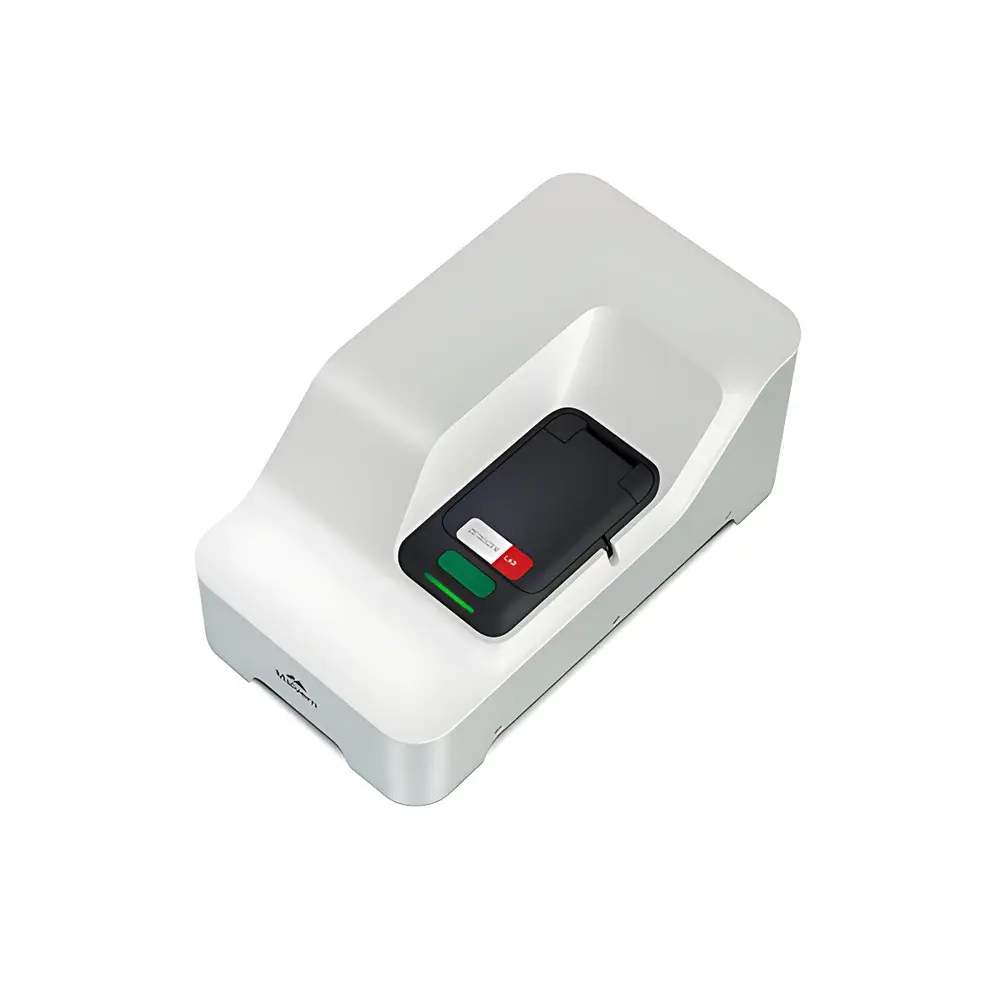
Malvern PANalytical Zetasizer Lab Nanoparticle Size and Zeta Potential Analyzer
| Brand | Malvern PANalytical |
|---|---|
| Origin | United Kingdom |
| Manufacturer Type | Original Equipment Manufacturer (OEM) |
| Import Status | Imported |
| Model Options | Blue Label and Red Label configurations |
| Particle Size Range | 0.3 nm – 15 µm |
| Size Measurement Repeatability | ±2% |
| Temperature Control Range | 10–35 °C |
| Temperature Stability | ±0.1 °C |
| Detection Angle | 90° (Classical Dynamic Light Scattering) |
| Minimum Sample Volume | 3 µL |
| Sample Concentration Range | 0.1 mg/mL – 40% w/v |
| Zeta Potential Range | No practical lower or upper limit |
| Typical Measurement Time | 3–5 minutes per analysis |
| Molecular Weight Range | 980 Da – 20 MDa |
Overview
The Malvern PANalytical Zetasizer Lab is a benchtop nanoparticle characterization system engineered for precision, robustness, and accessibility in academic, industrial, and quality control laboratories. It employs classical 90° dynamic light scattering (DLS) for hydrodynamic size distribution analysis and electrophoretic light scattering (ELS) for zeta potential determination—two foundational techniques for colloidal stability assessment. The instrument’s optical architecture is optimized for high signal-to-noise ratio detection across the full sub-nanometer to micrometer range, enabling reliable quantification of proteins, polymers, liposomes, surfactant micelles, and inorganic nanoparticles. Its design reflects decades of Malvern PANalytical expertise in light scattering physics, with core algorithms—including Adaptive Correlation—developed to enhance data fidelity while reducing reliance on operator-dependent optimization steps.
Key Features
- Classical 90° DLS optics with temperature-controlled cuvette chamber (10–35 °C, ±0.1 °C stability) ensures reproducible thermal management critical for conformational studies and accelerated stability screening.
- M3-PALS (Phase Analysis Light Scattering) with constant current mode enables accurate zeta potential measurement in high-conductivity media (e.g., physiological buffers, saline formulations), where traditional field inversion methods fail.
- ZS Xplorer software provides real-time data quality diagnostics powered by embedded machine learning models—flagging aggregation, dust contamination, or insufficient count rate—and delivers context-aware guidance for sample preparation refinement.
- Low-volume disposable capillary cells (ZSU1002) support measurements from as little as 3 µL, minimizing reagent consumption and cross-contamination risk—particularly valuable for precious biological samples.
- Extended size analysis mode improves resolution and accuracy for particles >1 µm and yields indicative results up to 10 µm using the same optical path, eliminating need for separate laser diffraction instrumentation in preliminary screening workflows.
- Static light scattering (SLS) at 90° enables absolute molecular weight determination without calibration standards, compliant with ISO 22412 and ASTM E2490 guidelines for macromolecular characterization.
Sample Compatibility & Compliance
The Zetasizer Lab accommodates a broad spectrum of colloidal systems: aqueous and organic dispersions, protein solutions, lipid nanoparticles, polymer emulsions, and ceramic suspensions. Its dual-label configuration supports method flexibility—Blue Label targets routine QC applications (e.g., batch release testing per USP ), while Red Label includes enhanced sensitivity and signal processing for low-scattering, low-concentration, or highly polydisperse samples (e.g., monoclonal antibodies below 1 mg/mL or surfactant micelles near CMC). All firmware and software comply with FDA 21 CFR Part 11 requirements, including electronic signatures, audit trails, and role-based access control—fully validated for GLP and GMP environments. Instrument design adheres to IEC 61010-1 safety standards and electromagnetic compatibility (EMC) directives.
Software & Data Management
ZS Xplorer is built around a sample-centric workflow architecture: users define sample identity, measurement protocol, and reporting templates prior to acquisition—ensuring traceability and method consistency. Raw correlation functions, intensity-weighted size distributions, and zeta potential histograms are stored in vendor-neutral .csv and .xlsx formats alongside metadata (temperature, viscosity, refractive index). Batch processing, automated report generation (PDF/HTML), and integration with LIMS via RESTful API are supported. Audit trail logs record every parameter change, user action, and data export event—fully compliant with regulatory inspection expectations under FDA, EMA, and PMDA frameworks.
Applications
- Biopharmaceutical Development: Rapid assessment of protein aggregation onset, excipient screening, and forced degradation studies—supporting ICH Q5C stability protocols and formulation risk mitigation.
- Nanomedicine & Drug Delivery: Characterization of liposomal, polymeric, and exosomal nanocarriers—correlating size dispersity (PDI), surface charge, and colloidal stability under physiological conditions.
- Materials Science: Monitoring nucleation/growth kinetics of metal oxide nanoparticles; evaluating dispersion quality of carbon nanotubes or graphene platelets in functional composites.
- Food & Beverage R&D: Quantifying droplet size evolution in emulsions during storage; assessing electrostatic stabilization of casein micelles or starch granules in acidic beverages.
- Coatings & Inks: Linking zeta potential trends to pigment flocculation behavior; optimizing dispersant dosage for rheological control and gloss retention in architectural paints.
FAQ
Is the Zetasizer Lab suitable for regulated GMP environments?
Yes—the system meets 21 CFR Part 11 requirements out-of-the-box, with full audit trail, electronic signature capability, and configurable user roles.
Can it measure samples with high salt content?
Yes—M3-PALS with constant current mode enables stable zeta potential measurements in conductivities up to 200 mS/cm, typical of PBS or cell culture media.
What is the difference between Blue Label and Red Label configurations?
Red Label includes upgraded detector electronics, enhanced signal processing algorithms, and extended dynamic range—optimized for challenging samples such as dilute proteins, micellar systems, or highly charged nanomaterials.
Can I upgrade to Zetasizer Pro or Ultra later?
Yes—all Zetasizer Lab instruments support field-upgradable hardware and software modules, including advanced scattering models, multi-angle detection, and automated titration capabilities.
Does it require annual recalibration?
No—Malvern PANalytical instruments are factory-calibrated using NIST-traceable polystyrene standards; routine verification with reference materials is recommended per ISO/IEC 17025 laboratory practice.



