
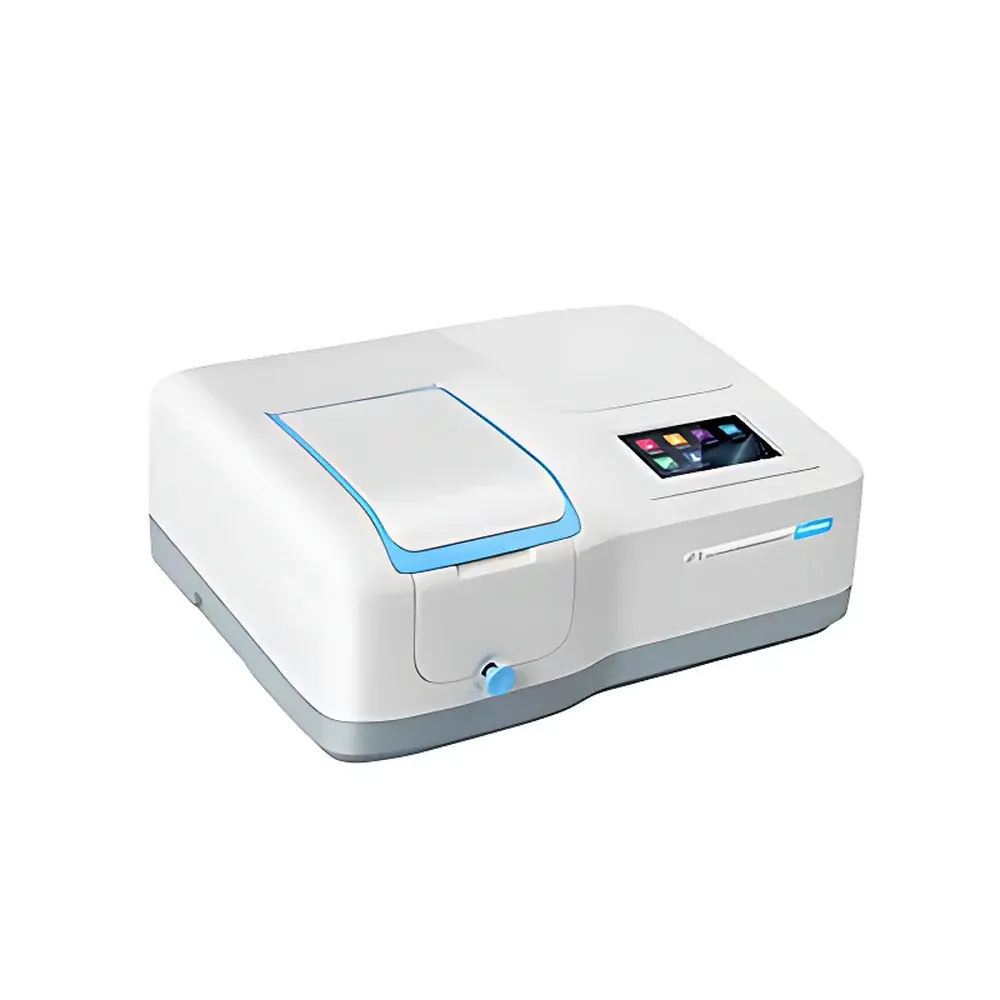
Mapada PV1 Economical Visible Spectrophotometer
| Brand | Mapada |
|---|---|
| Origin | Shanghai, China |
| Manufacturer Type | Manufacturer |
| Product Origin | Domestic (China) |
| Model | PV1 |
| Price Range | USD 1,400 – 2,800 |
| Optical System | Single-beam |
| Detector Type | Photocell |
| Automation Level | Automatic Wavelength Scanning |
| Wavelength Range | 320 – 1050 nm |
| Spectral Bandwidth | 4 nm |
| Wavelength Accuracy | ±0.8 nm |
Overview
The Mapada PV1 Economical Visible Spectrophotometer is a precision single-beam optical instrument engineered for routine quantitative and qualitative analysis in the visible and near-ultraviolet spectral region. Operating on the principle of Beer–Lambert law-based absorbance measurement, the PV1 delivers reliable photometric data across a wavelength range of 320–1050 nm—encompassing the full visible spectrum (400–700 nm) and extending into both the near-UV and near-IR regions. Its fixed 4 nm spectral bandwidth ensures sufficient resolution for standard colorimetric assays, concentration determinations, and kinetic studies where high spectral resolution is not required. Designed with an integrated photocell detector and automatic wavelength drive mechanism, the PV1 eliminates manual calibration drift associated with mechanical wavelength adjustment, enhancing measurement reproducibility across daily laboratory workflows.
Key Features
- Single-beam optical architecture optimized for cost-effective, high-stability transmission and absorbance measurements
- Automated wavelength scanning with stepper-motor-driven grating system, enabling precise positioning within ±0.8 nm accuracy
- Robust all-metal optical housing with thermally stabilized cuvette compartment to minimize thermal drift during extended operation
- Photocell-based detection system offering linear response over OD 0–2.0 (typical), suitable for standard aqueous and organic solvent-based samples
- Embedded microprocessor control with intuitive LED display interface; no external PC required for basic operation
- Standard 10 mm square quartz or glass cuvette compatibility; optional semi-micro and flow-cell adapters available upon request
Sample Compatibility & Compliance
The PV1 supports a broad range of transparent liquid samples—including aqueous buffers, dye solutions, enzyme reaction mixtures, pharmaceutical suspensions (after filtration), and industrial cleaning agents—provided they exhibit minimal scattering and absorbance below 2.5 AU at selected wavelengths. Sample containers must be optically matched and free of scratches or fingerprints to maintain photometric integrity. While the PV1 does not incorporate hardware-level compliance features such as audit trails or electronic signatures, its operational parameters align with foundational requirements outlined in ISO 6425 (spectrophotometer performance verification) and ASTM E275 (standard practices for UV–visible spectrophotometry). Laboratories implementing GLP or GMP frameworks may integrate the PV1 into validated workflows using documented SOPs for instrument qualification (IQ/OQ/PQ), particularly when paired with traceable NIST-calibrated neutral density filters and holmium oxide reference standards.
Software & Data Management
The PV1 operates independently via front-panel controls but supports optional RS-232 serial output for connection to external PCs running third-party data acquisition software (e.g., LabVIEW, MATLAB, or custom Python scripts). Raw absorbance/transmittance values, wavelength settings, and time stamps (when enabled via external trigger) can be logged sequentially. Though it lacks native USB connectivity or cloud synchronization, the device’s ASCII-formatted serial output conforms to ANSI X3.4 standards, ensuring interoperability with LIMS platforms that accept ASCII-delimited input. For regulated environments requiring 21 CFR Part 11 compliance, users must implement supplementary access controls, electronic signature protocols, and audit trail generation at the host software level—functions not embedded in the PV1’s firmware.
Applications
- Routine quality control of dyes, pigments, and food colorants in manufacturing laboratories
- Quantitative determination of transition metal ions (e.g., Fe²⁺/Fe³⁺, Cu²⁺, Co²⁺) via complexometric assays
- Enzyme kinetics monitoring (e.g., NADH/NADPH oxidation at 340 nm) under controlled temperature conditions
- Educational use in undergraduate chemistry and biology labs for teaching spectroscopic fundamentals
- Water quality assessment including nitrate, phosphate, and silicate analysis using standardized colorimetric methods (e.g., APHA 4500-NO₃⁻ B)
- Verification of optical density in microbiological culture growth studies (OD600)
FAQ
Does the PV1 support dual-beam or ratio referencing?
No. The PV1 employs a single-beam design; reference measurements must be performed manually by zeroing with blank solution prior to sample measurement.
Can the PV1 measure below 320 nm?
No. The optical components—including grating coating and photocell responsivity—are optimized for 320–1050 nm. Measurements below 320 nm require deuterium lamp illumination and UV-grade optics, which are not integrated into this model.
Is wavelength calibration traceable to NIST standards?
The factory calibration uses holmium oxide and didymium filters traceable to national metrology institutes. End-users may perform periodic verification using certified reference materials; recalibration services are available through Mapada’s authorized service centers in Asia-Pacific and Europe.
What is the recommended maintenance interval?
We recommend optical alignment verification and detector sensitivity check every 12 months or after 2,000 operating hours—whichever occurs first—using manufacturer-provided diagnostic procedures and reference filters.
Related Products




