
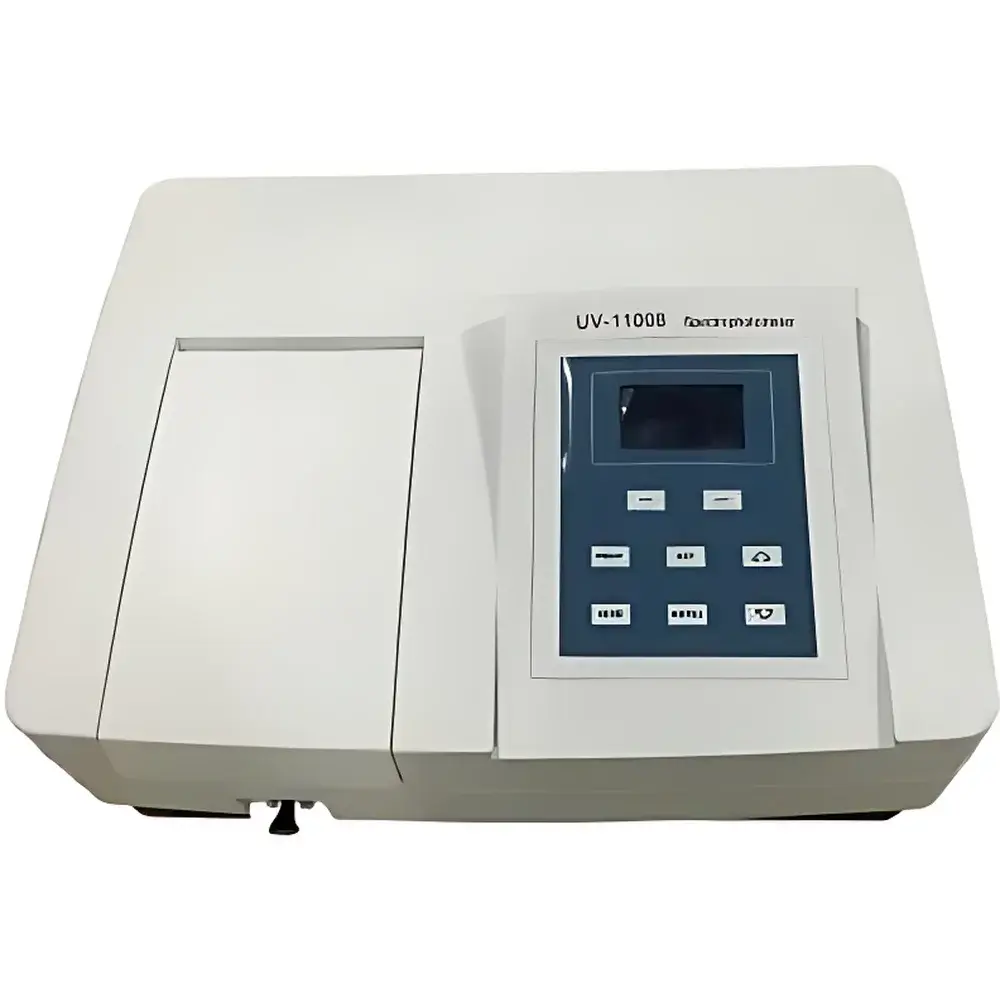
MAPADA UV-1100B UV-Visible Spectrophotometer
| Spectral Range | 200–1000 nm |
|---|---|
| Spectral Bandwidth | 4 nm |
| Wavelength Accuracy | ±2 nm |
| Wavelength Repeatability | 1 nm |
| Photometric Accuracy | ±0.5% T |
| Photometric Repeatability | 0.2% T |
| Stray Light | ≤0.2% T @ 360 nm |
| Baseline Stability | ±0.002 A/h @ 500 nm |
| Wavelength Resolution | 0.1 nm |
| Detector | Imported Silicon Photodiode |
| Light Sources | Imported Tungsten Lamp & Deuterium Lamp |
| Display | 128 × 64 Dot-Matrix LCD |
| Data Storage | 200 Sets Internal |
| Interface | USB Port |
| Sample Chamber | Accommodates Cuvettes from 5 to 100 mm Pathlength |
| Dimensions | 490 × 360 × 210 mm |
| Weight | 12 kg |
Overview
The MAPADA UV-1100B UV-Visible Spectrophotometer is a benchtop single-beam instrument engineered for routine quantitative and qualitative analysis in academic, industrial, and quality control laboratories. It operates on the principle of absorption spectroscopy, measuring the attenuation of ultraviolet and visible light (200–1000 nm) as it passes through a sample solution. The optical architecture integrates a high-efficiency 1200 lines/mm holographic grating and precision-aligned imported silicon photodiode detector, delivering consistent spectral resolution and signal-to-noise performance across its full wavelength range. Designed for robust daily use, the UV-1100B features automatic wavelength calibration, dual-lamp source management (deuterium for UV, tungsten for VIS), and plug-in lamp modules that eliminate optical realignment during replacement—reducing maintenance downtime and operator dependency.
Key Features
- Single-beam optical design with optimized stray light suppression (≤0.2% T @ 360 nm), ensuring reliable absorbance measurements in low-transmittance regions.
- High-stability dual-light-source system: independently controllable deuterium and tungsten lamps, each with dedicated power regulation and thermal management.
- Large-capacity internal memory storing up to 200 measurement sets—including wavelength, absorbance, transmittance, and energy values—enabling traceable offline data review without external storage.
- 128 × 64 dot-matrix LCD display with 0.1 nm wavelength resolution; supports simultaneous readout of multiple photometric modes (A, %T, Energy).
- Universal cuvette compartment accommodating standard pathlengths from 5 mm to 100 mm, compatible with square, rectangular, and micro-volume cuvettes.
- USB interface compliant with USB 2.0 specifications, enabling seamless data export to Windows-based PCs and integration with third-party or MAPADA-supplied analytical software for spectral processing, calibration curve generation, and GLP-compliant reporting.
- Plug-and-play lamp module design: no collimation or alignment required when replacing either the deuterium or tungsten lamp—minimizing service intervals and technician involvement.
Sample Compatibility & Compliance
The UV-1100B accommodates a broad range of liquid-phase samples in quartz, glass, or plastic cuvettes, supporting applications from nucleic acid quantification (A260/A280) to pharmaceutical assay validation. Its optical path and detector linearity are validated per ISO 6060 (Water Quality – Determination of Chemical Oxygen Demand) and ASTM E275 (Standard Practices for Describing and Measuring Performance of Ultraviolet–Visible Spectrophotometers). While not inherently 21 CFR Part 11 compliant out-of-the-box, the instrument’s data export functionality and audit-ready file structure support integration into regulated environments when paired with validated software platforms and documented SOPs. All firmware operations—including wavelength setting, lamp switching, and zeroing—are logged internally with timestamped event records for GLP/GMP traceability.
Software & Data Management
The UV-1100B supports direct communication via USB with MAPADA’s proprietary PC software suite, which provides wavelength scanning, kinetic studies, multi-point calibration, and fixed-wavelength quantitation. Raw spectral data is exported in ASCII or CSV format for post-processing in MATLAB, Origin, or Excel. The software includes built-in tools for baseline correction, peak identification, and derivative spectroscopy. For regulated users, optional add-ons enable electronic signature capture, user access levels, and audit trail generation—facilitating compliance with FDA 21 CFR Part 11 requirements when deployed within a validated IT infrastructure.
Applications
- Quantitative analysis of organic and inorganic compounds in environmental water testing (e.g., nitrate, phosphate, heavy metals via colorimetric methods).
- Concentration determination of proteins, DNA, and RNA using established extinction coefficients.
- Quality assurance of raw materials and finished products in food, beverage, and cosmetic manufacturing.
- Educational laboratory instruction for Beer–Lambert law verification, kinetics experiments, and spectral characterization of dyes and transition metal complexes.
- Pharmaceutical QC for dissolution testing, content uniformity, and stability-indicating assays per USP and EP 2.2.25.
FAQ
What is the maximum pathlength supported by the sample compartment?
The instrument accepts cuvettes with optical path lengths ranging from 5 mm to 100 mm.
Does the UV-1100B support kinetic or time-scan measurements?
Yes—when connected to compatible PC software, it enables time-resolved absorbance monitoring at user-defined intervals.
Is the wavelength accuracy verified at factory calibration?
Each unit undergoes factory calibration using NIST-traceable holmium oxide and didymium filters, with certificate of conformance provided.
Can the instrument operate on 110 V / 60 Hz power supply?
Yes—the power input supports both AC 220 V / 50 Hz and AC 110 V / 60 Hz configurations, with automatic voltage recognition.
How is photometric accuracy maintained over extended operation?
Baseline stability is specified as ±0.002 A/h at 500 nm after warm-up; regular zeroing and lamp intensity monitoring ensure long-term repeatability.
Related Products





