
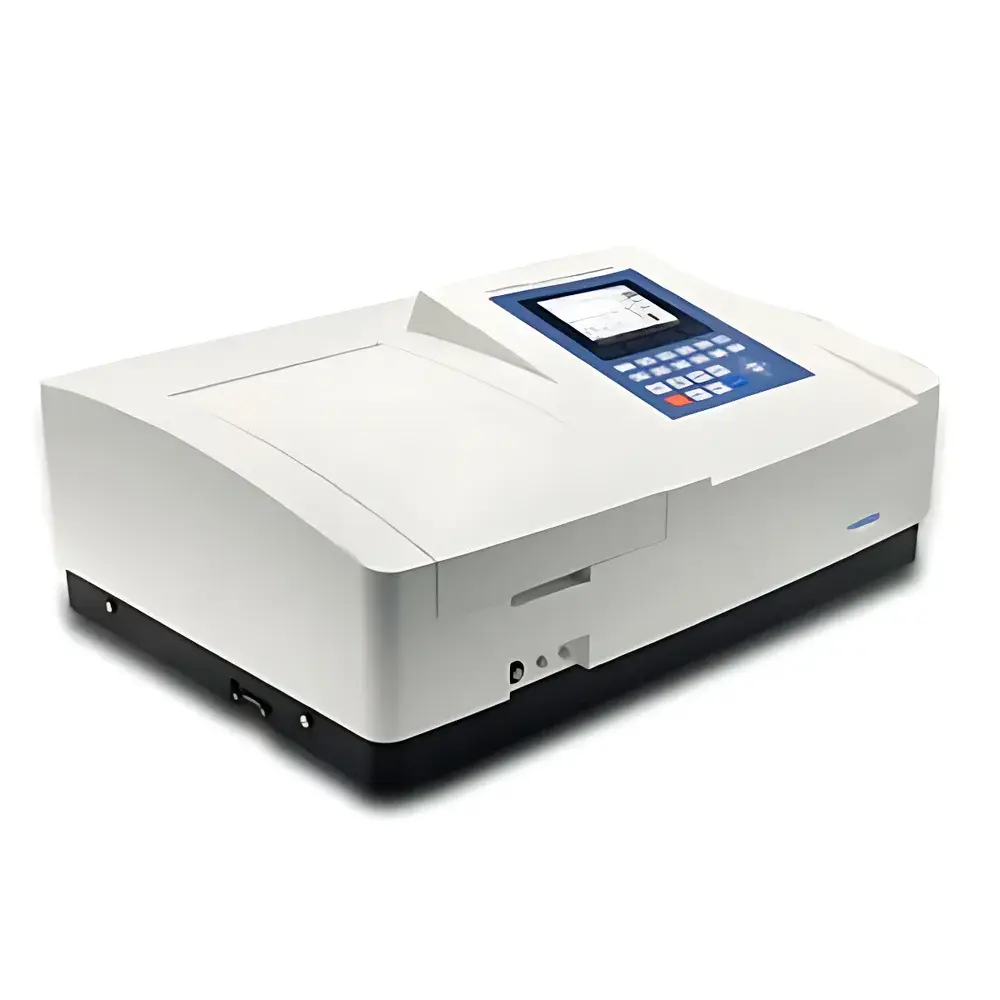
Mapada UV6100 / UV6100S / UV6300 Dual-Beam Ultraviolet-Visible Spectrophotometer
| Origin | Shanghai, China |
|---|---|
| Manufacturer Type | Authorized Distributor |
| Origin Category | Domestic (PRC) |
| Model Variants | UV6100, UV6100S, UV6300 |
| Optical Design | Pseudo-Dual-Beam |
| Detector | Photodiode Array (PDA) |
| Wavelength Range | 190–1100 nm |
| Wavelength Accuracy | Auto-Scanning |
| Spectral Bandwidth | 1.8 nm (UV6100), 0.5/1/2/4/5 nm (UV6100S), 1 nm (UV6300) |
| Display | 6-inch LCD (320 × 240 pixels) |
| Lamp System | Replaceable D₂ and W lamp modules |
| Sample Compartment | Accommodates Cuvettes from 5 mm to 100 mm pathlength |
| Compliance | GLP Self-Verification Functionality |
| Software Interface | Mapada UV-Vis Scan Suite (Windows-based, USB-connected) |
Overview
The Mapada UV6100, UV6100S, and UV6300 series are pseudo-dual-beam ultraviolet-visible spectrophotometers engineered for routine and research-grade absorbance, transmittance, and concentration measurements across the 190–1100 nm spectral range. Unlike true dual-beam systems that split light continuously between sample and reference beams, these instruments employ time-shared beam routing with high-speed chopper synchronization—delivering stable baseline performance and reduced photometric drift during extended scans or kinetic assays. The optical architecture integrates a 1200 lines/mm holographic grating for high dispersion efficiency and low stray light, coupled with a thermally stabilized photodiode array detector ensuring consistent responsivity across UV, visible, and near-IR regions. Designed for laboratories requiring regulatory traceability, each unit supports wavelength and photometric accuracy self-validation in accordance with GLP principles, enabling on-demand verification of instrument performance prior to critical analyses.
Key Features
- 6-inch high-contrast LCD display (320 × 240 resolution) with integrated graphical interface for real-time visualization of spectra, calibration curves, kinetic progress plots, and multi-wavelength overlays—no external PC required for basic operation.
- Modular lamp design: quick-swap deuterium and tungsten-halogen lamps with built-in usage-hour counters and automatic warm-up optimization; ozone-reduced D₂ lamp housing minimizes operator exposure during routine maintenance.
- Optimized optical bench featuring precision-aligned collimating optics, high-efficiency diffraction grating, and thermally compensated detector mounting—ensuring long-term photometric stability and reproducibility (RSD < 0.3% at 0.5 A).
- Expandable cuvette compartment accommodating standard rectangular cells from 5 mm to 100 mm pathlength—including ultra-micro, semi-micro, and macro formats—compatible with both quartz and high-transmission optical glass.
- Onboard GLP self-diagnostic protocol: automated wavelength accuracy check (using holmium oxide or didymium filters) and photometric linearity verification (neutral density filters); generates timestamped PDF reports compliant with internal audit requirements.
- USB-host interface supporting direct printing to compatible thermal or inkjet printers—enabling immediate hardcopy documentation of spectra, quantitative results, and method parameters.
Sample Compatibility & Compliance
The UV6100/S/6300 series accommodates liquid, suspension, and thin-film samples using standardized cuvettes, flow cells (with optional adapter), or solid-sample reflectance accessories. All models comply with ISO 6425:2022 (spectrophotometer performance specifications) and support method validation per USP <857> and EP 2.2.25. The firmware embeds audit-trail functionality for user logins, parameter changes, and calibration events—facilitating alignment with FDA 21 CFR Part 11 when used with validated Mapada UV-Scan software configurations. Instrument qualification documentation (IQ/OQ templates) is provided for GMP-regulated environments, including wavelength accuracy tolerance (±0.5 nm), photometric accuracy (±0.005 A at 1.0 A), and stray light levels (<0.05%T at 220 nm).
Software & Data Management
The included Mapada UV-Vis Scan Suite (v4.x) provides full remote control via USB 2.0, supporting spectral acquisition, quantitative analysis (single/multi-point calibration, equation-based concentration calculation), kinetic monitoring (up to 999 data points/sec), and nucleic acid/protein quantification (A260/A280 ratio, extinction coefficient input). Raw data export is available in CSV, TXT, and JCAMP-DX formats; spectral overlays, derivative spectroscopy, and baseline correction algorithms are embedded. The software enforces role-based access control, electronic signatures, and encrypted project archives—meeting ALCOA+ data integrity criteria for regulated QC labs. Data backup and restore functions integrate with network file systems or cloud-synced local repositories.
Applications
These spectrophotometers serve core analytical workflows in pharmaceutical quality control (excipient assay, dissolution testing), environmental monitoring (nitrate, phosphate, COD analysis), food safety (colorimetric enzyme assays, preservative quantitation), academic teaching laboratories (Beer–Lambert law validation, equilibrium constant determination), and biotechnology R&D (DNA/RNA purity assessment, protein folding kinetics, enzyme activity profiling). The UV6100S variant—with variable slit widths (0.5–5 nm)—is particularly suited for high-resolution spectral deconvolution of overlapping chromophores, while the UV6300’s fixed 1 nm bandwidth ensures optimal signal-to-noise for low-concentration trace metal analysis using colorimetric reagents.
FAQ
What distinguishes “pseudo-dual-beam” from true dual-beam operation?
Pseudo-dual-beam uses a single optical path with rapid mechanical or electronic beam switching between sample and reference positions—reducing complexity and cost while maintaining sufficient stability for most QC applications. True dual-beam systems require two parallel optical paths and are typically found in high-end research instruments.
Can the instrument be validated for GMP compliance?
Yes—the onboard GLP self-check, combined with Mapada’s IQ/OQ documentation package and software audit trail features, supports installation and operational qualification in regulated environments under ICH Q7 and EU Annex 11 guidelines.
Is the photodiode array detector cooled?
No—the PDA operates at ambient temperature with thermal compensation algorithms applied in firmware; active cooling is unnecessary given the instrument’s intended duty cycle and dynamic range (0–3.5 A).
What cuvette materials are supported across the full 190–1100 nm range?
Quartz (fused silica) cuvettes are required below 350 nm; optical glass or PMMA may be used above 350 nm for non-critical visible-range measurements.
Does the software support LIMS integration?
Direct LIMS connectivity is not native, but CSV and JCAMP-DX exports enable seamless ingestion into most laboratory information management systems via scheduled batch import protocols.






