
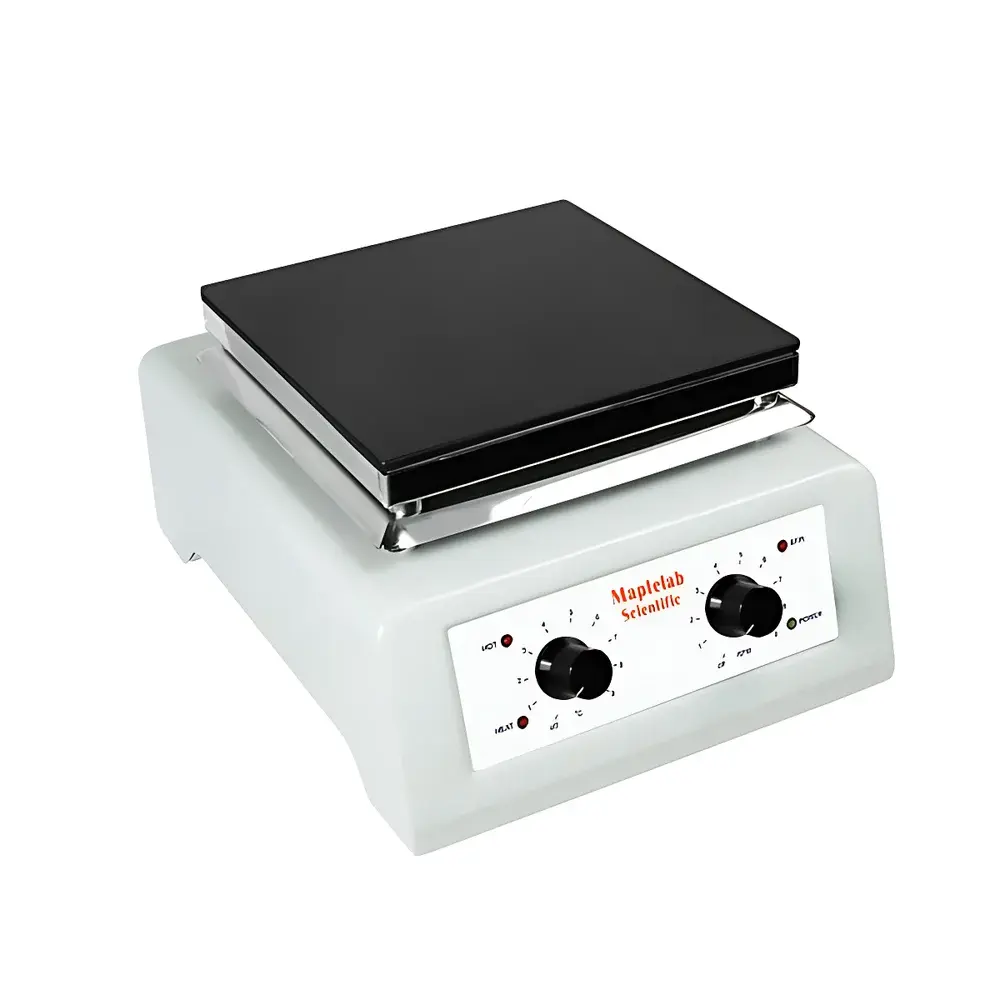
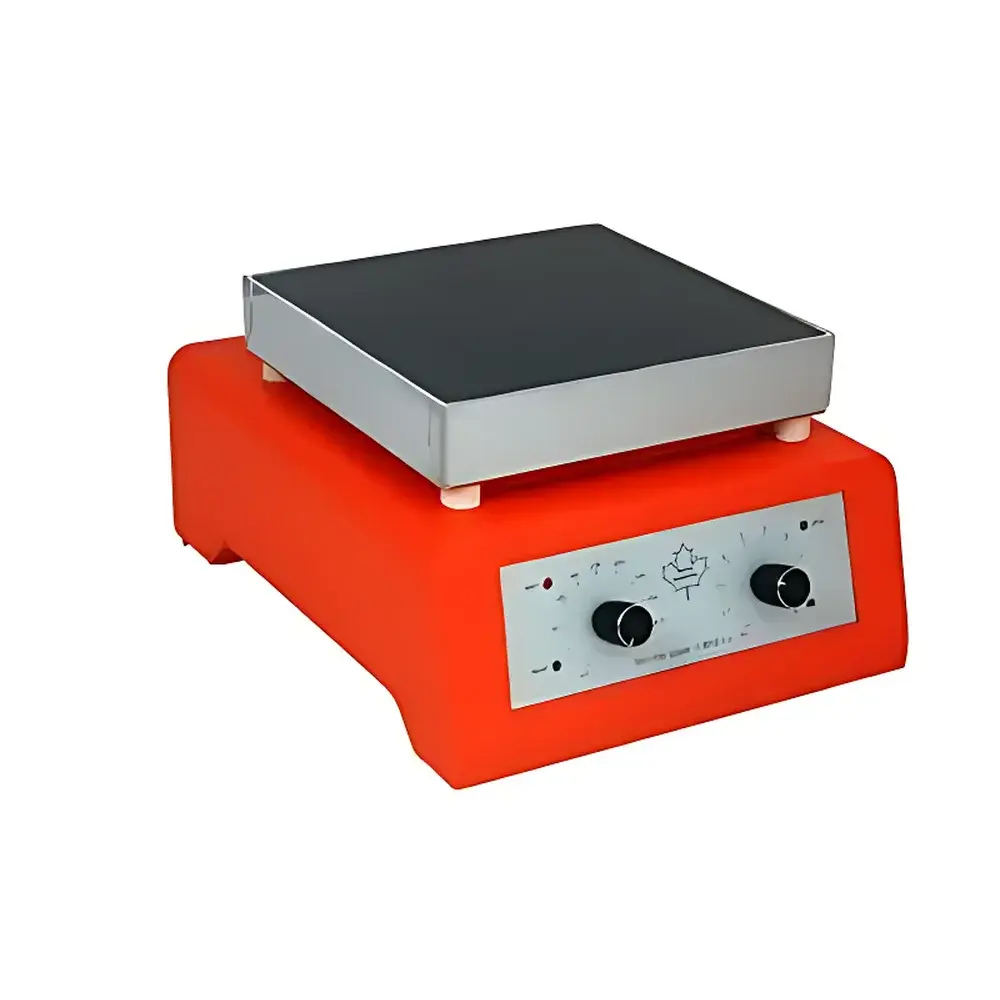
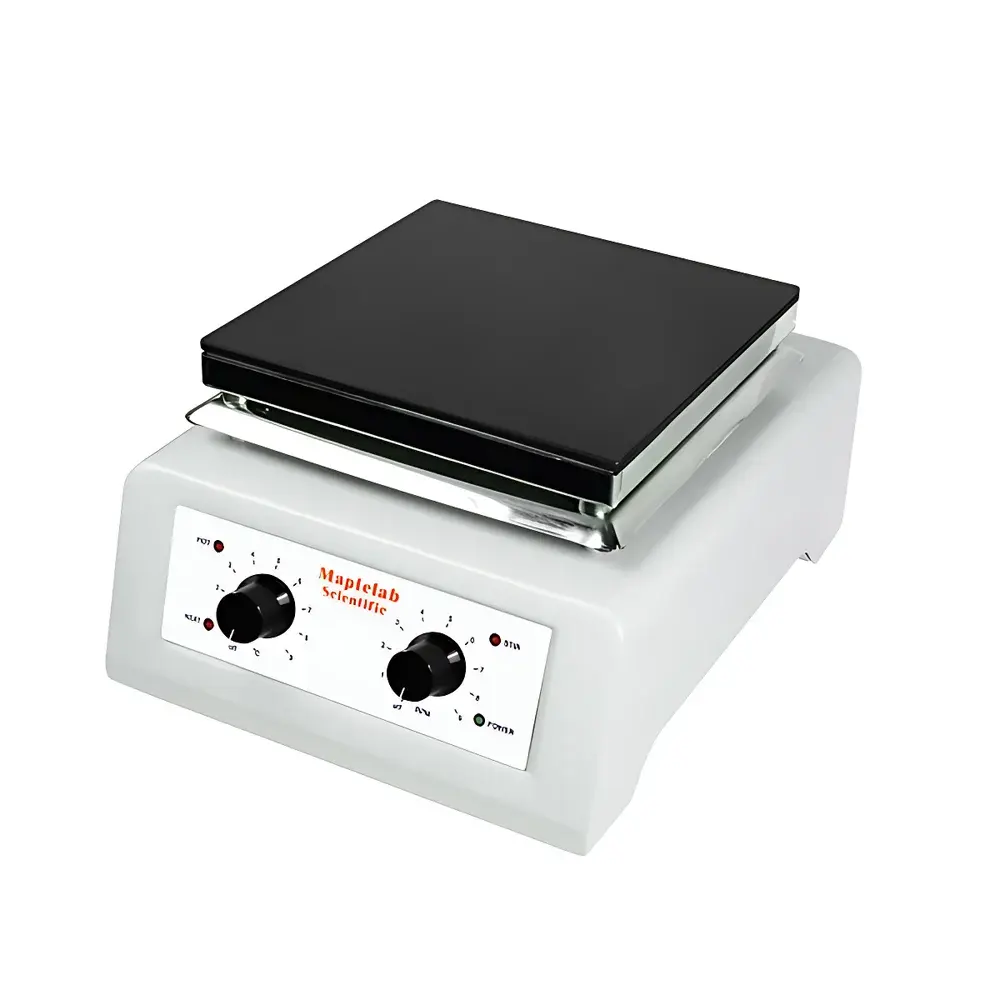
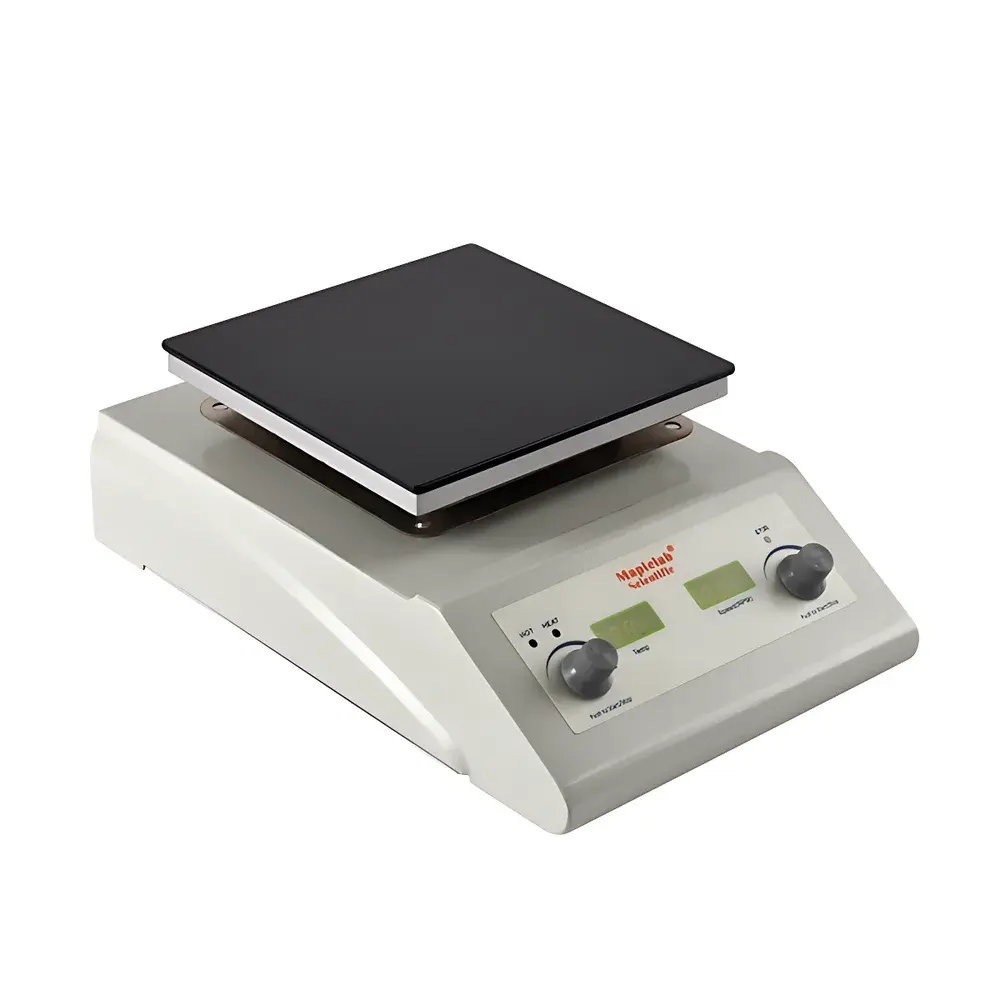
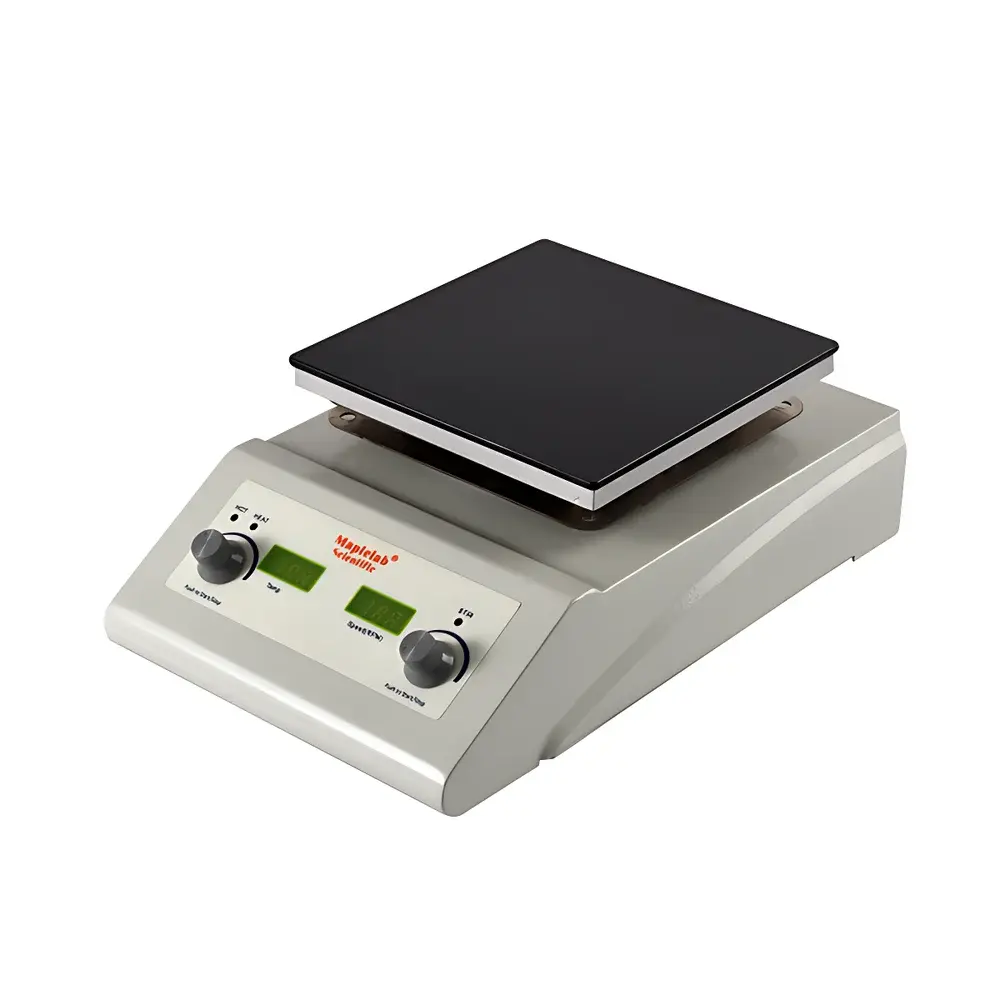
Maplelab SHC-I Microcrystal-Top Digital Hotplate Stirrer
| Brand | Maplelab |
|---|---|
| Origin | Guangdong, China |
| Model | SHC-I |
| Instrument Type | Magnetic Hotplate Stirrer |
| Maximum Stirring Volume | 10 L |
| Speed Range | 100–1500 rpm |
| Temperature Control Range | Ambient to 550 °C |
| Temperature Accuracy | ±0.5 °C |
| Heating Plate Material | High-Temperature Microcrystalline Ceramic |
| Stirring Surface Material | Acid-Resistant Ceramic |
| Power Supply | 230 V, 50 Hz |
| Heating Power | 550 W |
| Plate Dimensions | 160 × 160 mm |
| Heated Area | 120 × 120 mm |
| Net Weight | 3.6 kg |
Overview
The Maplelab SHC-I Microcrystal-Top Digital Hotplate Stirrer is an integrated laboratory instrument engineered for precision temperature-controlled mixing in demanding chemical, pharmaceutical, and materials science applications. It operates on the principle of magnetic coupling—using a rotating permanent magnet beneath a thermally stable microcrystalline ceramic plate to drive a PTFE- or glass-coated stir bar within the vessel—while simultaneously delivering uniform resistive heating across the entire heated surface. Unlike conventional aluminum or stainless-steel hotplates, the SHC-I’s microcrystalline top exhibits exceptional thermal stability (up to 550 °C), low thermal mass for rapid response, and outstanding resistance to thermal shock, strong acids (e.g., concentrated HNO₃, H₂SO₄), alkalis, and organic solvents. Its embedded microprocessor enables closed-loop PID temperature regulation with ±0.5 °C accuracy over the full operating range, making it suitable for protocols requiring strict thermal reproducibility—such as reflux synthesis, catalyst activation, polymerization initiation, and dissolution testing per USP .
Key Features
- Microcrystalline ceramic heating surface rated for continuous operation up to 550 °C, with superior chemical inertness and mechanical durability compared to standard ceramic or enamel-coated plates.
- Digital microprocessor control with real-time RPM and temperature display; independent adjustment of stirring speed (100–1500 rpm) and plate temperature (ambient to 550 °C).
- Integrated safety architecture: automatic thermal cutoff at preset overtemperature threshold, “Hot Surface” LED warning, spill-resistant edge design, and open-circuit detection for external PT100 probe failure.
- Intelligent probe monitoring: unit halts heating and emits audible alarm if the external temperature probe is disconnected, immersed incorrectly, or if solvent evaporation is detected—preventing thermal runaway and sample degradation.
- User-accessible probe calibration function via front-panel interface, supporting traceable adjustment to NIST-traceable reference standards.
- High-torque brushless DC motor and optimized magnetic coupling system ensure consistent agitation even with high-viscosity media (up to 10,000 mPa·s) and large-volume vessels (up to 10 L).
Sample Compatibility & Compliance
The SHC-I accommodates standard laboratory glassware—including round-bottom flasks (50 mL to 5 L), beakers, and digestion vessels—on its 120 × 120 mm active heating zone. Its acid-resistant ceramic surface permits direct contact with aggressive reagents used in trace metal analysis (e.g., aqua regia digestions), electroplating baths, and high-temperature hydrothermal synthesis. While not certified to IEC 61010-1:2010/AMD1:2019 for hazardous area use, the device conforms to general laboratory safety requirements under EN 61326-1 (EMC) and carries CE marking for electromagnetic compatibility and low-voltage directive compliance. Its operational parameters align with common method validation criteria in ISO/IEC 17025-accredited labs, particularly for temperature uniformity testing (ASTM E2209) and mixing homogeneity assessment (USP Analytical Instrument Qualification).
Software & Data Management
The SHC-I operates as a standalone instrument without proprietary software or PC connectivity. All settings—including setpoints, ramp rates, hold times, and probe calibration offsets—are retained in non-volatile memory after power cycling. For laboratories operating under GLP or GMP frameworks, the unit supports manual audit trails: operators may record setpoint values, start/stop timestamps, and observed deviations in lab notebooks. Though lacking FDA 21 CFR Part 11-compliant electronic signatures or automated data export, its deterministic behavior, stable setpoint retention, and built-in alarm logging (via audible tone + visual indicator) satisfy basic data integrity expectations for non-regulated research and teaching environments.
Applications
- Synthesis of nanomaterials requiring precise thermal ramping and homogeneous nucleation (e.g., sol-gel processing, quantum dot preparation).
- Dissolution testing of solid dosage forms under pharmacopeial conditions (USP Apparatus II, 37 °C ± 0.5 °C).
- Acid digestion of environmental samples (soil, sludge, biological tissue) prior to ICP-MS or AAS analysis.
- Preparation of calibration standards and stock solutions where thermal equilibration and mixing uniformity are critical.
- Long-duration reactions such as esterification, transesterification, and condensation polymerizations requiring sustained 120–250 °C operation.
- Teaching laboratories performing kinetic studies, Arrhenius plots, or thermodynamic equilibrium experiments.
FAQ
Does the SHC-I support external temperature feedback via PT100 probe?
Yes—the instrument accepts standard 2-wire or 3-wire PT100 sensors (class B, 100 Ω nominal) for solution-phase temperature monitoring. The controller prioritizes probe input over surface temperature when enabled.
Can the unit maintain temperature stability during extended operation (>8 hours)?
Under stable ambient conditions (<25 °C, no drafts), the SHC-I demonstrates drift ≤ ±0.8 °C over 12-hour periods at 300 °C, verified using calibrated handheld thermocouple meters.
Is the microcrystalline plate replaceable in the field?
No—the microcrystalline top is permanently bonded to the heating element assembly and is not a user-serviceable component. Replacement requires factory-level service.
What stir bar sizes are recommended for optimal coupling at 1500 rpm?
For 10 L volumes, elliptical PTFE-coated stir bars measuring 60–80 mm in length provide maximum torque transfer and vortex stability without splashing.
Does the device comply with RoHS or REACH substance restrictions?
Yes—all materials—including the microcrystalline substrate, internal wiring insulation, and housing polymers—meet EU Directive 2011/65/EU (RoHS 2) and Regulation (EC) No 1907/2006 (REACH) Annex XVII requirements.



