
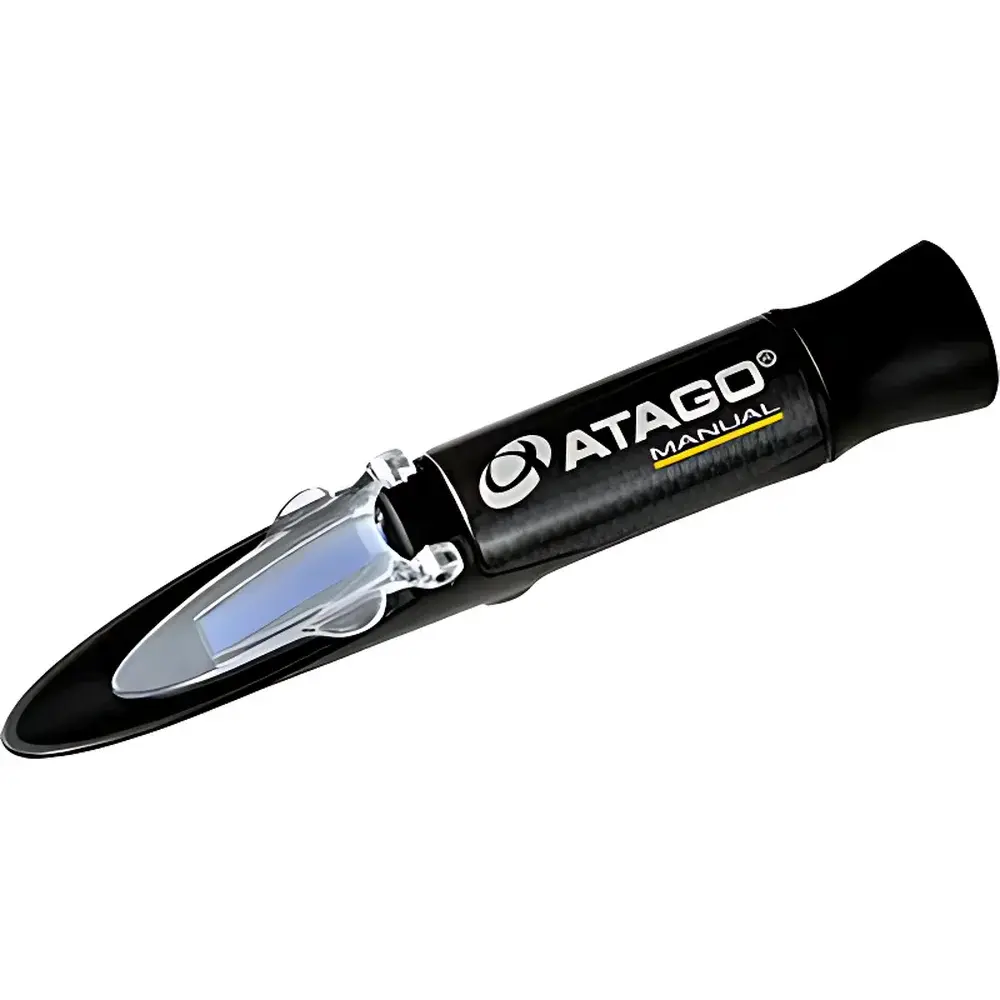
MASTER-BR Coolant Refractometer
| Origin | Japan |
|---|---|
| Manufacturer Type | Distributor |
| Origin Category | Imported |
| Model | MASTER-BR |
| Price | Upon Request |
| Ethylene Glycol Range | 0–70% w/w, Freezing Point: 0 to −50 °C |
| Propylene Glycol Range | 0–70% w/w, Freezing Point: 0 to −50 °C |
| Scale Division | 5% (glycols), 5 °C (freezing point) |
| Dimensions | 3.2 × 3.4 × 16.8 cm |
| Weight | 90 g |
| Optional Accessory | RE-2391-50M Micro-Sample Prism Cover (not for high-viscosity samples) |
| Consumable | RE-2391-59M Dedicated Daylight Plate |
Overview
The MASTER-BR Coolant Refractometer is a handheld, optical precision instrument engineered for rapid, field-deployable quantification of ethylene glycol (EG) and propylene glycol (PG) concentrations in aqueous coolant solutions—commonly used in automotive radiators, HVAC chillers, industrial heat-transfer systems, and battery thermal management units. Based on the principle of critical-angle refractometry, the device measures the refractive index of the sample at 20 °C and converts it directly into mass percentage (w/w %) and corresponding freezing point depression using pre-calibrated, empirically validated scales. Its compact, ergonomic design incorporates corrosion-resistant optics and housing materials specifically selected for resistance to chloride ions and weak organic acids—ensuring long-term stability in demanding maintenance environments where exposure to road salt, antifreeze additives, or acidic condensate is routine.
Key Features
- Optical calibration traceable to NIST-traceable glycol reference standards, supporting routine verification per ISO 21748 and ASTM D1120 guidelines.
- Dual-scale engraved prism plate enabling simultaneous reading of glycol concentration (%) and correlated freezing point (°C) for both ethylene and propylene glycol formulations.
- High-contrast daylight-viewing system with integrated RE-2391-59M dedicated daylight plate, eliminating reliance on artificial illumination and minimizing parallax error during visual interpretation.
- Chemically resistant prism surface and sealed optical path, rated for repeated contact with pH 3–10 glycol-water mixtures without degradation of optical fidelity.
- No batteries or electronics required—fully mechanical operation ensures intrinsic safety in flammable environments and eliminates calibration drift associated with electronic sensors.
- Micro-sample compatibility via optional RE-2391-50M prism cover (recommended for low-volume field checks; not suitable for viscous or particulate-laden coolants).
Sample Compatibility & Compliance
The MASTER-BR is validated for use with homogeneous, particle-free aqueous solutions containing only ethylene glycol, propylene glycol, water, and common corrosion inhibitors (e.g., silicates, azoles, molybdates) at typical OEM formulation concentrations. It is not intended for use with oil-based coolants, glycerol blends, or solutions containing suspended solids, emulsifiers, or >500 ppm total dissolved solids (TDS). The instrument complies with general requirements for portable optical testing devices under ISO 17025-accredited laboratories when operated within specified ambient temperature range (10–30 °C) and relative humidity (<80% non-condensing). While not a regulated medical or pharmaceutical device, its measurement methodology aligns with USP principles for solution clarity assessment in non-sterile industrial applications.
Software & Data Management
As a purely optical, analog measurement instrument, the MASTER-BR does not incorporate embedded firmware, data logging, or digital connectivity. All readings are interpreted visually through the eyepiece and recorded manually. For laboratories requiring audit-ready documentation, users may integrate the MASTER-BR into documented procedures compliant with GLP or GMP frameworks by maintaining logbooks that record operator ID, date/time, sample ID, observed scale values, environmental conditions (ambient temperature/humidity), and verification against control standards. Calibration verification using certified glycol reference solutions (e.g., 30% EG at 20 °C, ±0.2% tolerance) should be performed prior to each shift or daily—whichever is more frequent—in regulated maintenance workflows.
Applications
- Routine preventive maintenance of engine cooling systems across commercial fleets and municipal vehicle depots.
- Commissioning and seasonal verification of glycol concentration in HVAC secondary coolant loops and district heating/cooling networks.
- Quality assurance screening of incoming coolant batches prior to dilution and filling in manufacturing facilities.
- Field service diagnostics for battery thermal management systems in electric vehicles and energy storage installations.
- Educational laboratory demonstrations of colligative properties, refractive index relationships, and freezing point depression thermodynamics.
FAQ
Is the MASTER-BR suitable for measuring methanol or ethanol-based coolants?
No—the engraved scales and calibration curves are specific to ethylene and propylene glycol/water systems. Methanol and ethanol exhibit different refractive index–concentration relationships and cannot be accurately assessed using this instrument.
Can I use the MASTER-BR to test coolant after it has been in service for over two years?
Yes, provided the sample is filtered to remove debris, rust particles, or degraded inhibitor precipitates. Contaminants scatter light and distort the shadow line, leading to inaccurate readings.
Does temperature compensation require manual correction?
The scale is calibrated at 20 °C. Samples deviating significantly from this temperature must be equilibrated or corrected using published temperature compensation tables (e.g., ASTM D1120 Annex A) prior to interpretation.
How often should the prism surface be cleaned?
After every measurement—using lens tissue and reagent-grade isopropyl alcohol—to prevent residue buildup that affects optical clarity and measurement repeatability.
Is the RE-2391-50M micro-sample cover compatible with all MASTER-series refractometers?
It is designed exclusively for MASTER-BR and MASTER-α models with identical prism geometry; it is not interchangeable with MASTER-S or MASTER-HP variants due to dimensional differences in the prism chamber.




