
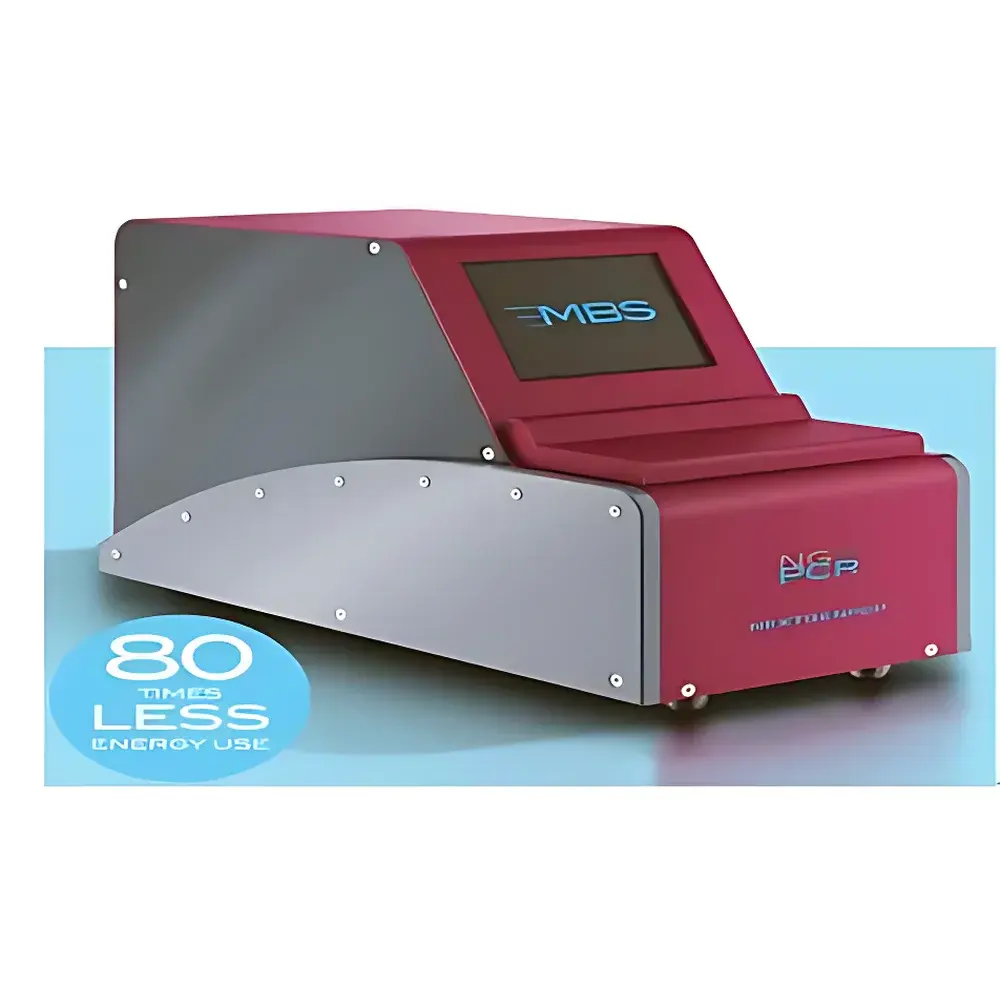
MBS NGPCR Next-Generation Ultra-Fast Thermal Cycler
| Brand | MBS |
|---|---|
| Origin | Netherlands |
| Model | NGPCR |
| Instrument Type | Ultra-Fast PCR Thermal Cycler |
| Sample Throughput | 96-well and 384-well plates |
| Thermal Architecture | Triple independent temperature control modules |
| Heating/Cooling Transition Time | <0.1 s between denaturation and annealing steps |
| Typical Cycle Time (100 bp amplicon) | 2 minutes for 30 cycles |
| Daily Throughput Capacity | Up to 80 × 384-well plates under optimal operational conditions |
Overview
The MBS NGPCR Next-Generation Ultra-Fast Thermal Cycler represents a fundamental re-engineering of thermal cycling architecture for polymerase chain reaction (PCR). Unlike conventional instruments relying on single-zone Peltier-based heating/cooling with inherent thermal inertia, the NGPCR employs a patented triple-module thermal control system—comprising independently regulated denaturation, annealing, and extension zones—each optimized for rapid heat transfer via direct conductive coupling to the plate base. This architecture eliminates thermal ramp delays by maintaining discrete, stable temperature setpoints across spatially segregated zones; samples transition between temperatures via precise mechanical translation rather than sequential heating/cooling of a shared block. As a result, the instrument achieves sub-100-millisecond thermal transitions between denaturation (95 °C) and annealing (55–65 °C), decoupling cycle time from physical thermal mass limitations. The kinetic bottleneck of PCR is thus shifted entirely to the biochemical kinetics of DNA polymerase activity—not instrument thermodynamics—enabling routine 30-cycle amplification of 100 bp targets in ≤120 seconds.
Key Features
- Triple independent thermal control modules enabling simultaneous maintenance of three distinct temperature zones (e.g., 95 °C / 60 °C / 72 °C) with ±0.1 °C stability
- Conductive thermal transfer design minimizing thermal lag; no forced-air or liquid cooling required
- Automated plate translation mechanism ensuring precise, repeatable positioning across thermal zones with positional accuracy <±5 µm
- Real-time block temperature monitoring via embedded platinum resistance thermometers (Pt1000) at each zone
- Programmable gradient capability across annealing zone (±5 °C over 384-well footprint)
- Integrated humidity control (40–60% RH) to prevent evaporation during ultra-short cycles
Sample Compatibility & Compliance
The NGPCR supports standard ANSI/SBS-compliant 96-well and 384-well PCR plates—including low-profile, skirted, and semi-skirted formats—as well as tube strips (0.2 mL) via optional adapter trays. All thermal profiles are validated per ISO 13485:2016 for in vitro diagnostic device manufacturing environments and comply with ASTM E2500-13 (Guide for Specification, Design, and Verification of Pharmaceutical and Biopharmaceutical Manufacturing Systems). Data integrity features include full audit trail logging (user, timestamp, parameter changes), electronic signatures per FDA 21 CFR Part 11, and secure export of raw thermal trace files (.csv) and cycle summary reports (.pdf). The system meets IEC 61010-1 safety requirements for laboratory equipment and operates within Class II biosafety cabinet-compatible dimensions.
Software & Data Management
Control and analysis are performed via NGPCR Control Suite v4.x—a Windows-based application supporting method development, remote monitoring, and batch reporting. The software includes built-in validation tools for thermal uniformity mapping (per ISO/IEC 17025), cycle-to-cycle reproducibility assessment, and real-time deviation alerts. All protocol parameters (ramp rates, dwell times, zone offsets) are stored with cryptographic hashing for version control. Raw thermal data is timestamped at 100 Hz resolution and archived with SHA-256 checksums. Export formats include CSV (for LIMS integration), PDF (GLP-compliant certificate of performance), and XML (for automated workflow orchestration via REST API).
Applications
- Routine high-throughput genotyping where turnaround time directly impacts clinical decision windows (e.g., point-of-care infectious disease screening)
- Library preparation for next-generation sequencing requiring rapid target enrichment prior to fragmentation
- qPCR pre-amplification of low-abundance transcripts without bias accumulation from prolonged cycling
- Process analytical technology (PAT) applications in biomanufacturing, including real-time monitoring of plasmid replication kinetics
- Education and training labs requiring visible demonstration of PCR kinetics without thermal artifact interference
FAQ
How does the triple-module design differ from traditional gradient PCR instruments?
Traditional gradient cyclers modulate temperature across a single block using resistive heating elements; the NGPCR uses physically separate, thermally isolated modules—each with dedicated power regulation and sensing—eliminating cross-zone thermal crosstalk and enabling true simultaneous multi-temperature operation.
Is the 2-minute 30-cycle claim dependent on specific enzyme formulations?
Yes—the stated performance assumes use of thermostable DNA polymerases engineered for rapid extension kinetics (e.g., engineered Taq variants with kcat > 50 s−1). Standard wild-type Taq will not achieve full cycle compression due to intrinsic enzymatic rate limits.
Can the NGPCR be integrated into automated liquid handling workflows?
Yes—it supports standard RS-232, USB CDC, and Ethernet (TCP/IP) interfaces with SCPI command set compliance, enabling seamless integration with Hamilton STAR, Tecan Freedom EVO, and Opentrons OT-2 platforms.
What maintenance is required beyond routine calibration verification?
No consumable parts or coolant replenishment is required. Annual verification of thermal uniformity (per ISO/IEC 17025 Annex B) and positional repeatability is recommended; all calibrations are traceable to NIST-certified reference standards.





