
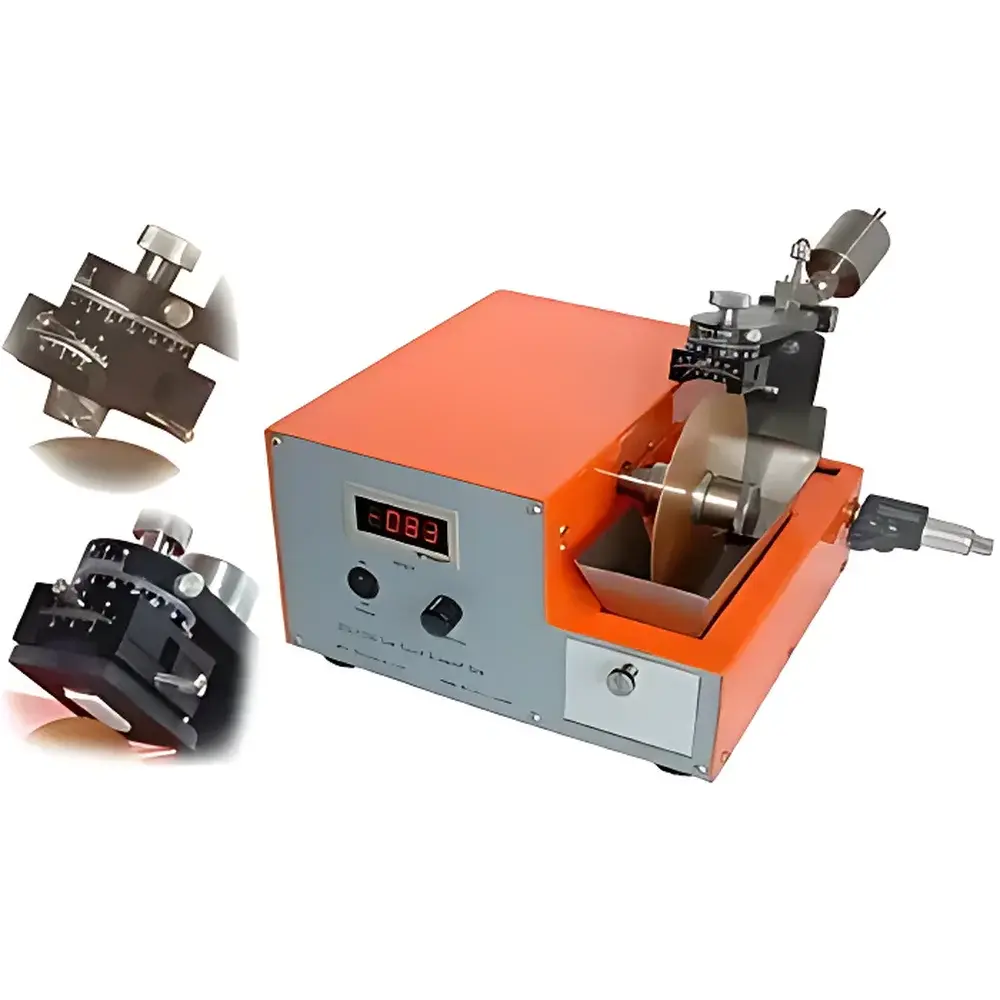
MC004-SYJ-160 Low-Speed Diamond Precision Cutting Machine
| Origin | Shanghai, China |
|---|---|
| Manufacturer Type | Authorized Distributor |
| Country of Origin | China |
| Model | MC004-SYJ-160 |
| Voltage | 110 V / 220 V AC |
| Speed Range | 20–600 rpm (infinitely variable) |
| Feed Positioning Accuracy | 0.01 mm (mechanical and digital display) |
| Horizontal Rotation | 360° |
| Vertical Tilt | ±15° |
| Maximum Travel | 50 mm (fine-adjustment range: 25 mm) |
| Max Blade Diameter | 150 mm (6 in) |
| Auto-Cut Termination | Yes |
| Digital Spindle RPM Display | Yes |
| Net Weight | 14.5 kg |
| Dimensions (L×W×H) | 400 × 300 × 300 mm |
Overview
The MC004-SYJ-160 Low-Speed Diamond Precision Cutting Machine is an engineered solution for controlled, low-stress sectioning of brittle, hard, or heterogeneous materials in research and quality control laboratories. Designed around the principle of low-speed abrasive cutting—minimizing thermal damage, micro-cracking, and edge chipping—the system employs precision-machined mechanical feed mechanisms and rigid kinematic alignment to ensure dimensional fidelity during sample preparation. Unlike high-speed abrasive saws, this machine operates at rotational speeds between 20 and 600 rpm, enabling optimal diamond grit engagement with minimal heat generation—a critical requirement for preserving crystallographic integrity in single crystals, optical ceramics, geological specimens, and advanced composites. Its modular architecture supports reproducible cross-sectional slicing for subsequent analysis via SEM, XRD, metallography, or thin-film deposition workflows.
Key Features
- Infinitely variable speed control (20–600 rpm) for optimized cutting performance across diverse material classes—from sapphire and silicon carbide to PCB laminates and refractory concretes.
- Mechanical + digital micrometer feed system with 0.01 mm resolution, supporting both tactile repeatability and traceable digital logging of cut depth.
- Full 360° horizontal rotation and ±15° vertical tilt capability for angular sectioning, oblique polishing prep, and multi-plane orientation studies.
- Automated cut termination logic: motor stops automatically upon reaching preset travel limit—enabling unattended operation under supervised lab conditions.
- Dual-mode spindle RPM monitoring: real-time digital display ensures process consistency and facilitates correlation between rotational velocity and surface finish metrics.
- Structural rigidity enhanced by cast-aluminum base and vibration-damped mounting—critical for maintaining kerf width stability (< 0.6 mm typical with standard 150 mm diamond blades).
Sample Compatibility & Compliance
The SYJ-160 accommodates a broad spectrum of solid-state samples requiring non-destructive sectioning: single-crystal substrates (e.g., LiNbO₃, GaN), technical ceramics (Al₂O₃, ZrO₂), optical glasses, geological cores (granite, basalt, shale), metallurgical alloys (Ti-6Al-4V, Inconel), polymer composites, and printed circuit boards. All standard and optional blades conform to ISO 527-2 (plastics), ASTM C1327 (advanced ceramics), and ASTM D792 (density-based material verification). The machine’s mechanical design complies with IEC 61000-6-2 (EMC immunity) and IEC 61000-6-4 (EMC emission) standards. While not certified for GMP production environments, its repeatable feed mechanism and digital traceability support GLP-aligned documentation when integrated into validated sample prep SOPs.
Software & Data Management
The MC004-SYJ-160 operates as a standalone electromechanical instrument without embedded firmware or network connectivity. However, its digital micrometer output is compatible with third-party analog-to-digital acquisition modules (e.g., National Instruments USB-6009) for time-synchronized logging of feed position vs. spindle RPM. Users may integrate cutting parameters—including start/stop timestamps, total revolutions, and manual feed increments—into LIMS or ELN platforms via CSV export from external DAQ software. Audit trails are maintained through operator-entered batch IDs recorded alongside physical logbooks—a practice aligned with FDA 21 CFR Part 11 principles when combined with controlled access protocols and electronic signature validation.
Applications
- Preparation of TEM lamellae and SEM cross-sections from bulk semiconductor wafers and MEMS devices.
- Sectioning of geological thin sections for petrographic microscopy and geochemical mapping.
- Isolation of representative subsamples from heterogeneous construction materials (e.g., fiber-reinforced concrete, asphalt binders).
- Cutting of optical-grade crystals for laser cavity fabrication and nonlinear optics characterization.
- Controlled segmentation of battery electrode stacks for post-cycling interface analysis.
- Routine QC slicing of sintered ceramic components prior to density and porosity testing per ISO 18755.
FAQ
What blade types are supported, and how do they differ in application?
Standard configuration includes edge-bonded diamond (0.55 mm thickness), electroplated diamond (0.40 mm), silicon carbide (0.40 mm), and aluminum oxide (0.40 mm) blades—each selected for specific hardness/toughness ratios. Edge-bonded blades offer longest life on ultra-hard crystals; electroplated variants provide sharper initial cut quality on plastics and soft metals.
Can the machine perform multi-layer or parallel cuts?
Yes—optional spacer shims (custom-designed per customer specification) enable precise blade-to-blade spacing for simultaneous multi-slice sectioning of stacked samples such as wafer-level packaging or layered battery electrodes.
Is calibration traceable to national standards?
The digital micrometer is factory-calibrated against NIST-traceable gauge blocks; recalibration intervals are recommended every 12 months or after 500 operational hours, using certified 0.01 mm step gauges.
Does it meet electrical safety requirements for EU or North American labs?
The unit carries CE marking per EN 61000-6-2/6-4 and complies with UL 61010-1 (Edition 3) for laboratory electrical equipment when operated within specified voltage tolerances (±10%) and ambient temperature (15–30°C).
How is sample mounting secured during low-speed cutting?
Standard fixtures include adjustable 2D clamps, graphite backing blocks (50 × 50 × 12 mm), and wax-adhesive mounting on aluminum carrier plates—ensuring zero slippage even at sub-50 rpm feed rates on polished crystal surfaces.



