
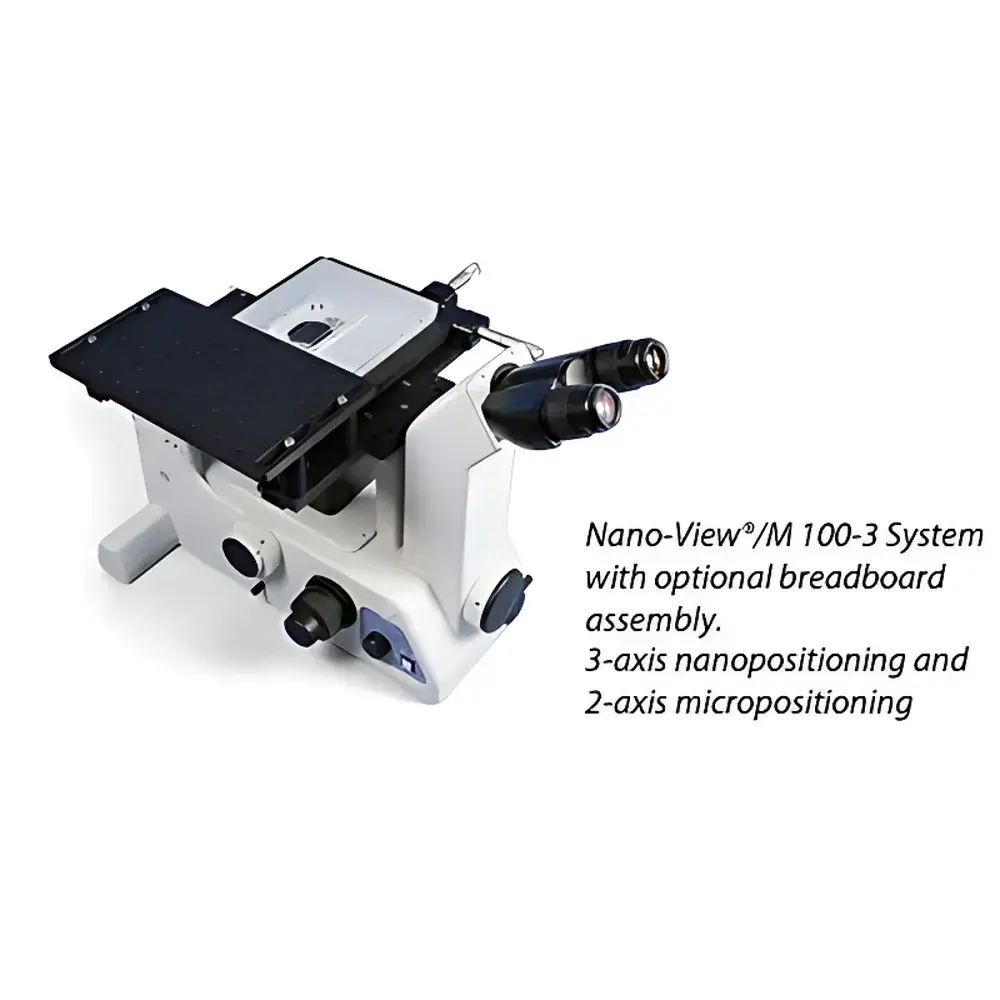
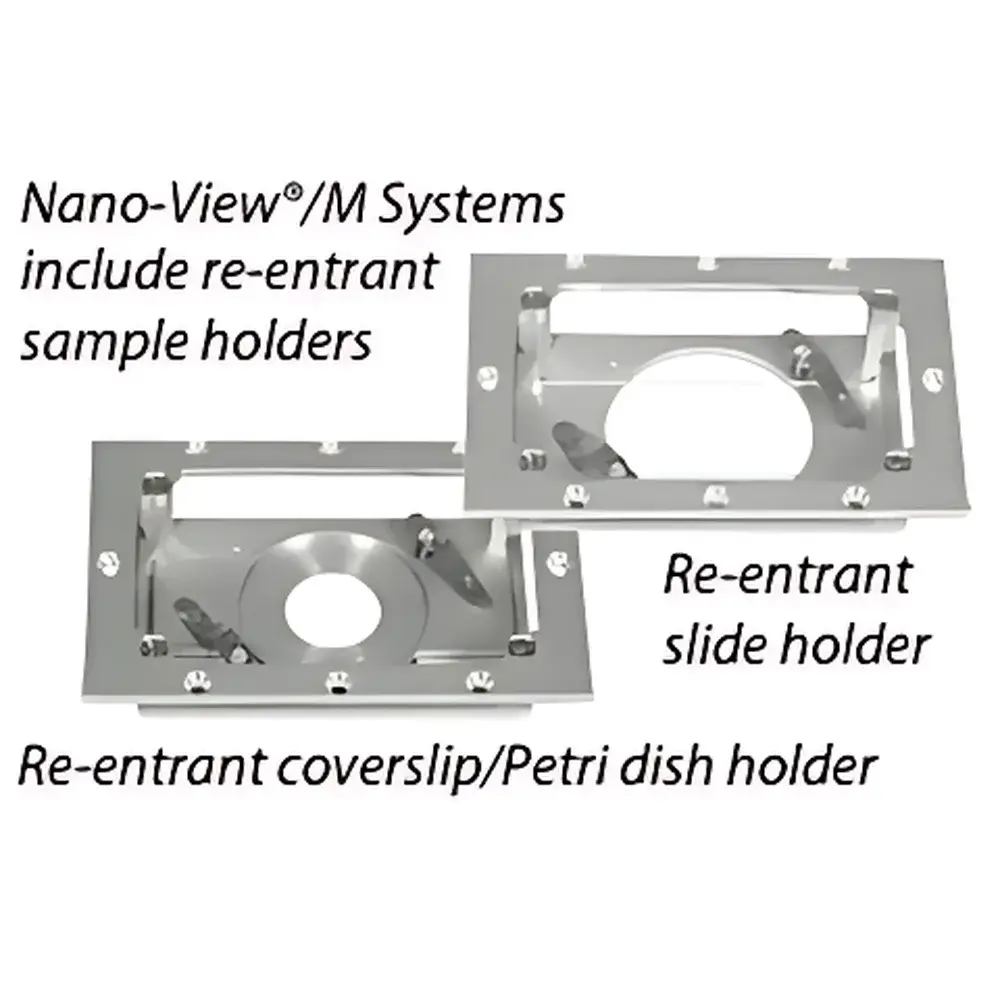
MCL Nano-View®/M Series Integrated Nanopositioning and Micropositioning Translation Stage
| Brand | MCL Think Nano |
|---|---|
| Origin | USA |
| Model | Nano-View®/M Series |
| Type | Motorized Translation Stage |
| Positioning Architecture | Hybrid Manual Micropositioning + Piezoelectric Nanopositioning (Closed-Loop) |
| Axes | XY or XYZ |
| Nanopositioner Range | Up to 300 µm per axis |
| Nanopositioner Resolution | 0.1–0.6 nm (model-dependent) |
| Micropositioner Range | 25 mm (X/Y), Graduation: 1 µm vernier |
| Stiffness | 1.0 N/µm |
| Angular Deviation (θ roll/pitch/yaw) | ≤1 µrad / ≤1 µrad / ≤3 µrad |
| Max Horizontal Load (nanopositioner) | 0.5 kg (low-profile), 100 g (high-speed) |
| Controller | Nano-Drive® |
| Software Compatibility | LabVIEW API, Native SDK |
| Microscope Compatibility | Olympus IX/IX2, Nikon TE2000/Ti, Leica DMI, Zeiss Axiovert/Axio Observer, RM21™ Platform |
| Sensor Technology | Proprietary PicoQ® Absolute Position Sensing |
| Mounting Options | Standard 1/4"-20 (1" grid) or M6 (25 mm grid) threaded breadboard interface |
Overview
The MCL Nano-View®/M Series is a purpose-engineered hybrid translation stage system designed for high-precision optical microscopy applications requiring both coarse manual positioning and sub-nanometer closed-loop nanopositioning. Built on a modular, inverted-microscope-integrated architecture, the system combines a robust 25 mm manual micropositioning stage with ultra-low-profile or ultra-high-speed piezoelectric nanopositioners—enabling seamless transition from macro-alignment to nanoscale manipulation without mechanical reconfiguration. Its operational principle relies on capacitive or strain-gauge-based PicoQ® position sensors embedded directly within each piezo actuator, delivering absolute, drift-free, repeatable position measurement traceable to metrological standards. The stage’s mechanical design prioritizes thermal stability and minimal parasitic motion: angular deviations are constrained to ≤1 µrad (roll/pitch) and ≤3 µrad (yaw), while stiffness is maintained at 1.0 N/µm across all axes—critical for maintaining focus stability during long-duration single-molecule tracking or super-resolution imaging.
Key Features
- Hybrid positioning architecture: 25 mm manual XY micropositioning (1 µm vernier resolution) integrated with piezoelectric nanopositioners offering 100–300 µm range (XY) and up to 50–300 µm (Z)
- Closed-loop control enabled by proprietary PicoQ® absolute position sensors—no homing required, no hysteresis-induced error accumulation
- Ultra-low-profile nanopositioner variant adds only marginally more height than standard manual XY stages—preserving working distance and optical access
- High-speed nanopositioner option supports resonant frequencies up to 1 kHz (±20%) for dynamic scanning applications such as high-frame-rate confocal line scanning or adaptive optics feedback loops
- Stable 10 N blocking force per coarse axis ensures mechanical rigidity during nanopositioner actuation, minimizing base deformation under load
- Modular mounting interface: optional breadboard assembly with standardized 1/4″-20 (1-inch grid) or M6 (25 mm grid) threading for probe integration or custom optical train extension
- Material options include aluminum (lightweight), Invar (low thermal expansion), and titanium (high strength-to-density ratio) to match application-specific environmental and loading requirements
Sample Compatibility & Compliance
The Nano-View®/M Series is validated for direct integration with major inverted microscope platforms—including Olympus IX/IX2, Nikon TE2000/Ti, Leica DMI, Zeiss Axiovert and Axio Observer series, and the Mad City Labs RM21™ platform—ensuring mechanical and optical alignment fidelity without third-party adapters. All nanopositioner variants comply with ISO 20957-4 (fitness-for-purpose of laboratory equipment) and meet electromagnetic compatibility (EMC) requirements per IEC 61326-1 for laboratory use. Closed-loop sensor data logging supports audit-ready operation under GLP and GMP frameworks when paired with Nano-Drive® controller firmware v3.2+, which implements timestamped position history with configurable sampling (up to 10 kHz) and supports 21 CFR Part 11-compliant electronic signatures via optional LabVIEW-based validation packages.
Software & Data Management
The system ships with the Nano-Drive® controller, featuring USB 2.0 and Ethernet interfaces, real-time PID tuning, and multi-axis synchronization triggers. A native LabVIEW driver suite (NI LabVIEW 2018–2023 compatible) provides full API access to position setpoints, sensor feedback, voltage outputs, and error flags. Raw position data is streamed in IEEE 754 double-precision format with microsecond-level timestamping, enabling correlation with external detectors (e.g., APDs, sCMOS cameras). For automated workflows, Python and MATLAB wrappers are available through MCL’s open-source SDK. Data export supports HDF5 and CSV formats, with metadata embedding compliant with FAIR principles (Findable, Accessible, Interoperable, Reusable) for reproducible microscopy experiments.
Applications
- Super-resolution microscopy: STORM and PALM imaging requiring precise, drift-corrected stage scanning with 10-minute acquisitions
- Single-molecule fluorescence spectroscopy: Nanometer-accurate sample repositioning between excitation spots while preserving focal plane integrity
- Confocal and multiphoton imaging: High-speed Z-stack acquisition using high-resonance nanopositioners synchronized to galvo or resonant scanners
- Nanomanipulation and nanofabrication: Coordinated XY/Z motion for AFM tip guidance, optical tweezer trapping, or maskless lithography alignment
- Particle tracking and dynamic localization microscopy: Sub-pixel trajectory reconstruction enabled by real-time closed-loop correction of stage drift
- Correlative light-electron microscopy (CLEM): Precise coordinate mapping between optical ROI and SEM/FIB targeting coordinates
FAQ
What microscope models does the Nano-View®/M support out-of-the-box?
Standard configurations are certified for Olympus IX/IX2, Nikon TE2000/Ti, Leica DMI, Zeiss Axiovert/Axio Observer, and Mad City Labs RM21™ platforms. Custom mechanical interfaces for non-standard stands or optical tables are available upon engineering consultation.
Can the Nano-View®/M operate in vacuum or controlled atmosphere environments?
Yes—Invar and titanium body variants are qualified for operation in dry nitrogen or argon environments; vacuum-compatible versions (10⁻⁶ mbar) with ceramic-insulated actuators and low-outgassing adhesives are offered as engineered options.
Is third-party software integration supported beyond LabVIEW?
The Nano-Drive® controller exposes a documented TCP/IP command protocol and REST-like JSON API, enabling integration with Micro-Manager, Python-based acquisition engines (e.g., PycroManager), and custom C++/C# applications.
How is calibration traceability ensured for nanopositioner displacement?
Each PicoQ® sensor undergoes factory calibration against NIST-traceable interferometric standards. Calibration coefficients are stored in non-volatile memory and applied in real time—no user recalibration is required under normal operating conditions.
What maintenance is required for long-term sub-nanometer performance?
No scheduled maintenance is required. The piezoelectric elements and PicoQ® sensors are solid-state with no moving parts; annual verification of positional repeatability (per ASTM E2544 Annex A3) is recommended for regulated environments.





