
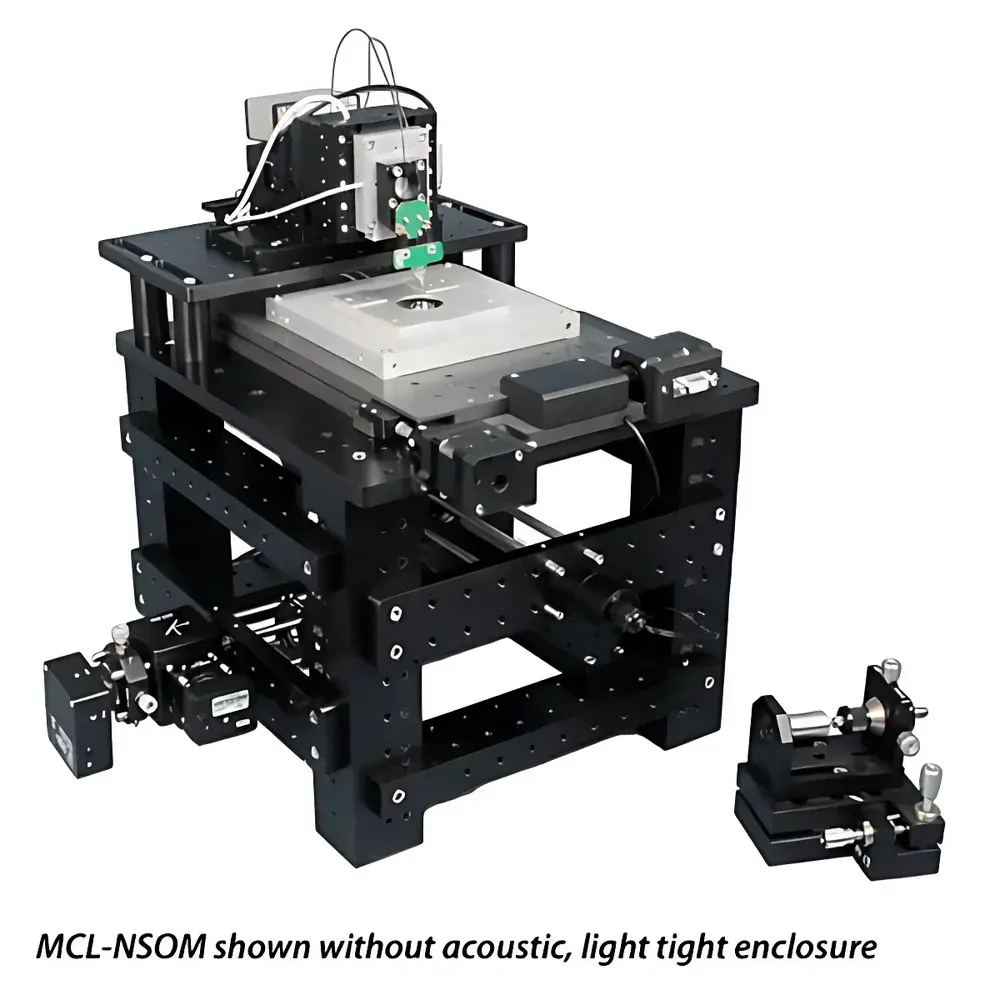
MCL-NSOM Near-Field Scanning Optical Microscope
| Brand | MCL Think Nano |
|---|---|
| Origin | USA |
| Manufacturer Type | Authorized Distributor |
| Origin Category | Imported |
| Model | MCL-NSOM |
| Instrument Type | Materials-Focused NSOM System |
| Positioning Noise | X-Y ≤ 0.15 nm RMS, Z = 35 pm RMS |
| Typical Imaging Bandwidth | 625 Hz |
| Sample Dimensions | Ø ≤ 15 mm, Thickness ≤ 5 mm |
| Sample Stage Travel Range | Ø ≤ 15 mm, Thickness ≤ 5 mm |
| XY Micropositioner Range | 25 mm |
| Z Lens Micropositioner Range | 50 mm |
| Fiber XYZ Micropositioner Range | 25 mm |
| Micropositioner Step Size | 95 nm |
| Piezo Nanopositioner Range (XYZ) | 200 µm × 200 µm × 30 µm |
| Piezo Resolution | 0.4 nm (XY), 0.06 nm (Z) |
| Piezo Step Size | 0.2 nm (XY), 0.03 nm (Z) |
| Excitation Source | 635 nm, 5 mW laser diode with fiber coupling |
| Objective | 20× oil immersion, 0.4 NA, infinity-corrected |
| Detection | Avalanche photodiode (200–1000 nm, 1 mm active area) |
| Alignment Camera | 0.3 MP CMOS |
| Feedback Mode | Shear-force |
| NSOM Modes | Illumination, Collection, Illumination+Collection, Reflection, Reflection+Collection |
| Control Software | AFMView™ and LabVIEW™-based automation suite |
| Controller Interfaces | USB 2.0, 20-bit DAC/ADC, 4-channel TTL I/O |
| Operating System Compatibility | Windows Vista/7/8/10 |
Overview
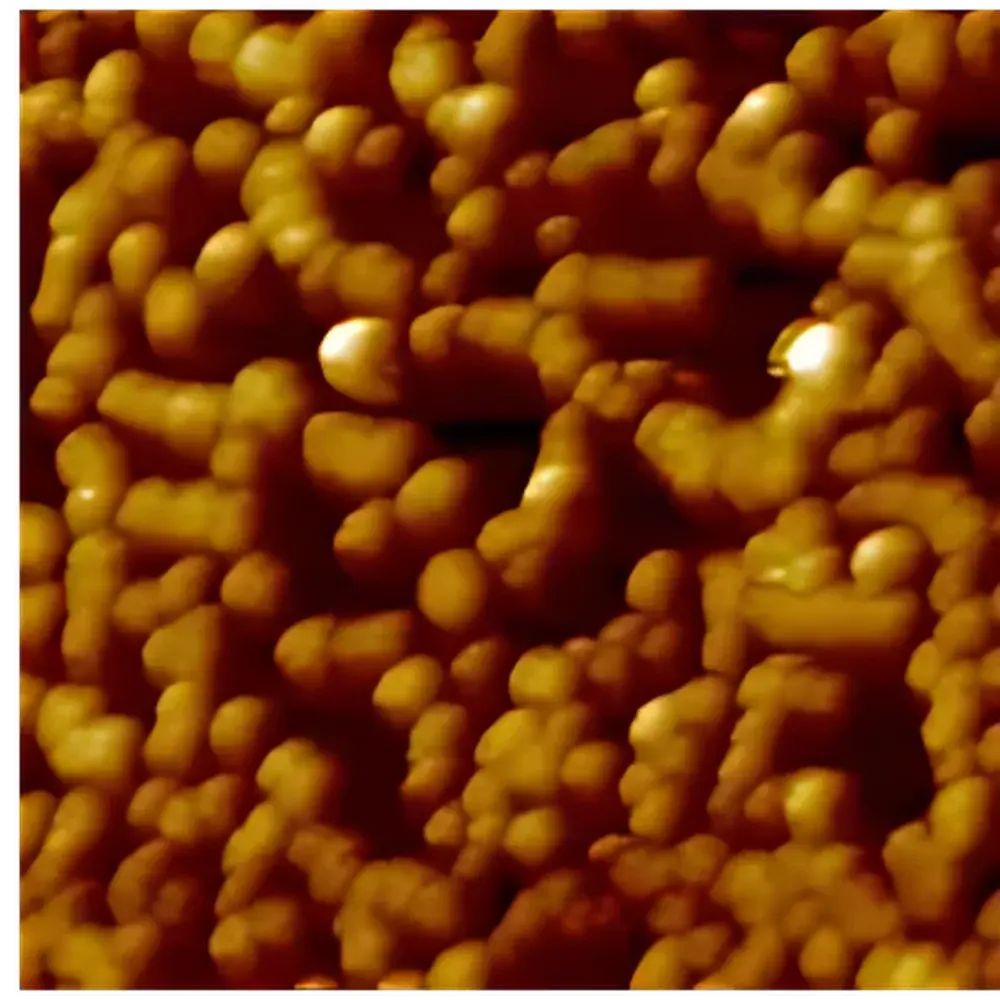
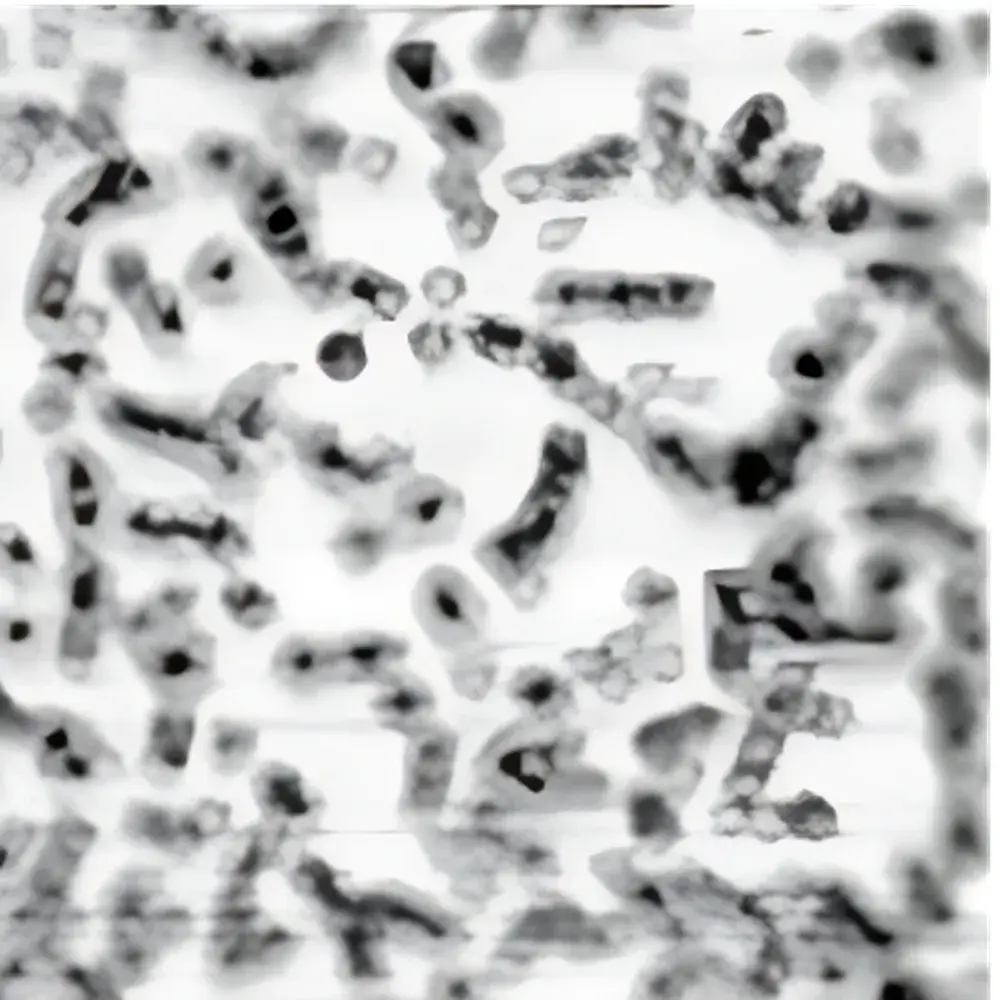
The MCL-NSOM Near-Field Scanning Optical Microscope is a high-precision, fully integrated platform engineered for nanoscale optical imaging beyond the diffraction limit. Based on the RM21™ inverted optical microscope architecture, it enables seamless multimodal operation—switching between aperture-mode near-field scanning optical microscopy (NSOM), atomic force microscopy (AFM), and widefield fluorescence or epifluorescence microscopy within a single instrument configuration. Its core measurement principle relies on evanescent field coupling via sub-wavelength apertures or apertureless scattering probes, combined with shear-force feedback for non-contact topographic stabilization at nanometer-scale standoff distances. The system is designed for rigorous materials science, nanophotonics, and life science applications where spatial resolution down to ~50 nm and quantitative optical contrast are required under ambient or controlled environmental conditions.
Key Features
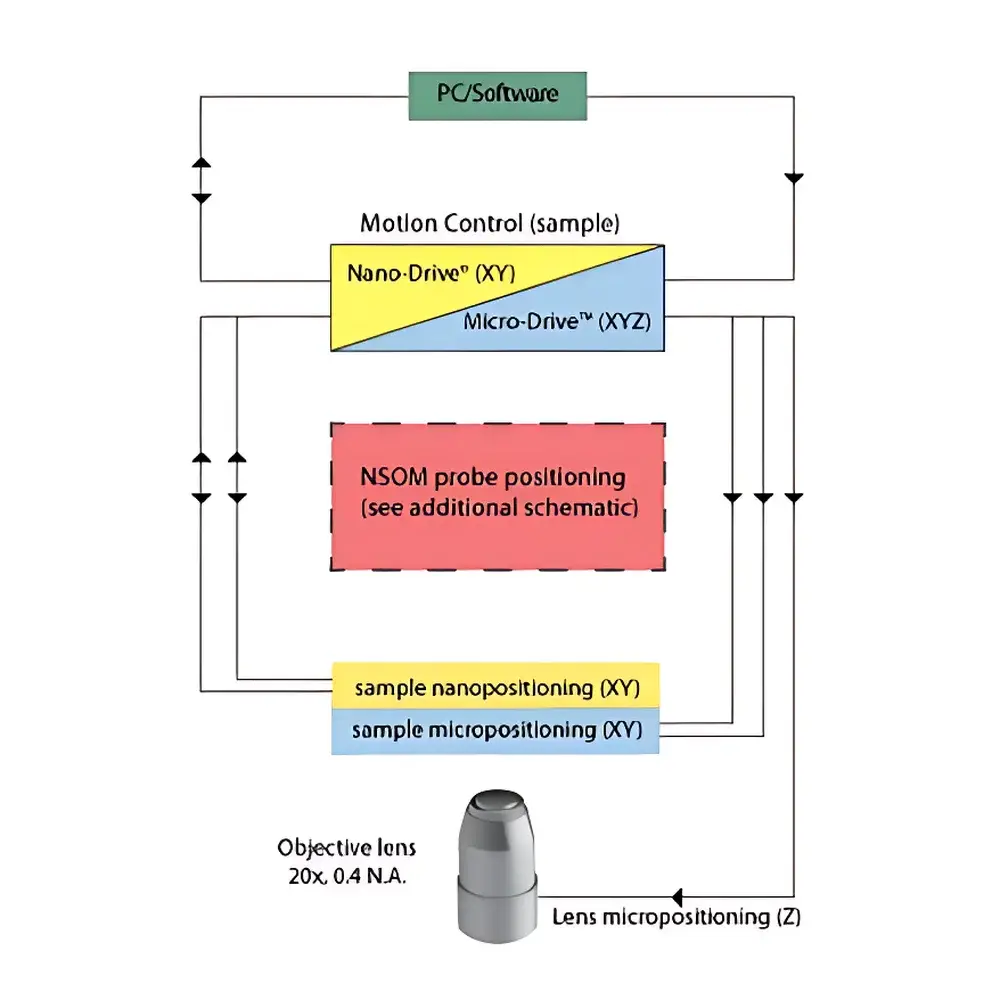
- Six-axis motorized positioning system (sample + probe) enabling precise alignment and reproducible approach sequences
- Closed-loop XYZ piezo nanopositioning stage with 0.4 nm XY resolution and 0.06 nm Z resolution, ensuring exceptional positional fidelity and thermal drift compensation
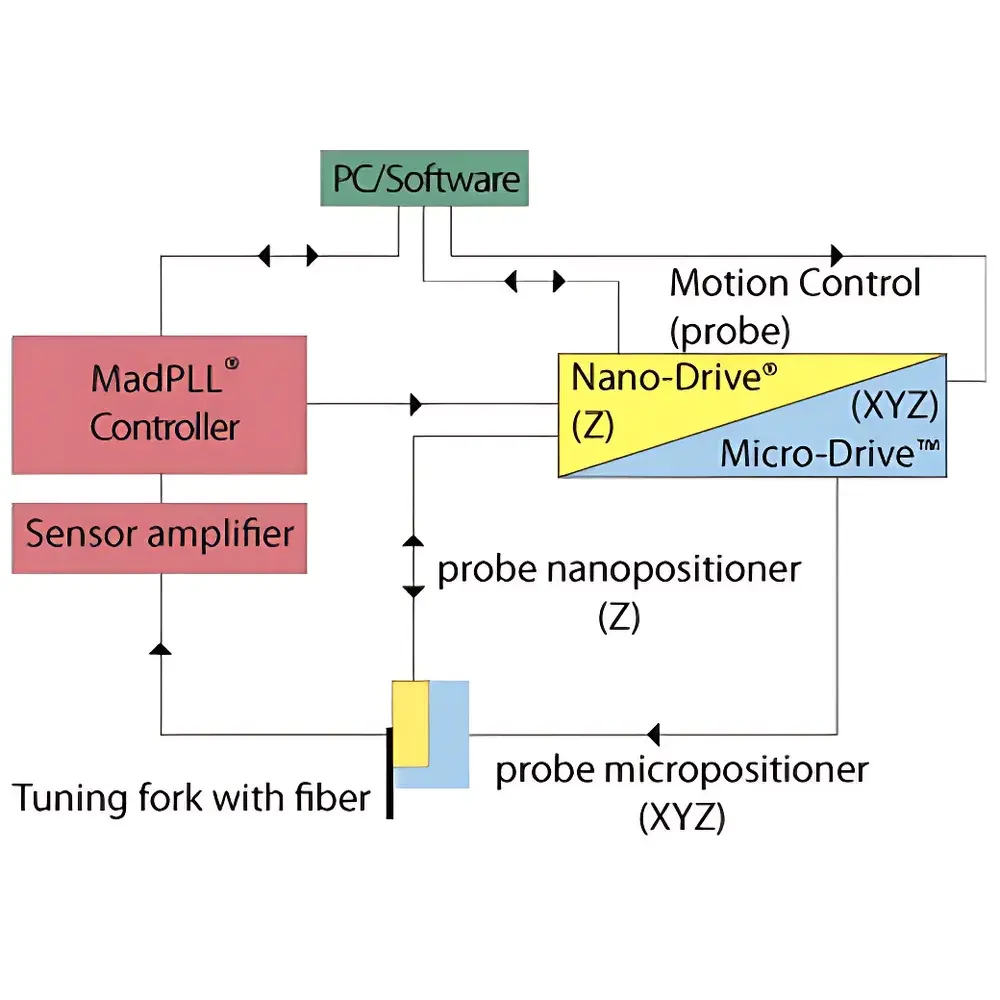
- Integrated MadPLL® phase-locked loop controller for stable, low-noise shear-force oscillation detection and real-time feedback regulation
- Dedicated fiber launch optics, 635 nm excitation source (5 mW), and high-sensitivity avalanche photodiode (APD) detector (200–1000 nm spectral range, 1 mm active area)
- Coaxial LED illuminator and 0.3 MP CMOS alignment camera for rapid probe-to-optical-axis registration
- 20× oil-immersion objective lens (0.4 NA, infinity-corrected) optimized for efficient far-field coupling and minimal background interference
- Modular hardware design compliant with ISO/IEC 17025 traceability frameworks; supports GLP/GMP-aligned data acquisition workflows when paired with validated LabVIEW™ software modules
Sample Compatibility & Compliance
The MCL-NSOM accommodates standard optical substrates including glass coverslips, silicon wafers, and conductive ITO-coated slides. Samples must be ≤15 mm in diameter and ≤5 mm in thickness to ensure compatibility with the inverted optical path and stage travel envelope. The system meets mechanical stability requirements outlined in ASTM E2533–19 for scanning probe instrumentation and conforms to electromagnetic compatibility (EMC) standards per FCC Part 15 Subpart B and IEC 61326-1. All motion control firmware implements audit-trail logging in accordance with FDA 21 CFR Part 11 guidelines when used with validated software configurations. No vacuum or cryogenic infrastructure is required—operation is optimized for ambient laboratory environments.
Software & Data Management
Instrument operation is managed through AFMView™—a cross-platform application providing intuitive scan parameter definition, real-time signal monitoring, and post-acquisition processing (FFT filtering, line profile extraction, height-normalized optical overlay). Full LabVIEW™ driver support enables custom automation of multi-technique experiments (e.g., simultaneous topography + NSOM + fluorescence mapping). Raw data files are stored in HDF5 format with embedded metadata (timestamp, piezo voltage maps, APD gain settings, laser power calibration), ensuring FAIR (Findable, Accessible, Interoperable, Reusable) compliance. Software packages include built-in tools for spectral deconvolution in near-field spectroscopy mode and batch-processing pipelines compatible with MATLAB and Python (via h5py and NumPy interfaces).
Applications
- Nanoscale mapping of plasmonic hotspots in metallic nanostructures
- Sub-diffraction imaging of membrane protein clusters in fixed and live-cell preparations
- Quantitative characterization of photonic crystal defect modes and waveguide confinement
- Correlative NSOM-AFM studies of polymer phase separation and domain boundaries
- Near-field luminescence spectroscopy of quantum dots and 2D transition metal dichalcogenides
- Reflection-mode NSOM for buried interface analysis in multilayer thin-film devices
FAQ
What NSOM operational modes does the MCL-NSOM support?
It supports five standard aperture-based modes: illumination-only, collection-only, illumination-and-collection, reflection, and reflection-plus-collection—all implemented with shear-force feedback.
Is vacuum or cryogenic operation required?
No. The system operates under ambient atmospheric conditions and is optimized for room-temperature, air- or liquid-environment measurements.
Can the MCL-NSOM be upgraded for apertureless NSOM or tip-enhanced Raman spectroscopy (TERS)?
Yes. The modular fiber launch and tuning fork mounting architecture allows integration of etched tungsten or Au-coated tips; TERS-ready configurations require optional 532 nm or 785 nm laser modules and spectrometer coupling.
What level of software validation is available for regulated environments?
AFMView™ and LabVIEW™ drivers can be deployed under IQ/OQ protocols; full 21 CFR Part 11 compliance requires site-specific validation documentation and electronic signature modules.
How is thermal drift mitigated during long-duration NSOM acquisitions?
Closed-loop piezo stages with real-time position sensing, coupled with active temperature stabilization of the RM21™ baseplate, reduce drift to <0.5 nm/min over 60-minute scans.



