
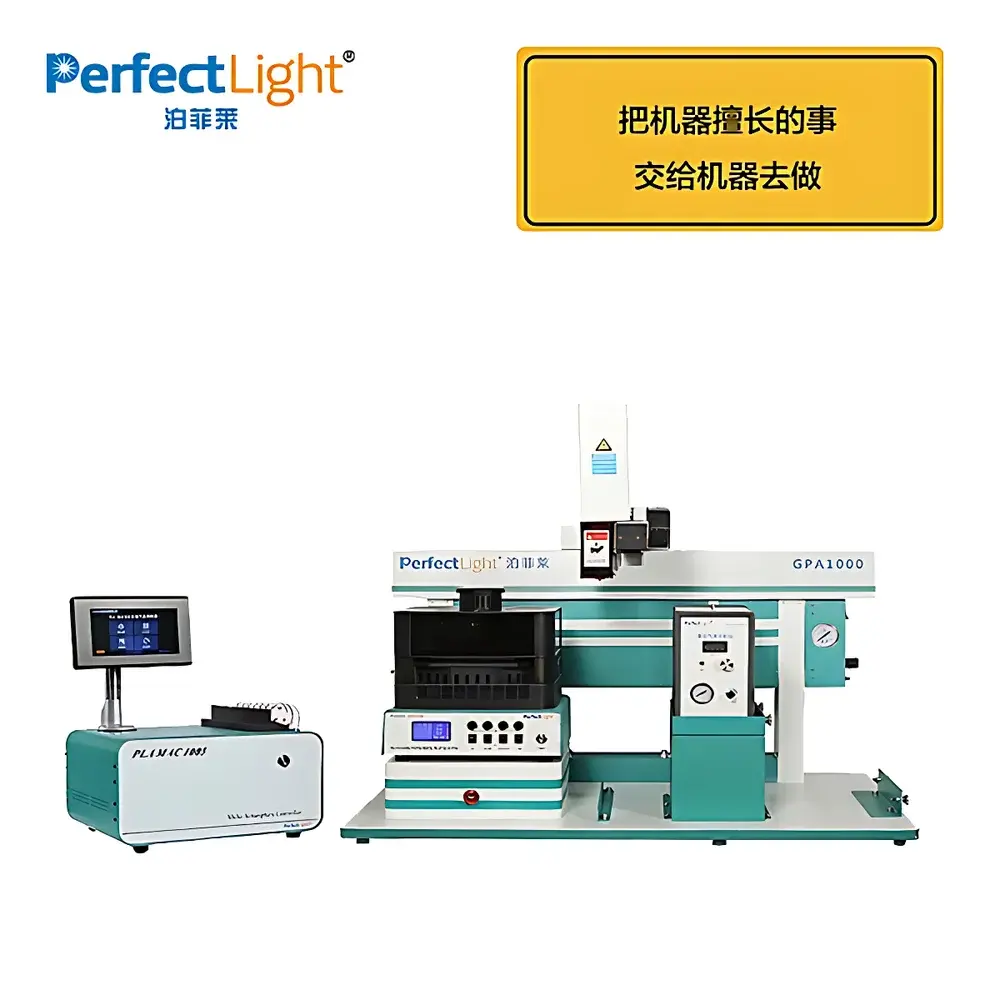
MCP-WS1000 Photocatalytic Reaction Station (PerfetLight)
| Brand | PerfetLight |
|---|---|
| Origin | Beijing, China |
| Model | MCP-WS1000 |
| Temperature Range | 10–80 °C |
| Temperature Control Accuracy | ±0.1 °C |
| Reaction Units | 9 |
| Reaction Vessel Capacity | 50 mL per unit |
| Manufacturer Type | Authorized Distributor |
| Country of Origin | China |
Overview
The MCP-WS1000 Photocatalytic Reaction Station is a benchtop, multi-channel photochemical synthesis platform engineered for high-throughput, reproducible screening of photocatalytic materials under controlled thermal and irradiation conditions. It operates on the principle of simultaneous parallel irradiation of nine independent reaction vessels using calibrated light sources—typically UV–vis or simulated solar irradiation—while maintaining precise temperature regulation across all units via integrated Peltier-based thermostatic control. Unlike single-vessel photoreactors designed for mechanistic validation or kinetic profiling, the MCP-WS1000 is purpose-built for systematic condition-space exploration: varying catalyst composition, co-catalyst loading, sacrificial reagent concentration, pH, dissolved gas content (e.g., Ar, N₂, O₂), and illumination intensity—all within a single experimental run. Its architecture supports both batch-mode and quasi-continuous operation modes, enabling direct correlation between reaction parameters and product formation rates (e.g., H₂, O₂, CO, CH₄) measured offline via GC-TCD/FID or online via integrated gas chromatography modules (optional). The system is not intended for industrial-scale synthesis but serves as a critical hardware layer in materials discovery workflows aligned with the Materials Genome Initiative (MGI) paradigm.
Key Features
- Nine independently controlled reaction channels, each equipped with sealed quartz or borosilicate glass reactors (50 mL nominal volume) compatible with inert-atmosphere purging and vacuum degassing.
- Precise temperature regulation from 10 °C to 80 °C with ±0.1 °C stability across all units, achieved via synchronized Peltier elements and PID feedback loops.
- Modular optical interface supporting interchangeable light sources: 300–800 nm LED arrays, 365 nm UV LEDs, or 150 W Xe arc lamps with adjustable intensity (0–100% stepless dimming).
- Integrated magnetic stirring with speed control (0–1200 rpm) and real-time torque monitoring per channel to ensure homogeneous suspension of heterogeneous photocatalysts.
- Front-panel touchscreen interface with pre-programmed protocols for common photocatalytic assays (e.g., water splitting, CO₂ reduction, dye degradation), plus USB export of time-stamped parameter logs.
- Structural design compliant with IEC 61000-6-3 (EMC emissions) and IEC 61010-1 (safety requirements for laboratory equipment).
Sample Compatibility & Compliance
The MCP-WS1000 accommodates liquid-phase suspensions, colloidal dispersions, and immobilized thin-film catalysts deposited on quartz substrates. Compatible solvents include water, methanol, ethanol, acetonitrile, and mixed aqueous–organic systems; reactor seals are fluoropolymer-lined to resist oxidative degradation under prolonged UV exposure. All wetted parts meet USP Class VI biocompatibility standards. The system supports method development in accordance with ASTM E2533-22 (Standard Guide for Photocatalytic Activity Testing of Semiconductor Oxides) and ISO 22197-1:2021 (Photocatalytic Air Purification Materials). While not certified for GLP or GMP environments, its parameter logging functionality—including operator ID, timestamp, setpoints, and deviations—facilitates audit-ready documentation when paired with validated LIMS integration.
Software & Data Management
The station includes PerfetLight’s PC-based ControlSuite v3.2 software, which enables remote scheduling, real-time parameter visualization (temperature, stir speed, lamp status), and synchronized data capture from external analytical instruments (e.g., GC, MS, UV-Vis spectrophotometers) via RS-232/USB/Modbus TCP. Raw logs are stored in CSV and SQLite formats with SHA-256 checksums for integrity verification. Audit trail features record all configuration changes, user logins, and manual overrides—supporting alignment with FDA 21 CFR Part 11 requirements when deployed with electronic signature modules and role-based access controls (available as optional add-ons). Exported datasets conform to MIAME-compliant metadata schemas for deposition in public repositories such as Figshare or Zenodo.
Applications
- Water Splitting: Quantitative H₂/O₂ evolution kinetics under AM 1.5G illumination; quantum yield determination via actinometry (e.g., potassium ferrioxalate).
- CO₂ Photoreduction: Multi-product analysis (CO, CH₄, C₂H₄, CH₃OH) using isotopically labeled ¹³CO₂ to confirm carbon origin.
- Organic Pollutant Degradation: First-order rate constant estimation for azo dyes (e.g., methyl orange), phenolic compounds, and pharmaceutical residues under visible-light activation.
- Catalyst Screening: Rapid comparative assessment of metal–organic frameworks (MOFs), g-C₃N₄ derivatives, perovskite oxides, and plasmonic nanostructures across >100 condition combinations per 24-hour cycle.
- Stability Testing: Long-term (>100 h) photocorrosion evaluation via periodic TEM/XPS sampling and ion chromatography of leachates.
FAQ
Can the MCP-WS1000 be used for gas-phase photocatalysis?
Yes—when coupled with optional gas recirculation manifolds and humidity-controlled feed lines, it supports VOC oxidation and NOₓ abatement studies under continuous-flow configurations.
Is calibration traceable to national standards?
Temperature sensors are factory-calibrated against NIST-traceable RTDs; irradiance calibration requires separate use of a reference photodiode (e.g., NIST SRM 2257) and is user-performed per ASTM E2737.
Does the system support automated sampling for GC analysis?
Not natively—but third-party robotic liquid handlers (e.g., Hamilton STAR) can be synchronized via TTL triggers and digital I/O ports provided on the rear panel.
What maintenance intervals are recommended?
LED light sources require no recalibration for 5,000 hours; Peltier modules should undergo thermal paste replacement every 24 months; quartz reactor windows must be inspected for UV-induced haze before each experiment series.
Is remote access available outside the local network?
Yes—ControlSuite supports secure HTTPS tunneling through enterprise-grade firewalls when configured with IT-approved reverse proxy servers and TLS 1.3 encryption.



