
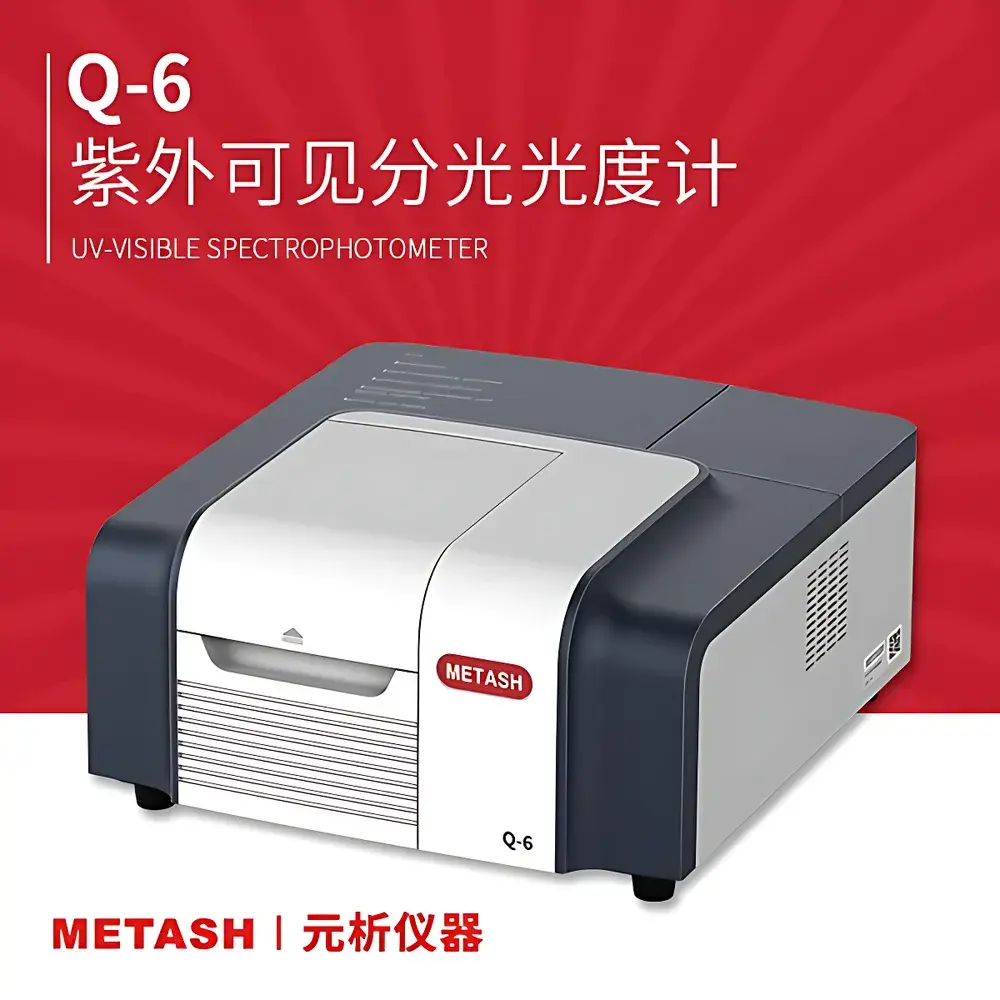
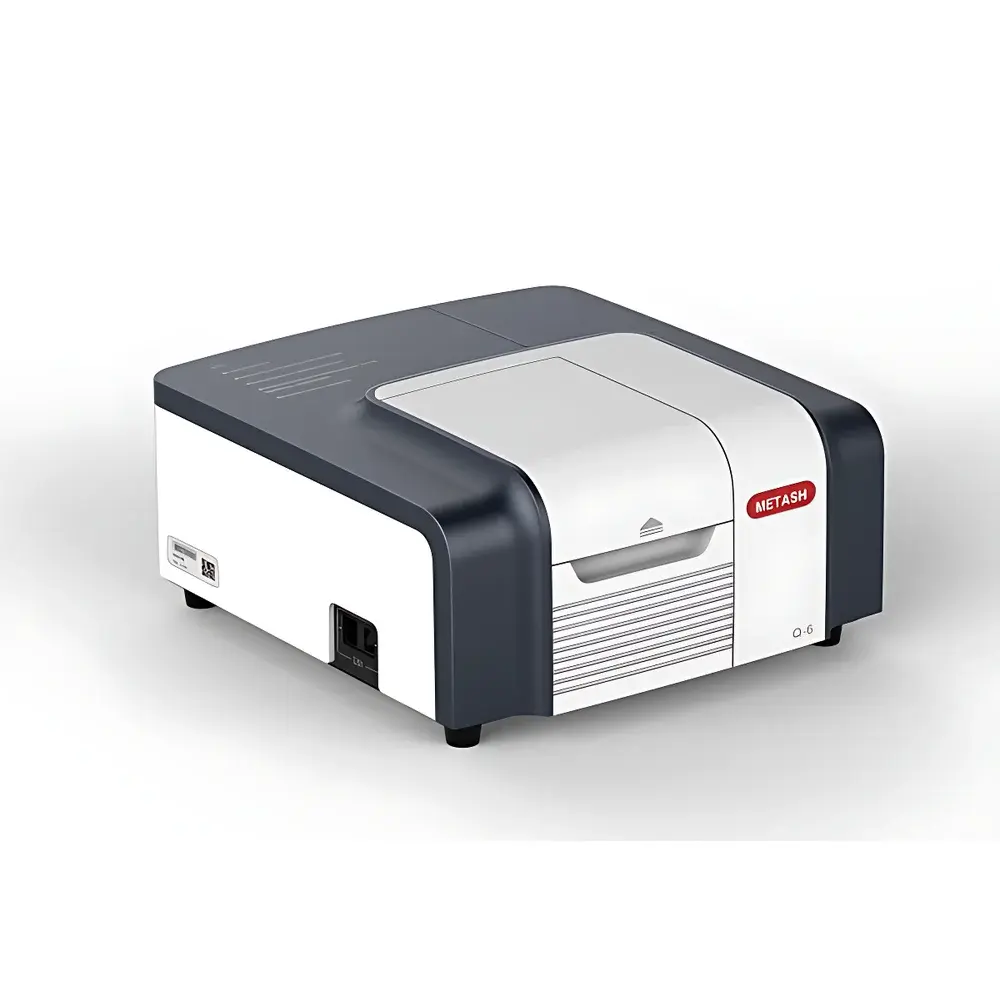
Metash Q-6 Dual-Beam Ultraviolet-Visible Spectrophotometer
| Brand | Metash Instruments |
|---|---|
| Origin | Shanghai, China |
| Manufacturer Type | Direct Manufacturer |
| Model | Q-6 |
| Optical System | Dual-Beam |
| Detector | Photomultiplier Tube (PMT) |
| Wavelength Range | 190–900 nm |
| Wavelength Accuracy | ±0.3 nm |
| Wavelength Repeatability | ≤0.1 nm |
| Spectral Bandwidth | 0.1–5.0 nm (continuously adjustable in 0.1 nm increments) |
| Stray Light | ≤0.005% T |
| Baseline Flatness | ±0.001 Abs |
| Photometric Repeatability | ≤0.1% T |
| Photometric Accuracy | ±0.3% T |
| Stability | ≤0.0001 Abs/h |
| Power Supply | AC 220 V / 110 V, 50/60 Hz, 500 W |
| Dimensions (L×W×H) | 500 × 550 × 260 mm |
Overview
The Metash Q-6 is a high-performance dual-beam ultraviolet-visible (UV-Vis) spectrophotometer engineered for precision absorbance, transmittance, reflectance, and energy measurements across the full spectral range of 190–900 nm. It employs a Czerny-Turner (C-T) monochromator architecture with a double-beam optical path to eliminate baseline drift caused by source intensity fluctuation and thermal-induced refractive index changes in sample solutions. The instrument integrates three calibrated light sources — deuterium (D₂), tungsten-halogen (W), and mercury (Hg) lamps — enabling automatic lamp switching and wavelength validation per pharmacopeial requirements (e.g., USP , EP 2.2.25). Its ultra-low stray light level (≤0.005% T) ensures accurate quantification of highly absorbing or turbid samples, while real-time dark-current auto-correction and computer-optimized optical base design guarantee long-term photometric stability — even under non-laboratory conditions such as mobile or field-deployed setups.
Key Features
- Dual-beam C-T optical system with active beam balancing, minimizing photometric error from lamp aging and thermal drift
- Photomultiplier tube (PMT) detector offering wide dynamic gain range, sub-millisecond response time, and superior signal-to-noise ratio for low-intensity UV detection
- Continuously variable spectral bandwidth (0.1–5.0 nm, adjustable in 0.1 nm steps), supporting both high-resolution spectral profiling and broad-band quantitative analysis
- Integrated Hg lamp for on-board wavelength calibration and verification, compliant with ISO 6425 and ASTM E275 validation protocols
- Modular lamp housing with plug-in D₂ and W lamp units — no optical realignment required during replacement
- Thermally stabilized optical bench with forced-air cooling, achieving thermal equilibrium 20% faster and reducing power consumption by ≥10% versus conventional designs
- Large-access sample compartment accommodating up to 100-mm pathlength cuvettes and third-party accessories without tooling
Sample Compatibility & Compliance
The Q-6 supports liquid, solid, and suspended-phase samples via interchangeable accessories including temperature-controlled cell holders (±0.1 °C stability), integrating spheres (for diffuse reflectance/transmittance), variable-angle solid-sample stages, and 8-position automated cuvette changers. All hardware and firmware comply with GLP and GMP operational frameworks: user authentication (role-based access control), full audit trail logging (ISO/IEC 17025 traceability), electronic signatures (21 CFR Part 11-ready configuration), and source-lamp usage time tracking with reset-on-replacement functionality. Regulatory alignment extends to pharmacopeial methods (USP, EP, JP), environmental standards (EPA Method 450.1), and industrial QC protocols (ASTM D1209, ISO 7887).
Software & Data Management
The Q-6 is operated via Metash SpectraPro™ v4.x — a Windows-based application developed under IEC 62304 medical device software guidelines. It provides eight scan interval options (0.025–5 nm), four scan speed modes, and simultaneous multi-mode display (Abs, %T, %R, E). Quantitative modules support 12 concentration units (mol/L, mg/mL, ppm, ppb, etc.) with polynomial and linear regression, limit-of-detection calculation, and uncertainty propagation per GUM (JCGM 100). Data files are saved in vendor-neutral .csv and .jdx formats; all operations — including autosampler positioning, wash cycles, and calibration sequence execution — are scriptable via ASCII command protocol. Built-in report engine supports PDF export, printer direct output, and customizable templates compliant with laboratory accreditation checklists.
Applications
The Q-6 serves routine and advanced applications across pharmaceutical QC (excipient purity, dissolution testing, content uniformity), environmental monitoring (nitrate, phosphate, COD analysis), food safety (colorant quantification, antioxidant capacity), nanomaterial characterization (plasmon resonance, quantum dot sizing), and academic research (enzyme kinetics, ligand-binding studies, photostability assays). Its 0.1 nm bandwidth resolution enables fine-structure analysis of vibronic transitions in organic dyes, while the 0.0001 Abs/h baseline stability supports extended kinetic runs (>24 h) without recalibration. The instrument’s compatibility with fiber-optic probes and flow cells further extends utility to inline process monitoring and reaction calorimetry integration.
FAQ
Does the Q-6 meet 21 CFR Part 11 requirements for electronic records and signatures?
Yes — when deployed with password-protected user roles, immutable audit logs, and electronic signature activation enabled in SpectraPro™, the system satisfies predicate rule requirements for regulated environments.
Can the Q-6 perform wavelength calibration without external reference materials?
Yes — the integrated mercury lamp provides NIST-traceable emission lines at 253.7, 365.0, 404.7, 435.8, and 546.1 nm for automated self-calibration and verification.
What is the minimum detectable absorbance change under standard operating conditions?
With PMT detector and 1.0 nm bandwidth, the instrument achieves a noise level of ≤0.0002 Abs RMS (0–1 Abs range, 1 s integration), corresponding to a detection limit of ~0.0006 Abs (3σ).
Is the software compatible with LIMS integration?
Yes — SpectraPro™ supports ASTM E1384-compliant data export and optional OPC UA server module for bidirectional communication with major LIMS platforms.
How often does the instrument require preventive maintenance?
Annual optical alignment verification and lamp replacement (D₂: ~1,000 h; W: ~2,000 h; Hg: ~500 h) are recommended; no routine mirror cleaning is required due to sealed optical path design.
Related Products





