
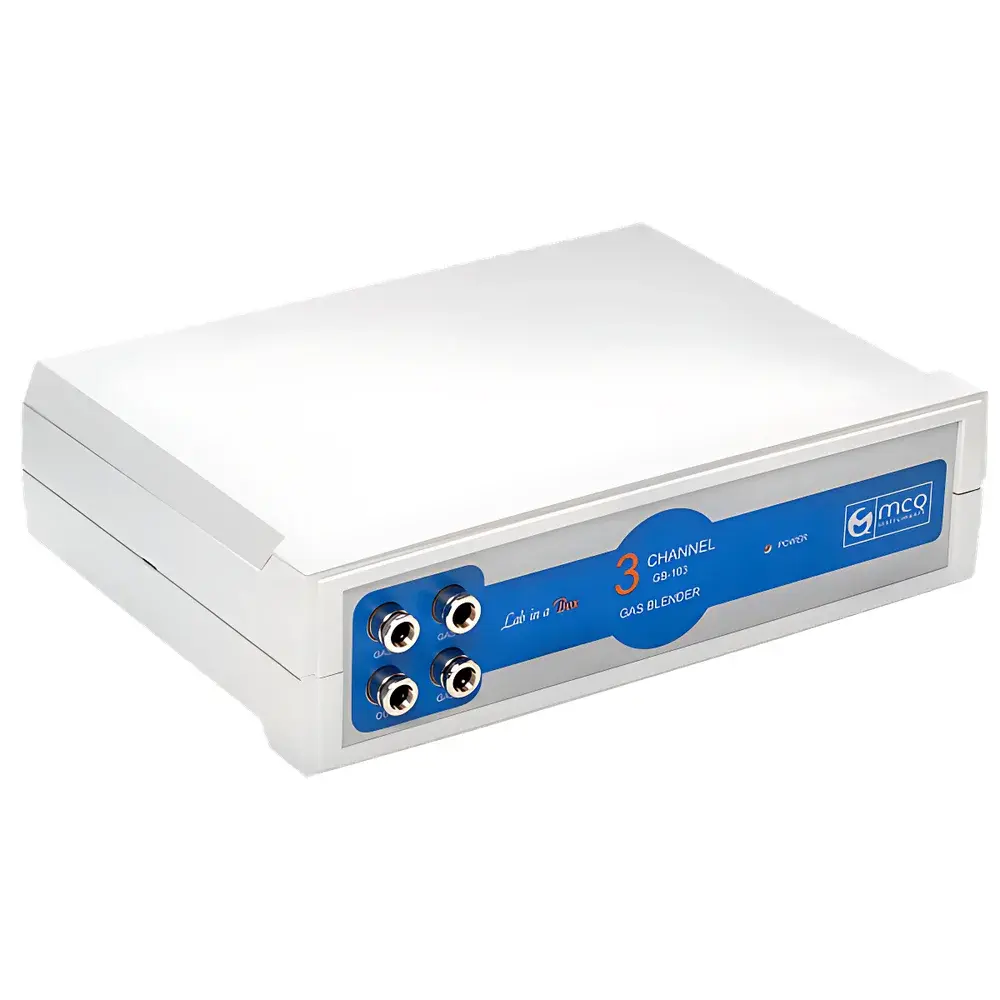
MCQ GB100 Dynamic Gas Dilution System
| Brand | MCQ |
|---|---|
| Origin | Italy |
| Model | GB 100 |
| Flow Range (per channel) | 0–500 mL/min (standard), 0–200 mL/min (optional) |
| Accuracy | ±1.0% of setpoint (5–100% FS), ±0.2% of full scale (<5% FS) |
| Repeatability | ±0.1% of reading |
| Response Time | 50 ms per channel |
| Total Mixed Flow | Up to 1.5 L/min |
| Channels | 3 inlet, 1 outlet |
| Operating Pressure | ≤25 psi |
| Power Supply | 16–36 VDC, min. 1.5 A |
| Operating Temperature | 0–50 °C |
| Gas Compatibility | N₂, O₂, CO₂, CH₄, Air, NO, CO, Ar, C₂H₄, C₂H₆, C₃H₈, C₄H₁₀ (H₂ not supported) |
| Certifications | CE, TÜV, cTÜVus |
| Interface | USB PC connection, LED front-panel display |
| Software | Dedicated gas mixing control software (Windows-based), no third-party API support for GB100 variant |
Overview
The MCQ GB100 Dynamic Gas Dilution System is an engineered solution for precise, real-time generation of calibrated gas mixtures in laboratory and industrial environments. Based on mass flow control principles, the GB100 employs three independently regulated thermal mass flow controllers (MFCs) to deliver stable, traceable dilutions of target analytes into carrier gases—enabling reproducible preparation of standard reference gases for calibration, verification, and method validation. Designed for low-flow applications, it operates across a total mixed output range up to 1.5 L/min with sub-second dynamic response (50 ms per channel), making it suitable for applications requiring rapid concentration transitions—such as dynamic calibration of continuous emission monitoring systems (CEMS), sensor response characterization, and transient exposure studies in toxicology or inhalation research. Its compact architecture, CE/TÜV-certified construction, and Made-in-Italy manufacturing ensure compliance with international safety and electromagnetic compatibility standards (EN 61326-1, EN 61000-6-3), supporting use in GLP-compliant laboratories and ISO/IEC 17025-accredited testing facilities.
Key Features
- Three independent, high-stability thermal MFC channels with factory-calibrated accuracy: ±1.0% of setpoint (5–100% FS) and ±0.2% of full scale below 5% FS
- Exceptional repeatability of ±0.1% of reading—critical for multi-point calibration curves and long-duration stability testing
- Fast dynamic response: 50 ms settling time per channel enables accurate simulation of transient gas concentration profiles
- Dedicated Windows-based control software with intuitive interface for defining multi-step dilution protocols, saving presets, and logging operational parameters
- Integrated LED front-panel display for real-time monitoring of individual channel flows, total output, and system status without PC dependency
- Robust mechanical design with 6–4 mm push-to-connect gas fittings, stainless steel internal wetted parts, and pressure-rated operation up to 25 psi (172 kPa)
- Compliance with key regulatory frameworks: CE marking, TÜV certification (EN 61010-1), and cTÜVus recognition for North American markets
Sample Compatibility & Compliance
The GB100 is validated for use with common non-corrosive, non-reactive, and non-hydrogen gases including nitrogen (N₂), oxygen (O₂), carbon dioxide (CO₂), methane (CH₄), synthetic air, nitric oxide (NO), carbon monoxide (CO), argon (Ar), ethylene (C₂H₄), ethane (C₂H₆), propane (C₃H₈), and butane (C₄H₁₀). Hydrogen (H₂) is explicitly excluded due to safety and material compatibility constraints inherent in low-flow thermal MFC design. All gas pathways are constructed from electropolished stainless steel and fluoropolymer-sealed components to minimize adsorption, memory effects, and cross-contamination. The system meets ISO 6145-1 (gas mixture preparation by dynamic dilution) requirements for certified reference material (CRM) generation when operated within specified flow and pressure ranges. It supports audit-ready documentation practices required under ISO/IEC 17025 and EPA Method TO-15/TO-11A calibration workflows.
Software & Data Management
The GB100 ships with proprietary MCQ GasMix Control Software, a Windows-native application providing full local control over all three channels—including flow setpoint definition, ramping profiles, dwell times, and manual override. Each session generates timestamped log files (.csv) containing flow values, system temperature, power status, and error flags—enabling traceability and post-hoc analysis. While the GB100 does not support third-party software integration (e.g., LabVIEW, Python API, or SCADA protocols), its USB 2.0 interface ensures plug-and-play connectivity and firmware update capability. Data export complies with 21 CFR Part 11 foundational principles—user authentication via password-protected access, electronic signature support for critical operations, and immutable audit trails for all configuration changes.
Applications
- Calibration and performance verification of fixed and portable gas analyzers (e.g., FTIR, NDIR, electrochemical, PID sensors)
- Dynamic generation of ozone, NOₓ, SO₂, and VOC standards for ambient air quality monitor validation (EPA PS-1, EN 14625)
- Method development and QC in environmental laboratories conducting ASTM D6196, ISO 16017, or ISO 16000-6 testing
- Inhalation toxicology studies requiring precisely controlled, time-varying exposure concentrations
- Gas chromatography (GC) carrier gas blending and detector response linearity assessment
- Pharmaceutical cleanroom environmental monitoring system challenge testing with trace-level contaminants
- Biotechnology process gas control validation for bioreactor off-gas analysis systems
FAQ
Is the GB100 compatible with hydrogen (H₂)?
No. H₂ is not supported due to thermal conductivity differences that compromise MFC accuracy and potential safety risks at low-flow regimes.
Can the GB100 be integrated into a custom automation platform?
The GB100 variant does not offer programmable logic controller (PLC) or third-party API connectivity; only the higher-channel MCQ models (e.g., GB400, GB600) provide Modbus RTU or Ethernet/IP interfaces.
What is the minimum detectable concentration achievable with the GB100?
At maximum dilution ratio (1:1000) and using a 100 ppm source gas, the theoretical lower limit is 100 ppb—subject to source gas purity, background contamination, and analyzer detection limits.
Does the system require periodic recalibration?
Yes. Annual recalibration against NIST-traceable standards is recommended to maintain stated accuracy; MCQ provides certified calibration certificates with optional on-site service.
Is the GB100 suitable for use in explosion-hazardous areas?
No. The GB100 is not ATEX or IECEx certified; it is intended for use in general laboratory or industrial environments classified as non-hazardous (Zone 2 / Class I, Division 2).
Related Products







