
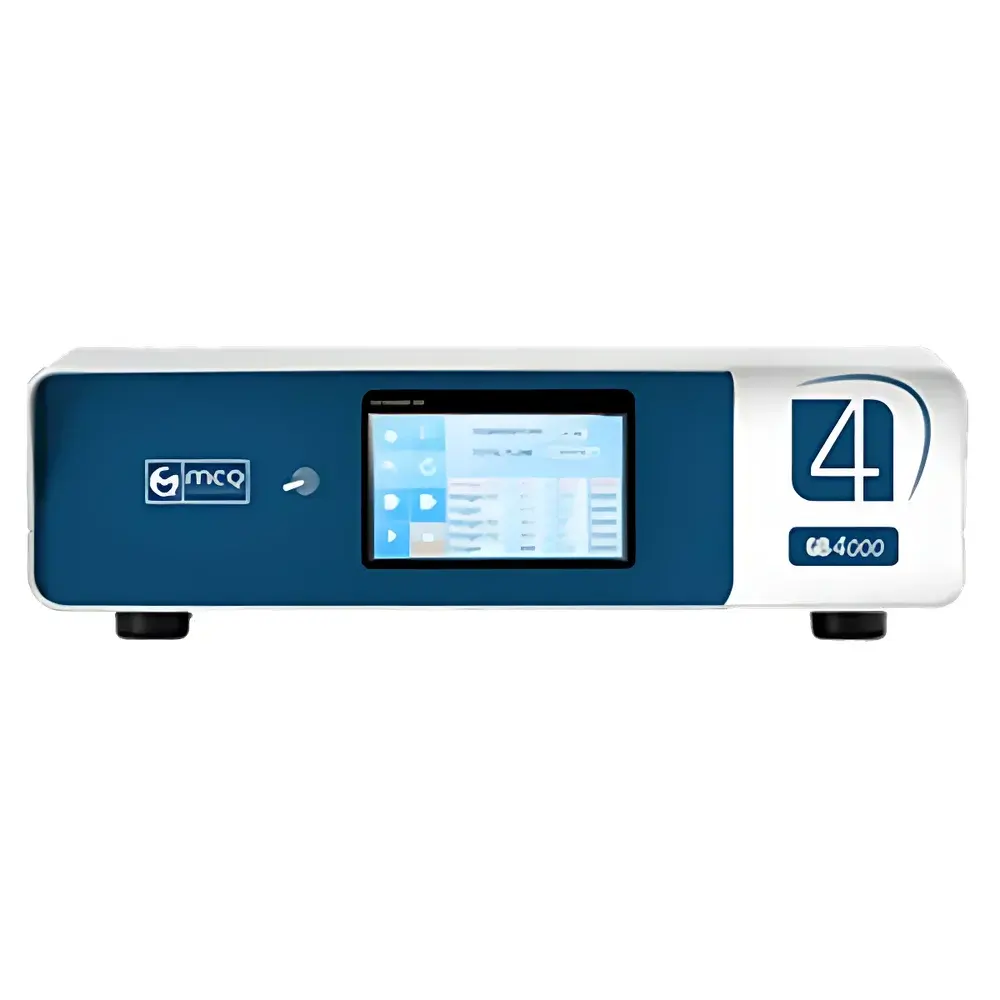
MCQ GB4000 Dynamic Gas Dilution System
| Brand | MCQ |
|---|---|
| Origin | Italy |
| Model | GB4000 |
| Inlet Channels | 4 |
| Outlet Channels | 1 |
| Flow Range per Channel | 0–5000 mL/min |
| Dilution Ratio | 1:1 to 1:1000 |
| Gas Compatibility | N₂, O₂, CO₂, CH₄, Air, NO, CO, Ar, C₂H₄, C₂H₆, SF₆, C₃H₈, C₄H₁₀, H₂, He, DME (C₂H₆O), N₂O, SO₂, and other custom gases upon request |
| Third-Party Software Integration | Yes |
| Certification | CE-marked, compliant with ISO/IEC 17025 traceability requirements for gas standard generation |
Overview
The MCQ GB4000 Dynamic Gas Dilution System is an engineered solution for the precise, real-time generation of certified reference gas mixtures in laboratory, calibration, and industrial process environments. Based on mass flow control principles—utilizing calibrated thermal mass flow controllers (MFCs) operating under laminar flow conditions—the GB4000 dynamically blends up to four primary gas streams into a single, stable output stream with programmable concentration accuracy. Unlike static cylinder-based standards, this system enables continuous, on-demand dilution without reliance on pre-mixed cylinders, significantly reducing operational costs, gas waste, and logistical overhead. Designed for metrological integrity, each MFC is factory-calibrated against NIST-traceable standards, and system-level verification supports ISO 6145-7 (dynamic dilution methods) and ASTM D6166 (calibration gas preparation). The GB4000 serves as a foundational tool for traceable gas standard generation where repeatability, long-term stability, and audit-ready documentation are required.
Key Features
- Four independently controlled inlet channels with full-scale flow range of 0–5000 mL/min per channel, enabling high-dynamic-range dilution across low-concentration ppb-level targets and high-flow calibration scenarios.
- High-accuracy thermal mass flow controllers with <±0.8% reading ±0.2% full scale uncertainty (at 23°C, 1 atm), compensated for temperature and pressure variations via integrated sensors.
- Real-time dilution ratio control from 1:1 to 1:1000, with programmable step resolution down to 0.01% of setpoint, supporting both manual and automated sequence-based operation.
- Native Modbus RTU and TCP/IP communication protocols for seamless integration with LIMS, SCADA, PLC, or custom Python/ LabVIEW applications—enabling remote configuration, live data streaming, and synchronized logging.
- Stainless steel 316L wetted path construction with electropolished surfaces, VCR fittings, and helium-leak-tested assembly (<1×10⁻⁹ mbar·L/s), ensuring compatibility with reactive, corrosive, and ultra-high-purity gases including H₂, SO₂, and NO.
- Integrated pressure regulation and back-pressure control to maintain constant downstream delivery conditions—critical for GC carrier gas blending, sensor response testing, and chamber dosing applications.
Sample Compatibility & Compliance
The GB4000 accommodates a broad spectrum of permanent and reactive gases—including but not limited to N₂, O₂, CO₂, CH₄, CO, NO, SO₂, SF₆, C₂H₄, C₃H₈, H₂, He, Ar, N₂O, and dimethyl ether (DME)—subject to material compatibility validation. Hydrogen-compatible configurations include optional stainless-steel diaphragm valves and leak-tight solenoid manifolds rated to 10 bar. All systems are CE-marked and designed in accordance with IEC 61000-6-2 (immunity) and IEC 61000-6-3 (emissions). For regulated environments, the GB4000 supports 21 CFR Part 11-compliant electronic records when paired with validated software platforms, and its calibration documentation aligns with ISO/IEC 17025 requirements for accredited gas laboratories. It is routinely deployed in facilities maintaining GLP and GMP compliance for environmental monitoring, emissions testing, and pharmaceutical residual solvent analysis.
Software & Data Management
The GB4000 operates with MCQ’s proprietary DiluSoft™ v3.2 control suite (Windows-based), offering intuitive graphical setup of multi-step dilution sequences, real-time MFC status visualization, and automatic log export in CSV and PDF formats. Audit trails record all parameter changes, user logins, and system events with timestamped digital signatures. For enterprise integration, open API libraries (DLL and RESTful endpoints) provide direct access to flow setpoints, actual readings, alarm states, and calibration history. Data exports comply with ASTM E2500-13 (data integrity for analytical instrumentation) and support third-party statistical process control (SPC) tools. Optional firmware upgrades enable periodic self-diagnostic routines and drift compensation algorithms based on ambient temperature and supply pressure feedback.
Applications
- Calibration of fixed and portable gas analyzers (e.g., FTIR, NDIR, electrochemical, PID, and laser-based sensors) used in ambient air quality networks and stack emission monitoring.
- Preparation of dynamic calibration standards for EPA Method 205, EN 14181 (QAL2/QAL3), and ISO 12039 compliance testing.
- Controlled atmosphere generation in environmental chambers, bioreactors, and cell culture incubators requiring ppm-level O₂/CO₂/N₂ balance.
- R&D support for catalyst evaluation, combustion studies, and gas-phase reaction kinetics where reproducible, variable-stoichiometry feeds are essential.
- Reference gas certification in national metrology institutes and accredited calibration labs performing ISO 6142-1 and ISO 6145-7 intercomparisons.
- On-site gas mixture synthesis for field-deployed GC-FID/TCD systems, eliminating cylinder logistics and minimizing cross-contamination risk.
FAQ
What is the minimum detectable concentration achievable with the GB4000?
The theoretical lower limit depends on base gas purity and MFC resolution; with 99.999% pure zero air and optimized configuration, sub-ppb-level dilutions are attainable for target analytes such as NO or SO₂.
Can the GB4000 be used with hydrogen (H₂) without modification?
Yes—the standard GB4000 configuration includes H₂-compatible wetted materials and is rated for use with hydrogen up to 10 bar inlet pressure; no retrofitting is required.
Is third-party software integration limited to specific protocols?
No—Modbus RTU (RS-485), Modbus TCP/IP, and ASCII serial command sets are natively supported; additional drivers for OPC UA or MQTT can be commissioned upon request.
How often does the system require recalibration?
Annual recalibration is recommended per ISO/IEC 17025 guidelines; however, built-in zero/span verification routines allow daily performance checks without external equipment.
Does the GB4000 meet requirements for EPA or EU regulatory audits?
Yes—when operated within specified environmental conditions and documented per SOP, it fulfills technical criteria for QAL2 (EN 14181) and PS-15 (EPA) gas standard generators, with full traceability to national standards.







