
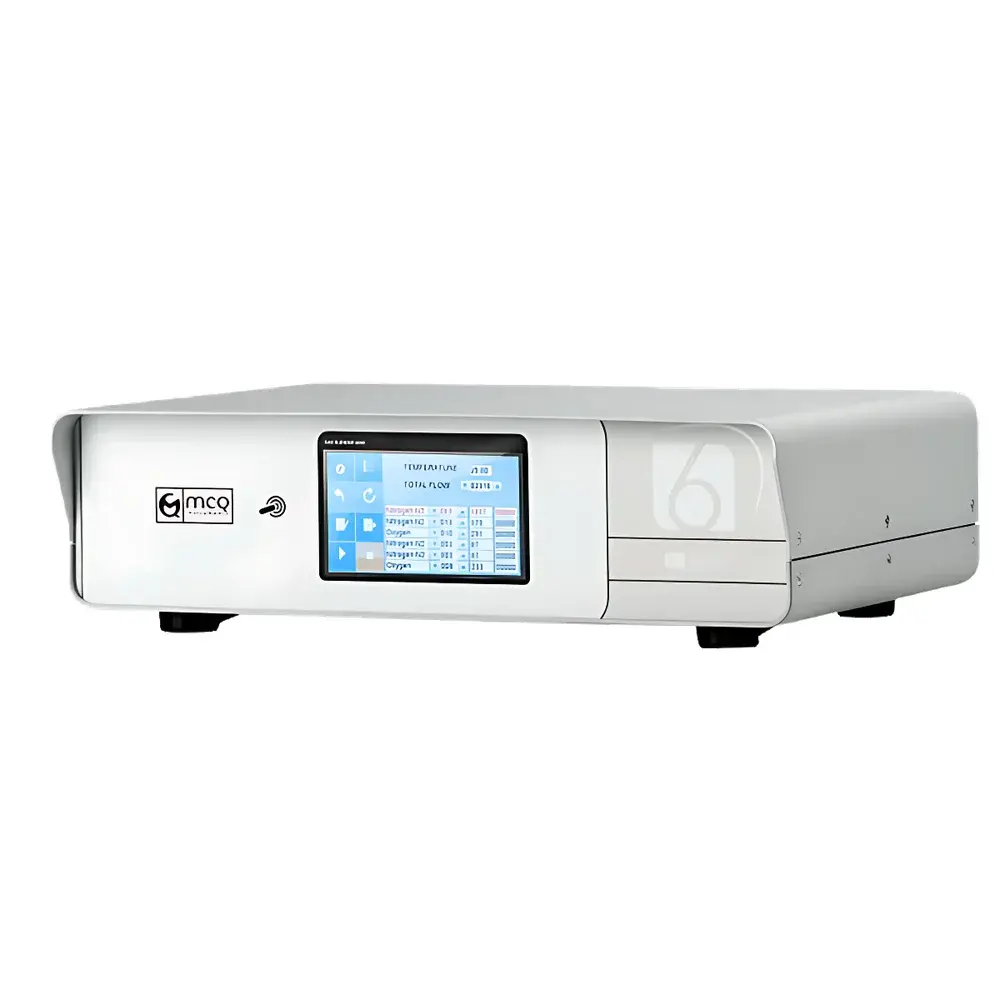
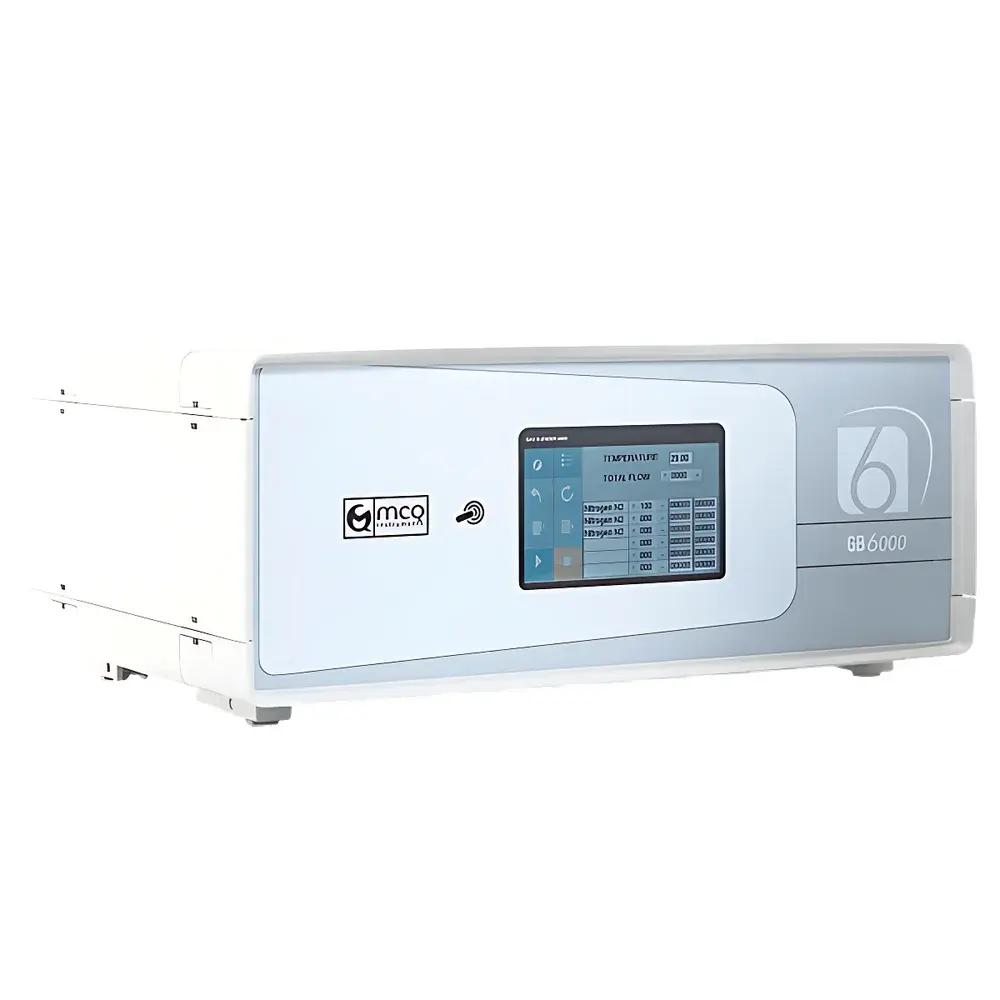
MCQ GB6000 Dynamic Gas Dilution System
| Brand | MCQ |
|---|---|
| Origin | Italy |
| Model | GB6000 |
| Input Channels | 6 |
| Output Channels | 1 |
| Flow Range per Channel | 0–5000 mL/min |
| Dilution Ratio | 1:1 to 1:1000 |
| Gas Compatibility | N₂, O₂, CO₂, CH₄, Air, NO, CO, Ar, C₂H₄, C₂H₆, SF₆, C₃H₈, C₄H₁₀, H₂, He, DME (C₂H₆O), N₂O, SO₂, and other custom gases upon consultation |
| Third-Party Software Integration | Yes |
| Certification Status | CE-marked, compliant with ISO/IEC 17025 traceability requirements for gas standard generation |
Overview
The MCQ GB6000 Dynamic Gas Dilution System is an engineered precision instrument designed for the real-time, gravimetrically traceable generation of certified reference gas mixtures across laboratory, calibration, and industrial process environments. Utilizing mass flow controller (MFC)-based dynamic dilution architecture, the GB6000 operates on the principle of continuous, laminar blending of primary gas streams—each independently metered and temperature/pressure compensated—to achieve stable, reproducible output concentrations with high temporal resolution. Unlike static cylinder-based standards, this system enables on-demand synthesis of multi-component gas mixtures at precisely defined volumetric ratios, eliminating cylinder dependency, reducing uncertainty propagation from secondary dilutions, and supporting dynamic challenge testing for analyzers such as FTIR, GC, chemiluminescence NOₓ detectors, and electrochemical sensors.
Key Features
- Six independently controlled mass flow channels (0–5000 mL/min each), enabling complex multi-gas mixture synthesis with simultaneous control over carrier and analyte streams.
- High-resolution digital MFCs with ±0.8% full-scale accuracy and <±0.2% repeatability, calibrated per ISO 6145-7 and traceable to NIST or PTB standards.
- Integrated temperature and absolute pressure compensation ensures volumetric consistency across ambient fluctuations (15–35°C, 80–106 kPa).
- Real-time concentration calculation engine embedded in firmware—supports linear and non-linear mixing models for reactive or condensable species where applicable.
- RS-485 Modbus RTU and Ethernet TCP/IP interfaces for seamless integration into SCADA, LIMS, or custom automation platforms (e.g., LabVIEW, Python-based control suites).
- Front-panel touchscreen interface with multilingual support (EN/DE/FR/ES), local data logging (up to 30 days at 1 Hz), and USB export capability.
- Modular chassis design facilitates field upgrades—including optional humidity control modules, ozone scrubbers, or catalytic converters—for specialized applications such as ambient air simulation or cleanroom gas validation.
Sample Compatibility & Compliance
The GB6000 supports a broad spectrum of non-corrosive, non-polymerizing gases including N₂, O₂, CO₂, CH₄, CO, NO, SO₂, SF₆, C₂H₄, C₂H₆, C₃H₈, C₄H₁₀, He, Ar, H₂, N₂O, DME, and synthetic air blends. Hydrogen compatibility is validated up to 4% v/v in inert carriers; higher concentrations require optional explosion-proof configuration (ATEX Category 2G). All wetted materials conform to ASTM F2229 and USP Class VI specifications. The system complies with ISO 6145-7 (dynamic dilution methods), ISO 17025 clause 5.9 (uncertainty budgeting for generated standards), and supports audit-ready documentation for GLP/GMP-regulated laboratories. Optional 21 CFR Part 11-compliant software add-ons provide electronic signatures, role-based access control, and immutable audit trails.
Software & Data Management
The GB6000 ships with MCQ ControlSuite™ v3.2—a Windows-based configuration and monitoring application supporting offline method development, batch recipe storage (≥500 protocols), and automated calibration verification logs. It generates PDF reports compliant with ISO/IEC 17025 Annex A.3, including expanded uncertainty calculations (k=2), drift monitoring charts, and MFC verification timestamps. Raw sensor data (flow, T, P, valve status) is streamed in CSV/JSON format via REST API or OPC UA for integration into enterprise analytics platforms. Firmware updates are delivered via secure HTTPS with SHA-256 signature verification.
Applications
- Primary standard generation for calibrating environmental monitoring systems (e.g., EPA Method 205, EN 14625).
- Dynamic challenge testing of gas analyzers used in stack emission monitoring, indoor air quality (IAQ) networks, and fugitive emission detection.
- Method validation and robustness studies under ISO 11843 and ICH Q2(R2) guidelines.
- Controlled atmosphere simulation for food packaging headspace analysis, pharmaceutical stability chambers, and bioreactor gas conditioning.
- Research-grade gas mixture preparation for catalysis studies, combustion modeling, and sensor response characterization.
- On-site traceability extension for national metrology institutes performing inter-laboratory comparisons.
FAQ
What is the minimum detectable concentration achievable with the GB6000?
The practical lower limit depends on base gas purity, MFC resolution, and background contamination—but routinely achieves ≤50 ppb for single-analyte dilutions using ultra-high-purity (99.999%) source gases and laminar flow path conditioning.
Can the GB6000 generate humidified gas standards?
Yes—when paired with the optional MCQ-HUMID module (dew point range −30°C to +40°C), it delivers NIST-traceable RH-controlled mixtures for sensor testing and climate chamber validation.
Is remote diagnostics supported?
Yes—via embedded web server (HTTPS) and optional VPN-enabled maintenance tunnel; firmware includes predictive fault logging and MFC health monitoring.
Does the system meet regulatory requirements for pharmaceutical QC labs?
When configured with 21 CFR Part 11 software options and operated under documented SOPs, it satisfies FDA and EMA expectations for analytical standard generation in GxP environments.
What maintenance intervals are recommended?
MFC recalibration every 12 months (or after 2000 operational hours); inlet filter replacement every 6 months; full system verification against reference standards quarterly per ISO/IEC 17025.
Related Products







