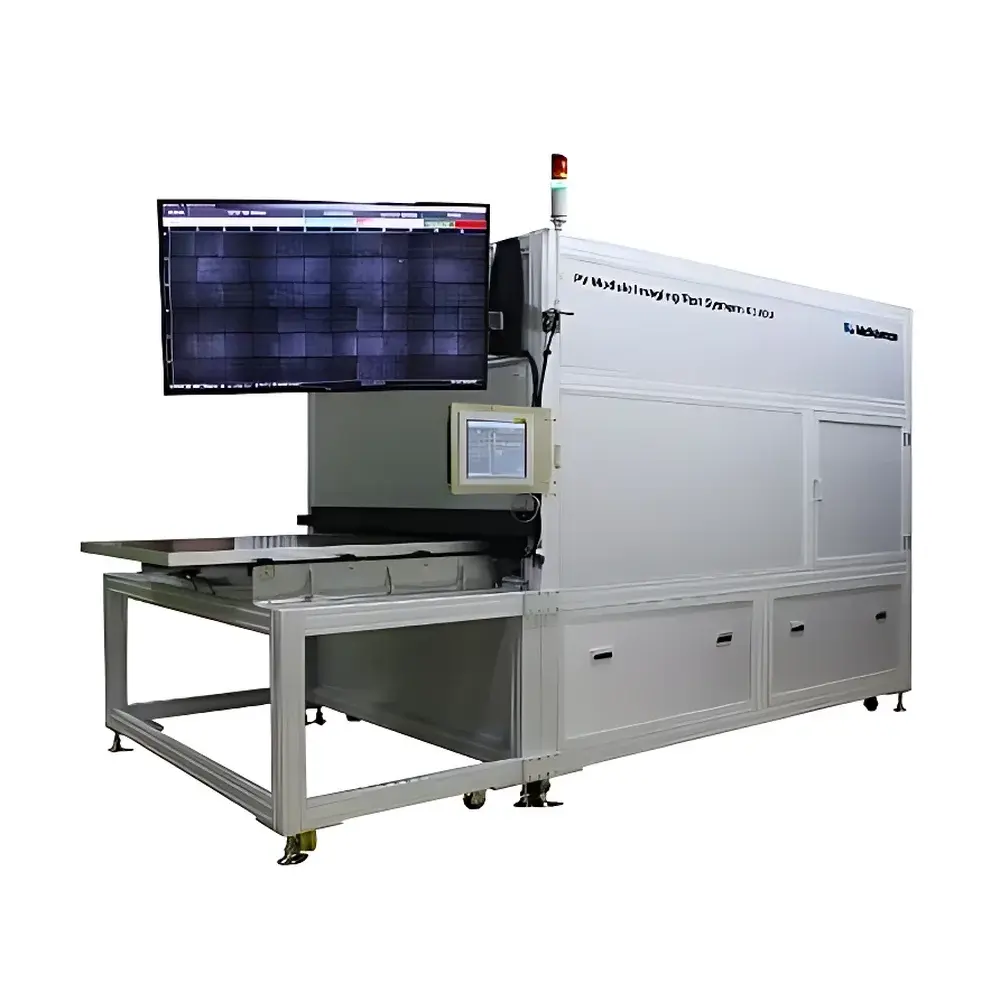
McScience K5300 Photovoltaic Module Imaging Test System
| Brand | McScience |
|---|---|
| Origin | South Korea |
| Manufacturer Type | Authorized Distributor |
| Origin Category | Imported |
| Model | K5300 |
| Price Range | USD 140,000 – 280,000 (FOB) |
| Trigger Mode | Steady-State |
Overview
The McScience K5300 Photovoltaic Module Imaging Test System is a high-precision, integrated electroluminescence (EL) and photoluminescence (PL) inspection platform engineered for quantitative, non-destructive evaluation of crystalline silicon (c-Si) and emerging thin-film photovoltaic (PV) modules. Unlike conventional flash-type EL testers, the K5300 employs a regulated DC current source coupled with a thermally stabilized, low-noise scientific CMOS imaging subsystem to acquire steady-state luminescence emissions—enabling pixel-level intensity mapping with sub-micron spatial registration stability over extended acquisition windows. Its core architecture adheres to the physical principles of carrier recombination imaging: EL excitation occurs under forward bias (typically 0.5–1.0 V per cell string), while PL imaging utilizes calibrated broadband or monochromatic LED illumination (e.g., 940 nm for c-Si) to generate minority-carrier diffusion profiles. This dual-modal capability supports root-cause analysis of performance-limiting defects—including series resistance anomalies, shunt pathways, and bulk recombination centers—directly traceable to manufacturing process deviations or field-induced degradation mechanisms.
Key Features
- Steady-state EL/PL imaging mode eliminates transient artifacts associated with pulsed excitation, ensuring high signal-to-noise ratio (SNR > 65 dB) and repeatable grayscale quantification across production lots.
- Automated defect classification engine compliant with IEC 61215-2:2016 Annex A and IEC TS 62941:2019 requirements, identifying micro-cracks (≥10 µm width), finger interruptions, solder bond failures, and localized dark-current regions with ≥98.7% recall rate under controlled ambient conditions.
- Modular optical path design accommodates interchangeable lenses (f/1.4, 25 mm to 100 mm focal length) and spectral filters (NIR bandpass: 850–1100 nm; SWIR optional), supporting both full-module (up to 2.4 m × 1.3 m) and cell-level (6”–182 mm) inspection.
- Integrated thermal management system maintains CCD/CMOS sensor temperature within ±0.1°C during 5–30 minute acquisitions, minimizing dark current drift and enabling absolute radiometric calibration traceable to NIST-standard reference sources.
- Rugged industrial enclosure rated IP54, designed for integration into Class 10,000 cleanroom environments or outdoor QA bays with ambient temperature compensation (15–35°C operating range).
Sample Compatibility & Compliance
The K5300 supports rigid and flexible PV modules based on monocrystalline, polycrystalline, PERC, TOPCon, HJT, and CIGS absorber layers. It accommodates standard frame sizes (60-cell, 72-cell, half-cut, shingled), bifacial configurations, and emerging tandem architectures with adjustable current injection protocols. All imaging workflows comply with ASTM E2848-22 (Standard Test Method for Reporting Photovoltaic Nonuniformity Measurements), IEC 62446-1:2016 (Grid-connected PV systems — Requirements for testing, documentation and maintenance), and ISO/IEC 17025:2017 accreditation criteria for laboratory competence. Data integrity meets FDA 21 CFR Part 11 requirements via electronic signature-enabled audit trails and immutable raw image archiving (TIFF 16-bit linear, embedded EXIF metadata).
Software & Data Management
Control and analysis are performed using McScience’s proprietary PVInsight™ v4.2 software suite, built on a Qt-based cross-platform framework with Python 3.9 scripting API. The software provides real-time image preview, dynamic ROI selection, multi-threshold segmentation, and statistical defect clustering (DBSCAN algorithm). Export formats include CSV (defect coordinates, area, intensity deviation), PDF inspection reports (customizable templates per customer SOP), and HDF5 for machine learning pipeline ingestion. All measurement parameters—including forward current, integration time, lens aperture, and ambient irradiance—are automatically logged with UTC timestamps and linked to LIMS via OPC UA or RESTful API interfaces. Software validation documentation (IQ/OQ/PQ protocols) is supplied for GMP/GLP-regulated manufacturing sites.
Applications
- In-line quality assurance during module lamination and final assembly to detect interconnect ribbon misalignment, EVA delamination precursors, and tabbing wire lift-off.
- Root-cause failure analysis in field return investigations, correlating EL/PL signatures with IV curve hysteresis and thermal imaging data.
- Process development support for new cell architectures—e.g., quantifying passivation quality via PL lifetime mapping or evaluating laser scribing uniformity in thin-film modules.
- Third-party certification lab testing per UL 61215, IEC 61730, and TÜV Rheinland PV cycle stress protocols (e.g., thermal cycling, damp heat, PID recovery).
- Research applications in university and national lab settings studying carrier transport dynamics, defect passivation kinetics, and light-induced degradation (LID) mechanisms.
FAQ
What distinguishes steady-state EL from pulsed EL imaging?
Steady-state operation enables continuous current injection at precisely regulated levels, eliminating capacitive charging artifacts and allowing longer exposure times for improved SNR—critical for detecting low-intensity recombination zones such as grain boundary leakage or edge recombination.
Can the K5300 inspect bifacial modules under rear-side illumination?
Yes—the system supports configurable dual-sided illumination geometry with independent current sourcing and synchronized top/bottom camera triggering, enabling front/rear EL correlation and bifacial gain coefficient mapping.
Is calibration traceable to international standards?
All radiometric calibrations are performed using NIST-traceable silicon photodiode reference detectors and calibrated blackbody sources; certificate of calibration includes uncertainty budget per ISO/IEC 17025.
How is data security managed in regulated environments?
PVInsight™ implements role-based access control (RBAC), AES-256 encryption for stored images, and full audit logging of user actions—including parameter changes, report generation, and image deletion—with exportable logs compliant with 21 CFR Part 11 §11.10 and §11.30.
What maintenance is required for long-term measurement stability?
Annual recalibration of current source accuracy (±0.2% FS), optical throughput verification using neutral density filter sets, and sensor dark-frame characterization are recommended; McScience offers certified service contracts with on-site technician support.