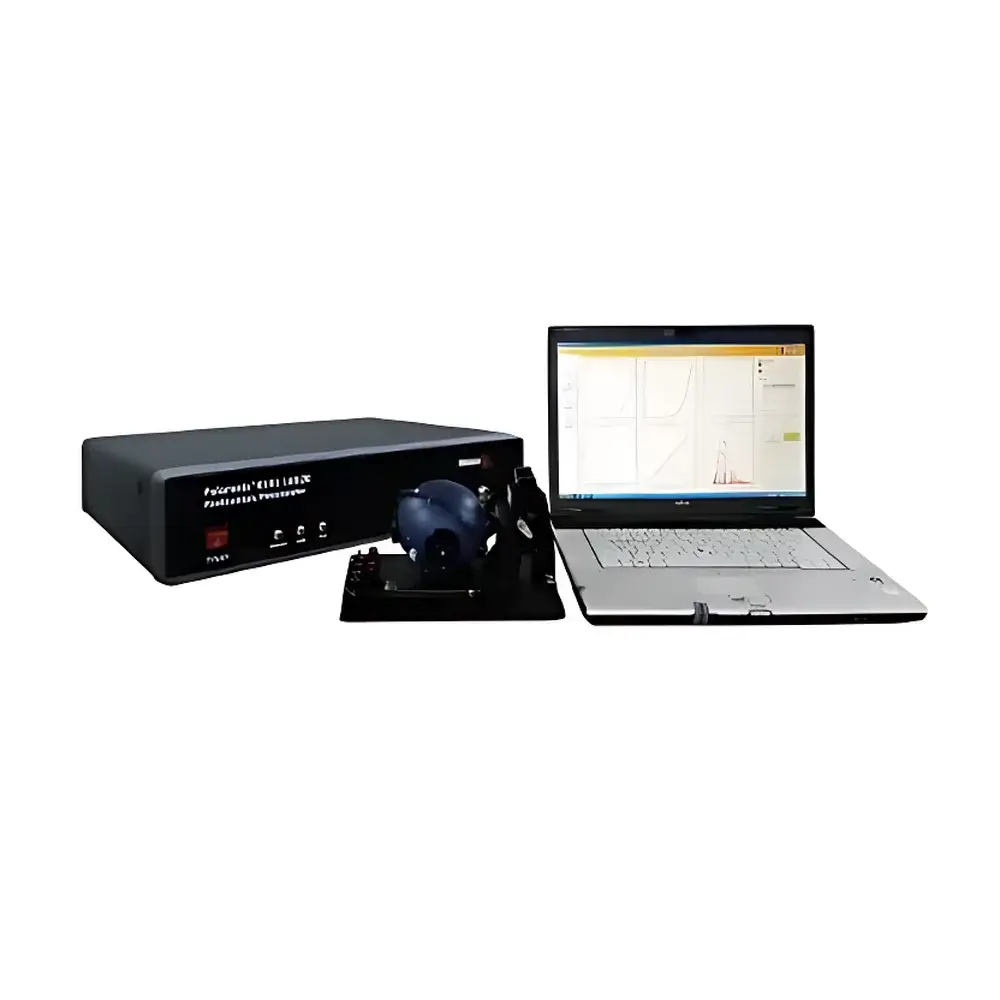
McScience L5300 Integrated Photoluminescence Quantum Yield (PLQY) and Electroluminescent (IVL) Characterization System
| Brand | McScience |
|---|---|
| Origin | South Korea |
| Model | L5300 |
| Type | Integrated PLQY & IVL Measurement Platform |
| Compliance | ISO/IEC 17025-aligned optical calibration traceability |
| Software | McScience QYLab v4.2 with audit trail and user access control |
Overview
The McScience L5300 Integrated Photoluminescence Quantum Yield (PLQY) and Electroluminescent (IVL) Characterization System is a turnkey optical-electrical metrology platform engineered for quantitative, traceable evaluation of light-emitting semiconductor devices—including OLEDs, PeLEDs, QLEDs, micro-LEDs, and organic/polymer light-emitting diodes. It combines absolute photoluminescence quantum yield measurement via integrating sphere-based excitation–emission spectral analysis with synchronized electroluminescent current–voltage–luminance (IVL) characterization under controlled environmental conditions. The system operates on the principle of comparative spectral radiometry: PLQY is determined by ratioing integrated photon counts from sample emission to a calibrated reference standard under identical excitation (e.g., 365 nm or 405 nm LED or laser), while IVL data are acquired using precision source-measure units (SMUs) with sub-microampere current resolution and voltage sweep linearity better than ±0.02% of reading. All optical paths are thermally stabilized and vibration-isolated to ensure high reproducibility (<±0.8% RSD for repeated PLQY measurements on certified phosphor standards).
Key Features
- Simultaneous dual-mode operation: Independent yet synchronized PLQY and IVL acquisition within a single vacuum-compatible or nitrogen-purged chamber (optional)
- High-fidelity integrating sphere (150 mm diameter, Spectralon® coating, >99% diffuse reflectance @ 250–2500 nm) with calibrated baffle geometry to minimize port coupling error
- Back-thinned CCD spectrometer (200–1100 nm range, 0.2 nm optical resolution, thermoelectric cooling to –10 °C) coupled to fiber-optic light collection with NIST-traceable spectral irradiance calibration
- Dual-channel SMU architecture supporting four-quadrant operation: ±200 V / ±1 A sourcing with 100 fA current resolution and 10 µV voltage resolution
- Automated angular luminance mapping (±80° horizontal, ±45° vertical) via motorized goniometer stage with real-time CIE 1931 chromaticity interpolation
- Integrated thermal management: Peltier-controlled sample stage (–20 to +120 °C, ±0.1 °C stability) with real-time junction temperature monitoring via embedded thermocouple
Sample Compatibility & Compliance
The L5300 accommodates substrates up to 100 × 100 mm (including glass, silicon, flexible PET/PI, and ceramic carriers) and supports device architectures ranging from bottom-emission OLEDs to top-emission and transparent configurations. Sample holders feature gold-plated contact pins with spring-loaded force optimization (0.3–1.2 N per contact) to minimize series resistance artifacts. All optical calibrations follow procedures aligned with ISO/IEC 17025 requirements for testing laboratories; spectral responsivity is validated annually against NIST SRM 2035 and 2065a. The system meets electromagnetic compatibility (EMC) per IEC 61326-1 and safety standards per IEC 61010-1. For regulated environments, optional FDA 21 CFR Part 11 compliance package includes electronic signature support, role-based permissions, and immutable audit logs for all measurement sessions.
Software & Data Management
QYLab v4.2 is a Windows-based application built on .NET Framework with deterministic real-time data acquisition threading. It provides full instrument orchestration—including spectrometer triggering, SMU ramp sequencing, goniometer positioning, and thermal setpoint synchronization—within a single workflow editor. Raw spectral data are stored in HDF5 format with embedded metadata (excitation wavelength, integration time, slit width, ambient temperature/humidity, operator ID). Quantitative outputs include EQE (electroluminescent external quantum efficiency), PLQY (photoluminescence quantum yield), luminous efficacy (lm/W), CIE x,y and u’v’ coordinates, correlated color temperature (CCT), and lifetime parameters (T50, T70, τ₀) derived from accelerated stress protocols. Export options include CSV, XML, and PDF reports compliant with GLP/GMP documentation templates.
Applications
- Material screening: Comparative PLQY assessment of emissive layer host–dopant combinations under varied excitation densities
- Device optimization: Correlating voltage-dependent EL spectra with charge balance metrics and exciton confinement efficiency
- Process validation: Monitoring batch-to-batch consistency of thin-film deposition and encapsulation integrity via lifetime and angular uniformity metrics
- Reliability testing: Accelerated aging studies at constant current or constant luminance, with automated failure threshold detection
- Standards development support: Reference-grade measurement capability for national metrology institutes and industry consortia (e.g., OLED Display Standards Working Group)
FAQ
What excitation sources are supported for PLQY measurement?
The system ships with interchangeable high-stability LEDs (365 nm, 405 nm, 450 nm) and optional laser diode modules (e.g., 375 nm CW or pulsed); all sources include calibrated power monitoring and collimation optics.
Can the L5300 measure both forward and reverse bias characteristics?
Yes—the dual-channel SMU supports bidirectional current sourcing and sinking, enabling leakage current analysis, breakdown voltage determination, and transient response characterization.
Is spectral calibration performed in situ or requires external lab service?
Full spectral radiometric calibration is factory-performed using NIST-traceable standards and can be verified in-house via included calibration verification kit; annual recalibration is recommended.
Does the software support automated pass/fail criteria for production-line testing?
Yes—QYLab v4.2 allows definition of multi-parameter acceptance windows (e.g., PLQY ≥ 82%, CIE y ≤ 0.32, T50 ≥ 500 h) with configurable alarm triggers and exportable SPC-ready datasets.