
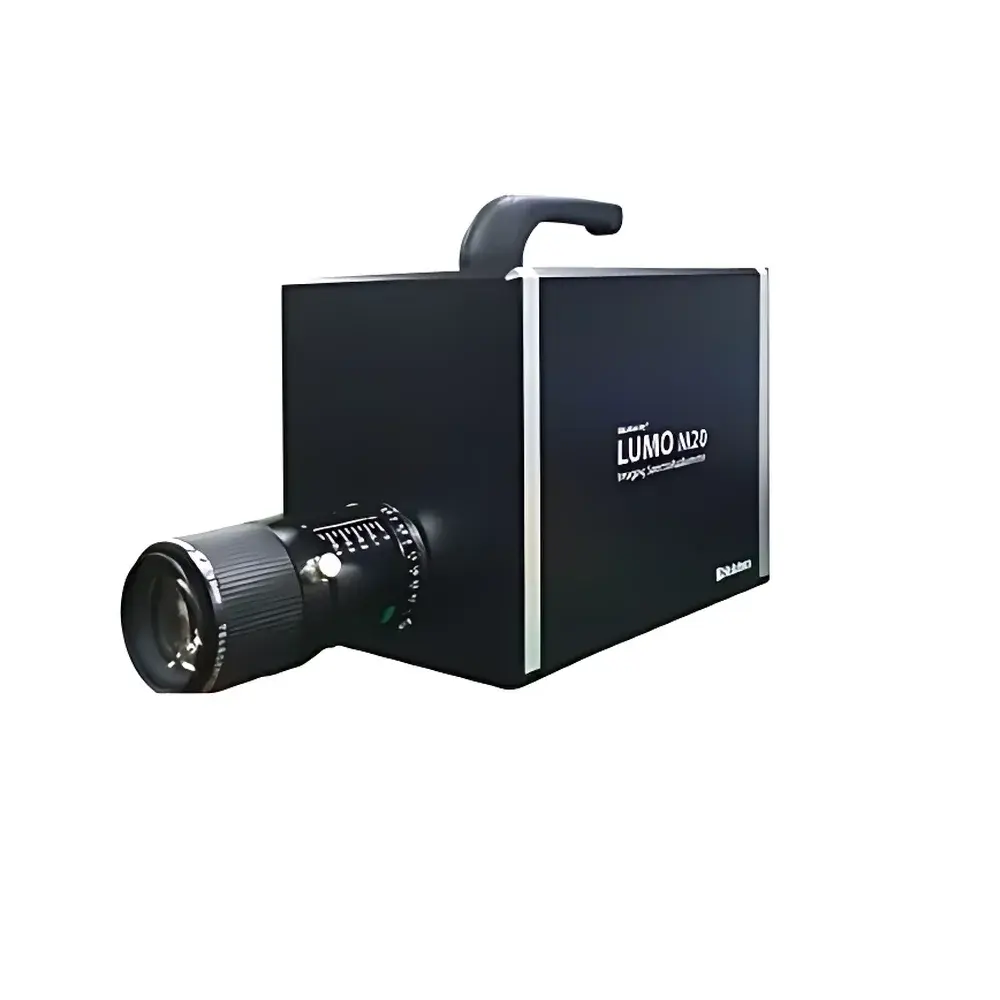
McScience M20 LUMO Spectroradiometer
| Brand | McScience |
|---|---|
| Origin | South Korea |
| Manufacturer Type | Authorized Distributor |
| Import Status | Imported |
| Model | M20 |
| Pricing | Upon Request |
| Spectral Range | 380–780 nm |
| Spectral Resolution | 1 nm |
| Luminance Measurement Range (Illuminant A) | 0.1–100,000 cd/m² |
| Imaging Capability | Integrated CCD Camera |
| Optional Accessories | Close-up Lens, Neutral Density Filters |
| Interface Compatibility | Windows PC & Android Tablet |
| Compliance | Designed for display metrology per CIE S 026/E:2015, ISO 13406-2, and VESA DisplayHDR™ test protocols |
Overview
The McScience M20 LUMO Spectroradiometer is a high-fidelity, application-optimized instrument engineered for precision photometric and colorimetric characterization of self-emissive and reflective displays. Operating on the principle of grating-based spectral dispersion and CCD-array detection, the M20 captures full spectral radiance data across the visible spectrum (380–780 nm) at 1 nm resolution, enabling traceable calculation of photometric quantities—including luminance (cd/m²), chromaticity coordinates (CIE 1931 x,y and u′,v′), correlated color temperature (CCT), dominant wavelength, and color rendering indices (CRI, TM-30 Rf/Rg). Unlike broadband photometers, the M20’s spectroradiometric architecture eliminates metamerism-related errors and supports dynamic measurement modes essential for evaluating temporal behavior—such as flicker (flicker percentage, frequency, and waveform analysis), response time artifacts, and pulsed backlight modulation—critical in OLED, microLED, and high-refresh-rate LCD validation.
Key Features
- Integrated high-resolution CCD imaging system for real-time optical alignment, spatial targeting, and region-of-interest (ROI) selection—enabling pixel-level uniformity mapping and defect localization.
- Motorized variable aperture control (0.5° to 5° field-of-view) with mechanical target focus and live optical alignment monitoring via on-device display or host interface.
- Modular optical path design supporting optional close-up lenses for near-field micro-display measurements (e.g., AR/VR micro-OLEDs) and calibrated neutral density filters for extended dynamic range up to 100,000 cd/m² under Illuminant A conditions.
- Native dual-platform compatibility: fully functional driver support for Windows 10/11 (x64) and Android 8.0+ tablets via USB-C or Bluetooth Low Energy (BLE), facilitating portable lab-in-a-tablet workflows in cleanroom or production-floor environments.
- Rugged aluminum chassis with thermally stabilized optical bench, minimizing drift during extended thermal soak or ambient temperature fluctuations typical in display burn-in and aging studies.
Sample Compatibility & Compliance
The M20 is validated for use with flat-panel displays (LCD, OLED, QD-LCD, microLED), automotive HUDs, signage modules, and emissive lighting panels. It meets the geometric and spectral requirements defined in IEC 62341-6-3 (OLED display measurements), ISO 9241-307 (optical ergonomics), and VESA DisplayHDR™ True Black certification test procedures. Data traceability aligns with ISO/IEC 17025:2017 clause 7.7 (measurement uncertainty estimation), and spectral calibration is NIST-traceable via factory certificate with annual recalibration interval recommendation. The system supports GLP-compliant audit trails when operated under McScience’s optional LUMO Control Suite v3.x with 21 CFR Part 11–enabled user access controls and electronic signature logging.
Software & Data Management
The bundled LUMO Control Suite provides a unified environment for instrument control, spectral acquisition, real-time visualization, and automated report generation (PDF, CSV, XML). It includes preconfigured test sequences for industry-standard metrics: Delta E₂₀₀₀ (ΔE₀₀), gamma curve fitting (2.2, sRGB, DCI-P3, BT.2020), white point deviation, and luminance uniformity (corner-to-corner, 9-point grid). Raw spectral data is stored in JIS X 0211-compliant .spc binary format with embedded metadata (timestamp, operator ID, device SN, calibration epoch). Export modules support integration with MATLAB, Python (via PyLUMO SDK), and enterprise MES/QMS platforms through RESTful API endpoints with OAuth 2.0 authentication.
Applications
- Display R&D: Spectral characterization of novel emissive materials, evaluation of blue-shift degradation in OLEDs, and spectral power distribution (SPD) modeling for human-centric lighting design.
- Production QA: In-line verification of brightness and chromaticity binning, conformance testing against DisplayHDR 1000/1400 specifications, and flicker compliance screening per IEEE 1789-2015.
- Regulatory Testing: Supporting CE marking documentation for EN 62471 (photobiological safety) and ENERGY STAR® Version 8.0 display efficiency reporting.
- Academic Research: Time-resolved spectral acquisition for transient electroluminescence studies and cross-platform color appearance modeling under varying surround conditions (CIE TC 1-88).
FAQ
What spectral calibration standards are used for the M20?
The M20 is calibrated using NIST-traceable tungsten-halogen and deuterium lamps, with spectral irradiance reference data certified to ±0.3% uncertainty (k=2) over 380–780 nm.
Can the M20 measure pulsed or PWM-driven displays without aliasing?
Yes—the M20 supports external trigger synchronization (TTL input) and offers adjustable integration time from 1 ms to 10 s, enabling phase-locked acquisition of fast-switching emitters without temporal aliasing.
Is firmware update capability available in the field?
Yes—firmware updates are delivered via signed .bin packages through LUMO Control Suite, requiring administrator credentials and SHA-256 checksum verification prior to installation.
Does the system support automated pass/fail grading per customer-defined tolerances?
Yes—custom threshold rules can be scripted in LUMO Control Suite using Boolean logic across multiple parameters (e.g., “luminance ≥ 500 cd/m² AND Δu′v′ ≤ 0.003”), with results exported to SQL databases or shared network folders.
Related Products





