McScience M6000 UVX UV–NIR Perovskite LED Lifetime Testing System
| Brand | McScience |
|---|---|
| Origin | South Korea |
| Manufacturer Type | Authorized Distributor |
| Origin Category | Imported |
| Model | M6000 UVX |
| Pricing | Upon Request |
Overview
The McScience M6000 UVX is a purpose-built, multi-channel electroluminescent (EL) lifetime and reliability testing system engineered for next-generation emissive semiconductor devices operating across the ultraviolet to near-infrared spectral range (200–1100 nm). It employs precision source-measure unit (SMU)-based current/voltage biasing combined with calibrated photometric and spectroradiometric detection to quantify luminance decay, efficiency roll-off, and operational stability under controlled electrical stress conditions. Designed specifically for emerging optoelectronic materials—including perovskite LEDs (PeLEDs), micro-LEDs, QLEDs, OLEDs, micro-OLEDs, and light-emitting electrochemical cells (LECs)—the M6000 UVX supports standardized accelerated aging protocols aligned with industry practices for reliability qualification in R&D, process development, and pre-manufacturing validation.
Key Features
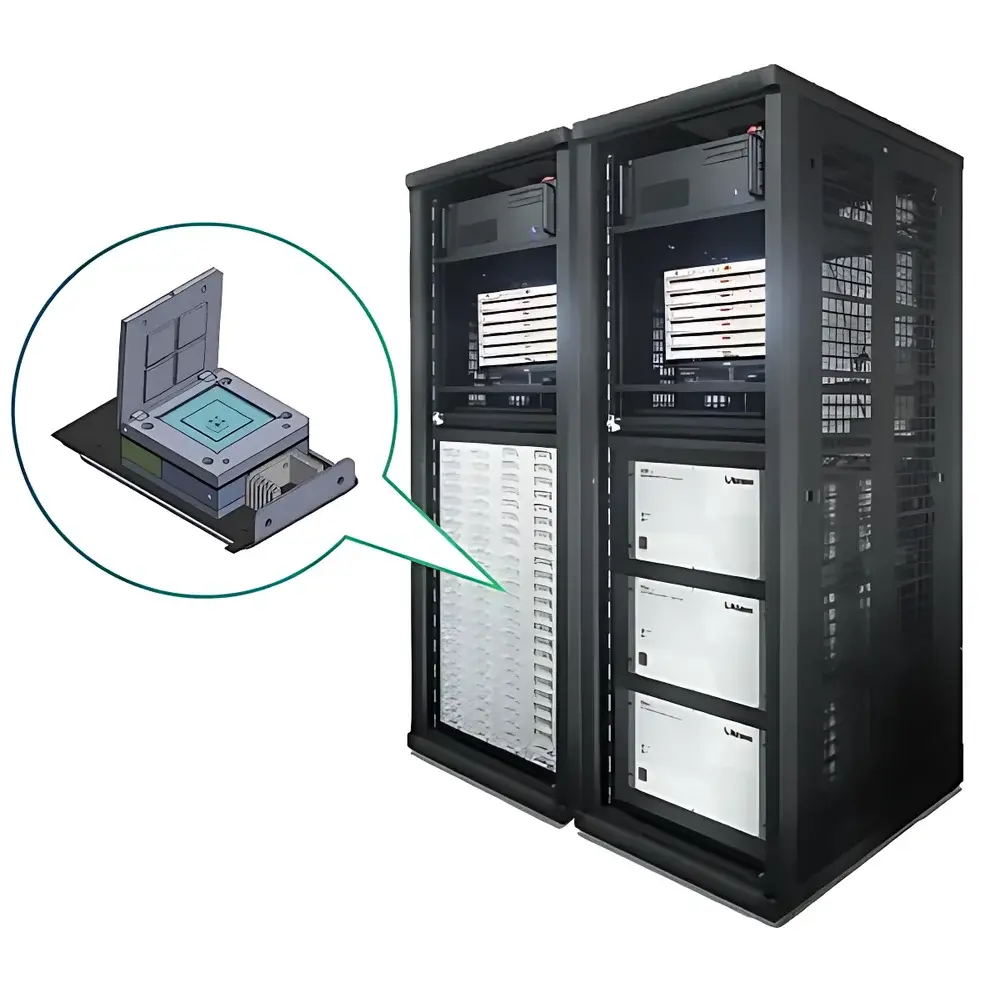
- Multi-channel architecture supporting simultaneous real-time monitoring of up to 16 independent device sites, enabling statistically robust lifetime extrapolation via parallel stress testing.
- Programmable current/voltage sourcing with high-resolution SMUs offering CC (constant current), CV (constant voltage), PC (pulse current), PV (pulse voltage), and PCV (pulse current–voltage) modes—critical for mimicking actual drive conditions and mitigating Joule heating artifacts.
- Integrated spectral response calibration traceable to NIST-traceable standards, covering 200–1100 nm with optional fiber-coupled spectroradiometer for absolute radiant flux and external quantum efficiency (EQE) tracking over time.
- Modular JIG design with customizable electrode contact geometry, thermal interface options, and vacuum/controlled-atmosphere compatibility for encapsulated or inert-gas-operated test configurations.
- Recipe-driven test sequencing with user-defined stress profiles, including stepwise current ramping, duty-cycle modulation, and periodic I–V–L (current–voltage–luminance) characterization embedded within long-term aging runs.
- Onboard temperature control interface supporting integration with commercial environmental chambers (–40 °C to +120 °C) for Arrhenius-based acceleration factor modeling and thermal stress analysis.
Sample Compatibility & Compliance
The M6000 UVX accommodates standard substrate formats (e.g., glass, silicon, sapphire wafers up to 6-inch diameter) and discrete chip-on-carrier packages. Its low-noise analog front-end and guarded measurement topology ensure high signal fidelity for low-current PeLEDs (1000 cd/m²). The system complies with electromagnetic compatibility (EMC) requirements per IEC 61326-1 and meets functional safety guidelines per IEC 61010-1 for laboratory instrumentation. All data acquisition and logging workflows are structured to support GLP/GMP-aligned documentation, including audit-trail-enabled user authentication, timestamped raw data export (CSV/HDF5), and configurable metadata tagging per test instance.
Software & Data Management
Control and analysis are executed via McScience’s proprietary LifetimeStudio™ software, a Windows-based platform featuring intuitive graphical workflow configuration, real-time parameter visualization, and automated lifetime endpoint detection (e.g., T₅₀, T₇₀, T₉₀ based on luminance or EQE decay thresholds). The software implements built-in statistical models—including single-exponential, stretched exponential, and empirical power-law fitting—for comparative degradation kinetics analysis. Exported datasets conform to ASTM E2921-22 (Standard Practice for Reporting Photoluminescence and Electroluminescence Lifetime Data) and support integration into LIMS environments via OPC UA or RESTful API interfaces. Audit trail logs record all parameter changes, operator actions, and instrument state transitions in accordance with FDA 21 CFR Part 11 requirements when configured with electronic signature modules.
Applications
- Accelerated lifetime evaluation of solution-processed and vapor-deposited perovskite LEDs under constant-current and pulsed-drive conditions.
- Comparative reliability screening of charge transport layer architectures (e.g., NiOₓ, PEDOT:PSS, TFB) in PeLED stacks.
- Thermal activation energy (Eₐ) determination via isothermal aging at multiple junction temperatures.
- Correlation of electroluminescent spectral shift (peak wavelength drift, FWHM broadening) with operational degradation mechanisms.
- Pre-compliance assessment for JEDEC JESD22-A108 (reliability stress testing of optoelectronic devices) and IEC TR 62715-1-2 (perovskite optoelectronics reliability guidance).
FAQ
What spectral range does the M6000 UVX support for photometric detection?
The base configuration includes broadband photodiode-based luminance monitoring; optional fiber-coupled spectroradiometry extends full-spectrum capture from 200 nm to 1100 nm.
Can the system perform in-situ I–V–L measurements during lifetime testing?
Yes—integrated I–V sweep capability allows periodic or triggered characterization without interrupting aging sequences.
Is the software compliant with 21 CFR Part 11 for regulated environments?
When deployed with optional electronic signature and audit trail modules, LifetimeStudio™ meets core technical requirements for Part 11 compliance.
Does the M6000 UVX support humidity-controlled testing?
While not integrated, the system’s modular JIG interface enables seamless coupling with third-party environmental chambers offering RH control (10–95% RH, non-condensing).
How many devices can be tested concurrently?
The standard chassis supports 16 independent channels; scalable rack-mount configurations accommodate higher channel counts upon request.