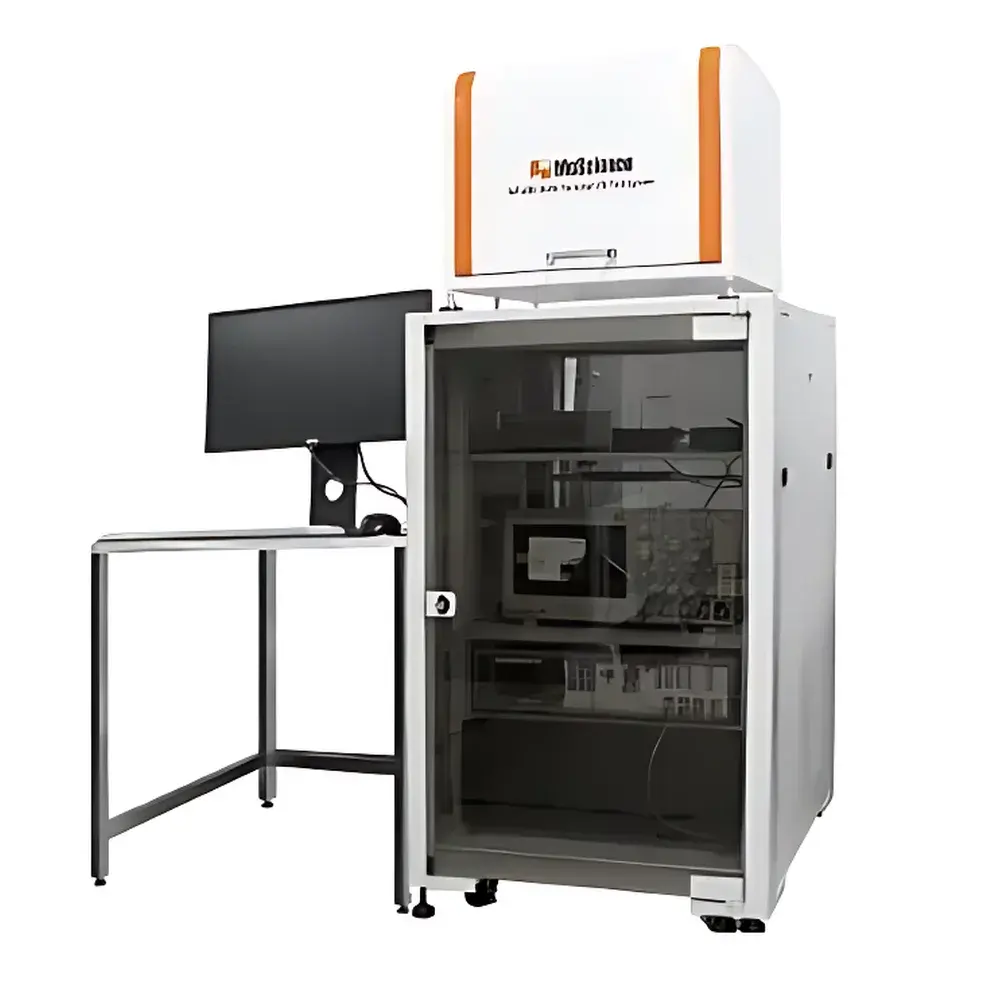
McScience M6200 Transient Electroluminescence & Photoluminescence Cryogenic Characterization System
| Brand | McScience |
|---|---|
| Origin | South Korea |
| Model | M6200 |
| Application | Transient EL/PL, Carrier Dynamics, Low-Temperature Spectroscopy |
| Excitation Sources | Precision Current Pulse Generator (for Tr-EL) & Ultrafast Pulsed Laser (for TR-PL) |
| Temperature Range | 10 K – 300 K (with Closed-Cycle Cryostat) |
| Detection | Time-Correlated Single Photon Counting (TCSPC) or Fast Digitizer (up to 1 GS/s) |
| Spectral Resolution | < 0.5 nm (with 1/4 m Monochromator) |
| Temporal Resolution | < 50 ps (TR-PL), < 100 ns (Tr-EL) |
| Compliance | ASTM F2891–22 (OLED Device Testing), ISO/IEC 17025–2017 (Calibration Traceability) |
Overview
The McScience M6200 Transient Electroluminescence & Photoluminescence Cryogenic Characterization System is an engineered platform for quantitative, time-resolved optoelectronic analysis of organic and hybrid light-emitting devices—including OLEDs, perovskite LEDs (PeLEDs), quantum-dot LEDs (QLEDs), and TADF-based emitters. It operates on two complementary physical excitation pathways: transient electroluminescence (Tr-EL), driven by precisely shaped current pulses applied directly to the device under test; and time-resolved photoluminescence (TR-PL), initiated by sub-nanosecond pulsed laser excitation. The system integrates a high-stability closed-cycle cryostat (10 K–300 K), enabling temperature-dependent carrier dynamics mapping—critical for distinguishing trap-assisted recombination, triplet–triplet annihilation, and thermally activated delayed fluorescence (TADF) mechanisms. Its architecture supports both direct current pulse triggering (for charge transport and turn-on delay analysis) and optical pumping (for intrinsic exciton lifetime quantification), making it suitable for fundamental studies in device physics as well as process development in R&D laboratories compliant with ISO/IEC 17025 calibration frameworks.
Key Features
- Modular dual-excitation design: Independent Tr-EL and TR-PL measurement modes, each with dedicated timing electronics and synchronization logic
- Cryogenic operation from 10 K to 300 K using a vibration-isolated, low-base-temperature closed-cycle refrigeration system
- High-fidelity temporal resolution: <50 ps for TR-PL (via TCSPC with ultrafast PMT or SPAD detector); <100 ns for Tr-EL (using calibrated fast current source and digitizer)
- Integrated monochromator-based spectral detection (1/4 m focal length, Czerny–Turner configuration) with spectral resolution <0.5 nm across 250–1100 nm range
- Automated long-persistence luminescence (afterglow) acquisition up to 10⁴ s with logarithmic time-binning and dark-current compensation
- Hardware-level trigger synchronization between pulse generator, laser driver, detector gate, and data acquisition unit (sub-ns jitter)
Sample Compatibility & Compliance
The M6200 accommodates standard OLED substrate formats (up to 50 mm × 50 mm) with vacuum-compatible electrical feedthroughs and optical access via fused silica windows (UV–NIR broadband transmission). Device contact is achieved through spring-loaded micro-probes or wire-bonded electrode interfaces, minimizing series resistance artifacts. All optical and electronic modules are calibrated traceably to NIST standards. The system meets ASTM F2891–22 requirements for transient luminance and voltage response characterization of emissive display devices. Data acquisition firmware supports audit-trail logging and user-access control per FDA 21 CFR Part 11 guidelines when operated in GLP/GMP-aligned environments. Calibration certificates for timing electronics, temperature sensors, and spectral responsivity are provided with each installation.
Software & Data Management
Acquisition and analysis are performed using McScience’s proprietary M6200 Control Suite—a Windows-based application built on .NET Framework with deterministic real-time scheduling. The software enables synchronized multi-parameter capture: time-domain decay traces, spectral evolution maps (λ vs. t), temperature sweeps with auto-hold stabilization, and derivative metrics including τ₁, τ₂, average lifetime (τₐᵥ), and stretched exponential β parameters. Export formats include HDF5 (for MATLAB/Python interoperability), CSV (with metadata headers), and industry-standard CDF. Raw datasets retain full timestamping, hardware configuration snapshots, and environmental logs (cryostat pressure, stage temperature stability ±0.02 K over 1 h). Optional API integration allows remote scripting via Python SDK for high-throughput screening workflows.
Applications
- Quantifying carrier mobility and injection barriers via transient EL rise/fall kinetics under varied bias conditions
- Distinguishing monomolecular (radiative recombination) vs. bimolecular (exciton–exciton annihilation) decay pathways in TADF and hyperfluorescence systems
- Mapping trap density distribution through temperature-dependent Tr-EL decay analysis (thermal detrapping modeling)
- Evaluating operational stability: tracking luminance decay kinetics during accelerated aging at elevated temperatures
- Correlating TR-PL lifetimes with film morphology (e.g., crystallinity gradients measured via GIWAXS) in solution-processed PeLEDs
- Validating exciton confinement efficiency in multilayer QD-OLED architectures via interfacial PL quenching dynamics
FAQ
What minimum detectable lifetime does the M6200 support in TR-PL mode?
The system achieves instrument response function (IRF) widths below 50 ps using optimized TCSPC configuration, enabling reliable fitting of decays down to ~150 ps (subject to sample quantum yield and signal-to-noise ratio).
Can the M6200 perform simultaneous spectral and temporal acquisition?
Yes—using the monochromator-scanned TCSPC mode or gated ICCD option, users acquire full decay curves at each wavelength step, generating time-resolved emission spectra (TRES) matrices.
Is vacuum compatibility required for cryogenic operation?
No. The integrated cryostat uses helium exchange gas cooling; however, optional vacuum jacketing is available to suppress condensation and improve thermal stability below 80 K.
Does the system support pulsed DC bias for Tr-EL measurements on fragile thin-film devices?
Yes—the current pulse generator delivers programmable amplitude (±1 µA to ±1 A), width (100 ns–10 s), and duty cycle (0.001–99.9%), with active compliance limiting to prevent dielectric breakdown.
How is temperature uniformity ensured across the sample stage?
The cold finger incorporates a high-conductivity copper mounting plate with embedded Pt-1000 sensors and feedback-controlled thermal shunts, achieving ±0.05 K spatial uniformity over 25 mm diameter.