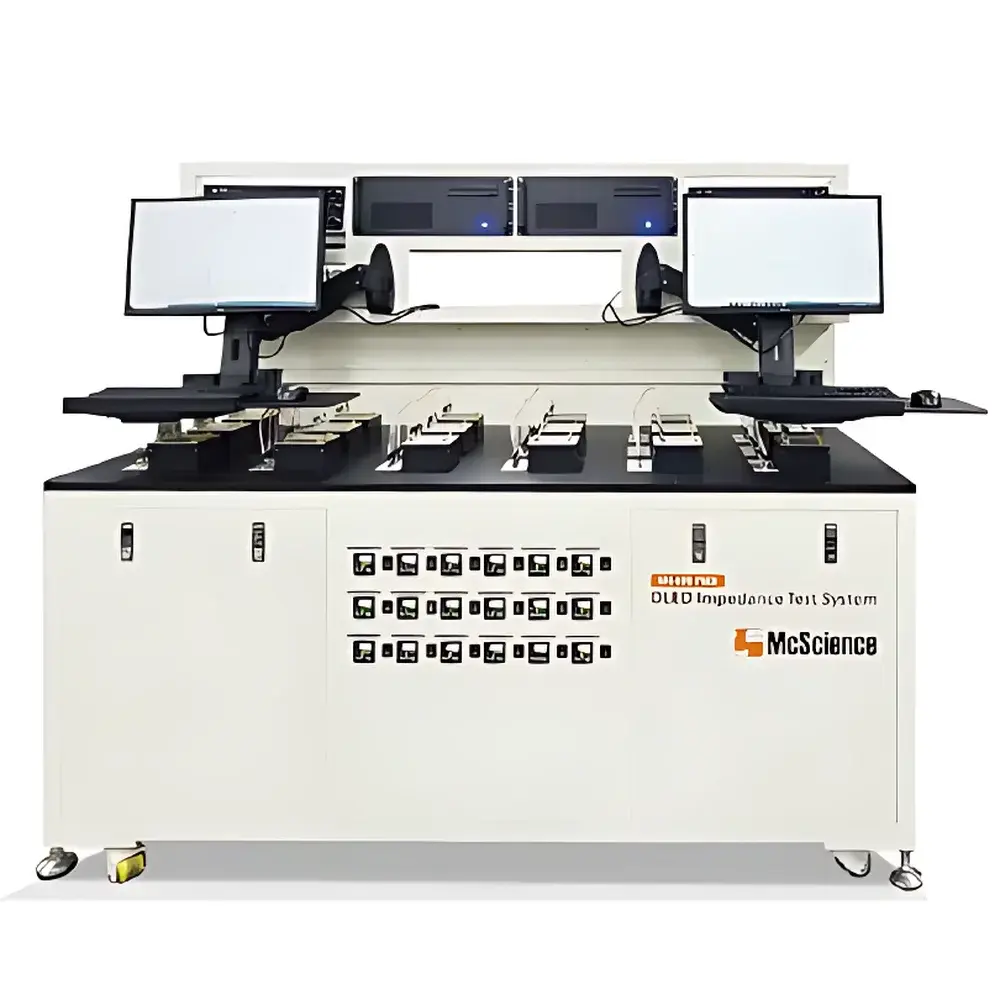
McScience M6400 OLED Impedance Spectroscopy System
| Brand | McScience |
|---|---|
| Origin | South Korea |
| Manufacturer Type | Authorized Distributor |
| Origin Category | Imported |
| Model | M6400 |
| Pricing | Upon Request |
Overview
The McScience M6400 OLED Impedance Spectroscopy System is a precision-engineered platform designed for comprehensive electrical characterization of organic light-emitting diode (OLED) devices and related thin-film semiconductor structures. It operates on the principles of frequency-domain impedance spectroscopy (IS), capacitance–voltage (C–V), and capacitance–frequency (C–F) analysis to extract critical device parameters including charge injection barriers, carrier mobility, interfacial trap density, dielectric constant, and series/parallel impedance components. Unlike general-purpose LCR meters, the M6400 integrates synchronized bias control, multi-step automated sequencing, and optional thermal regulation—enabling quantitative, reproducible measurements under controlled DC bias, AC excitation, and environmental conditions. Its architecture supports both steady-state and transient response evaluation, making it suitable for R&D laboratories focused on emissive layer optimization, interface engineering, and degradation mechanism studies in solution-processed or vacuum-deposited OLED stacks.
Key Features
- Automated multi-sample measurement sequence with programmable sample indexing—reducing manual handling and improving throughput consistency.
- Simultaneous DC bias sweep and AC frequency sweep (C–F mode) for impedance component decomposition across 10 mHz–5 MHz range.
- Fixed-frequency C–V profiling with high-resolution voltage stepping (10 mV step resolution) to quantify charge accumulation, depletion width, and effective doping concentration.
- Multi-condition measurement scripting (CFV and CVF modes): enables combined frequency–bias sweeps for 2D parameter mapping (e.g., capacitance vs. frequency at multiple bias points, or capacitance vs. bias across discrete frequencies).
- Optional ThermoStation integration: supports independent temperature setpoints per sample stage (−40 °C to +150 °C, ±0.1 °C stability), enabling Arrhenius-based activation energy extraction and thermal reliability assessment.
- Built-in guard shielding, low-noise current preamplification, and four-terminal (Kelvin) probing configuration to minimize parasitic interference and ensure traceable measurement integrity.
Sample Compatibility & Compliance
The M6400 accommodates standard OLED test substrates (e.g., ITO/glass, flexible PET/PEN, and encapsulated pixel arrays) with electrode configurations up to 8 mm × 8 mm. It supports both bottom-emission and top-emission architectures, as well as non-encapsulated devices under nitrogen glovebox integration. Measurement protocols align with ASTM F3025–16 (Standard Practice for Electrical Characterization of Organic Semiconductor Devices) and ISO/IEC 17025–2017 requirements for calibration traceability and uncertainty quantification. The system’s software enforces user-level access control, audit trails, and electronic signature capability—supporting GLP-compliant data acquisition environments and FDA 21 CFR Part 11 readiness when deployed with validated IT infrastructure.
Software & Data Management
Control and analysis are executed via McScience’s proprietary ImpedanceStudio v4.x software, a Windows-based application with intuitive workflow builder, real-time FFT-based noise monitoring, and batch-processing engine. Raw data are stored in HDF5 format with embedded metadata (timestamp, operator ID, instrument configuration, environmental logs). Export options include CSV, MATLAB (.mat), and IMP (ZView-compatible) formats. Advanced analysis modules include equivalent circuit modeling (ECM) using nonlinear least-squares fitting (Levenberg–Marquardt algorithm), Kramers–Kronig validation, and distribution-of-relaxation-times (DRT) transformation. All measurement sessions generate PDF reports with configurable templates, compliant with internal SOPs and external regulatory submissions.
Applications
- Quantifying hole/electron injection barriers at anode/organic and cathode/organic interfaces via C–V-derived built-in potential and barrier height estimation.
- Evaluating carrier mobility in transport layers using low-bias C–F dispersion analysis and space-charge-limited current (SCLC) correlation.
- Monitoring interfacial degradation under accelerated aging (bias stress + thermal cycling) through time-resolved impedance spectra.
- Characterizing encapsulation layer integrity via moisture-induced capacitance drift and low-frequency dielectric loss peaks.
- Validating batch-to-batch uniformity of printed OLED emitters by statistical comparison of C–V hysteresis area and frequency-dependent phase angle.
FAQ
What types of electrodes are compatible with the M6400?
The system supports standard probe stations with tungsten carbide or beryllium-copper tips; custom fixtures for edge-contact, top-contact, or coplanar configurations can be integrated upon specification.
Does the M6400 support pulsed bias or transient impedance measurement?
No—it is optimized for steady-state AC impedance and quasi-static C–V; for time-domain transients, McScience recommends coupling with external source-measure units (SMUs) via TTL synchronization.
Is calibration required before each measurement session?
A full two-port open/short/load calibration is recommended before daily operation; on-the-fly compensation for cable length and fixture parasitics is available via built-in calibration wizard.
Can the ThermoStation option be retrofitted to existing M6400 units?
Yes—retrofit kits including thermal interface hardware, firmware update, and software license activation are available directly from McScience authorized service centers.
How is data security managed during remote operation?
All network communication uses TLS 1.2 encryption; local storage adheres to NIST SP 800-53 controls; role-based permissions prevent unauthorized export or modification of raw datasets.