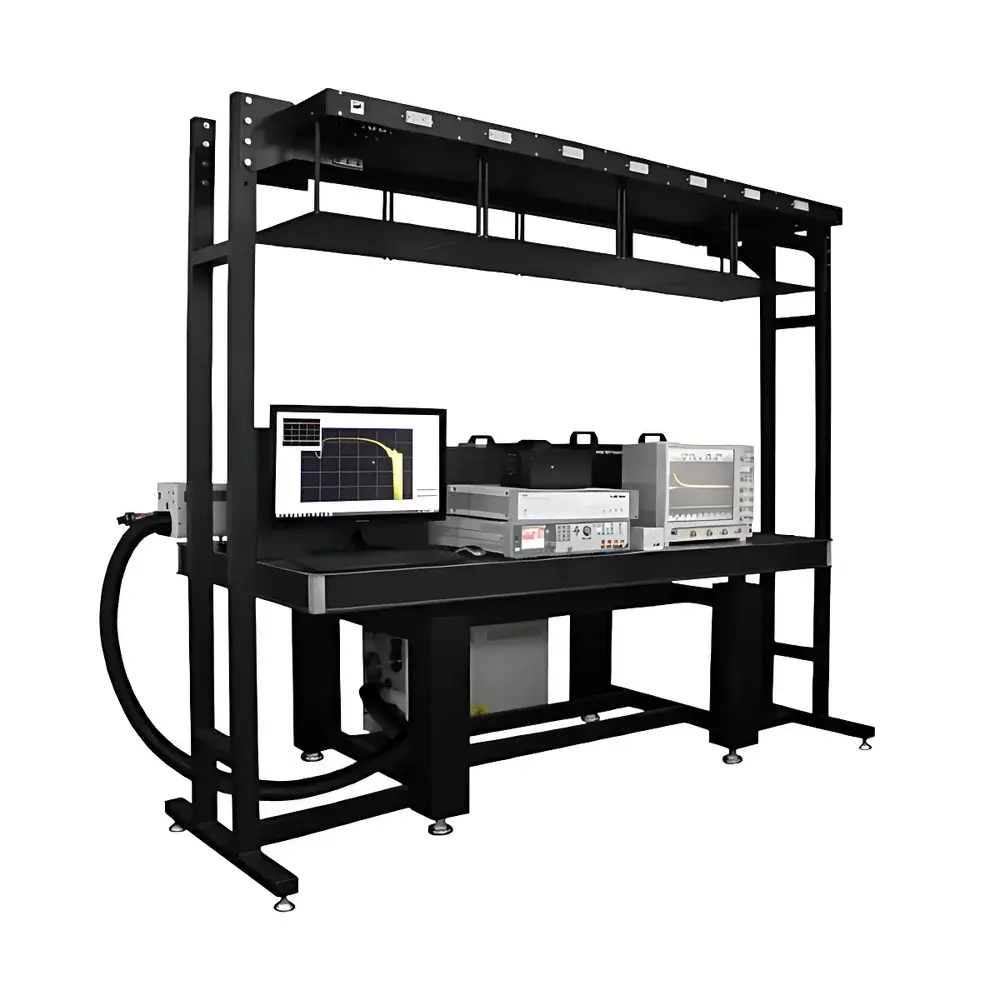
McScience T3000 PLUS OLED Time-Delayed Collection Field (TDCF) Measurement System
| Brand | McScience |
|---|---|
| Origin | South Korea |
| Model | T3000 PLUS |
| Application | Transient charge dynamics characterization of organic optoelectronic devices |
| Core Excitation Source | Nanosecond-pulsed laser system |
| Timing Resolution | Sub-nanosecond delay control |
| Bias Control | Programmable DC/AC voltage source (±100 V, <10 mV resolution) |
| Detection Bandwidth | DC to 2 GHz (current amplification + digitization) |
| Compliance | Fully compatible with ISO/IEC 17025 laboratory practices for transient electrical measurements |
Overview
The McScience T3000 PLUS OLED Time-Delayed Collection Field (TDCF) Measurement System is a purpose-built instrumentation platform engineered for quantitative analysis of transient charge carrier dynamics in organic semiconductor thin-film devices. Operating on the fundamental principle of time-resolved photocurrent extraction under controlled electric field modulation, the system enables direct interrogation of charge generation, separation, transport, and recombination kinetics on nanosecond-to-microsecond timescales. Unlike steady-state characterization methods, TDCF provides intrinsic temporal resolution by decoupling photogeneration events (via precisely timed laser excitation) from subsequent collection bias application—allowing independent variation of delay time, field strength, and spectral excitation. The system integrates a synchronized nanosecond-pulsed laser source, high-bandwidth current transients acquisition module, programmable voltage bias unit, and optical path alignment stage optimized for standard OLED, OPV, and perovskite device architectures.
Key Features
- Sub-500 ps timing jitter between laser trigger and bias pulse onset, enabling reliable resolution of early-time carrier trapping and detrapping processes.
- Dual-channel synchronized acquisition: simultaneous measurement of transient photocurrent and reference photodiode signal for real-time normalization and drift compensation.
- Programmable bias waveform generator supporting DC, pulsed, ramped, and bipolar voltage profiles (±100 V range, 10 mV step resolution, 10 ns rise time).
- Laser excitation flexibility: interchangeable diode-pumped solid-state (DPSS) modules at 355 nm, 405 nm, 532 nm, and 635 nm—each with adjustable pulse energy (0.1–100 µJ) and repetition rate (1 Hz–1 MHz).
- Modular detector interface accommodating both low-noise transimpedance amplifiers (10⁴–10⁹ V/A gain) and high-speed oscilloscopes (≥2 GHz bandwidth) for optimal signal fidelity across dynamic ranges.
- Thermally stabilized sample stage with vacuum-compatible flange option and integrated temperature monitoring (−40 °C to +85 °C, ±0.1 °C stability).
Sample Compatibility & Compliance
The T3000 PLUS supports standard device geometries including ITO/PEDOT:PSS/Active Layer/Ca/Al, ITO/ZnO/Perovskite/Spiro-OMeTAD/Au, and inverted OPV stacks. Device contact configurations (planar, sandwich, lateral electrode) are accommodated via configurable probe station integration. All electrical and optical calibration procedures adhere to traceable NIST-referenced standards. Data acquisition workflows are designed to meet ISO/IEC 17025 requirements for transient electrical testing laboratories, including full audit trails for instrument settings, environmental parameters, and raw data provenance. While not certified as medical or safety-critical equipment, the system complies with IEC 61010-1 for measurement, control, and laboratory use.
Software & Data Management
Acquisition and analysis are performed using McScience’s proprietary TDCF Studio v4.x software suite, built on a modular LabVIEW-based architecture. The software implements automated parameter sweeps (delay time, bias voltage, laser fluence), real-time FFT-based noise filtering, and multi-exponential decay fitting (Levenberg–Marquardt algorithm). Export formats include HDF5 (for long-term archival), CSV (for third-party modeling tools), and MATLAB .mat files. All raw waveforms and metadata are stored with embedded timestamps, instrument configuration hashes, and user-defined experiment tags. Audit logging satisfies GLP/GMP documentation needs, with optional 21 CFR Part 11 compliance add-on (electronic signatures, role-based access control, and immutable record retention).
Applications
- Quantitative extraction of hole/electron mobility via time-of-flight (TOF) analysis under variable bias and temperature.
- Discrimination of geminate vs. non-geminate recombination pathways through delay-dependent collection efficiency mapping.
- Correlation of transient electroluminescence (Tr-EL) onset delay with interfacial charge accumulation in tandem OLEDs.
- Interface trap density estimation in perovskite solar cells using bias-dependent TDCF hysteresis analysis.
- Stability assessment of operational degradation mechanisms (e.g., ion migration, interfacial dipole relaxation) under accelerated pulsed stress conditions.
FAQ
What types of organic semiconductor devices can be tested with the T3000 PLUS?
Standard OLEDs, organic photovoltaics (OPVs), perovskite light-emitting diodes (PeLEDs), and organic field-effect transistors (OFETs) with active layer thicknesses between 50 nm and 500 nm.
Is laser safety certification included with the system?
Yes—the integrated laser subsystem complies with IEC 60825-1 Class IV requirements; full safety interlocks, beam shutter, and key-controlled operation are standard.
Can the system be upgraded for low-temperature transient measurements?
Yes—optional cryogenic probe station integration (down to 10 K) is available with magnetic shielding and differential thermal contraction compensation.
Does the software support batch processing of multiple TDCF datasets?
Yes—batch analysis mode enables parallel fitting of >100 delay scans with automatic outlier rejection and statistical summary reporting.
How is calibration traceability maintained across instrument lifetime?
Annual factory calibration includes laser pulse width verification (using autocorrelator), current amplifier linearity check (with precision current source), and timing skew validation (via RF signal generator and time-interval analyzer).