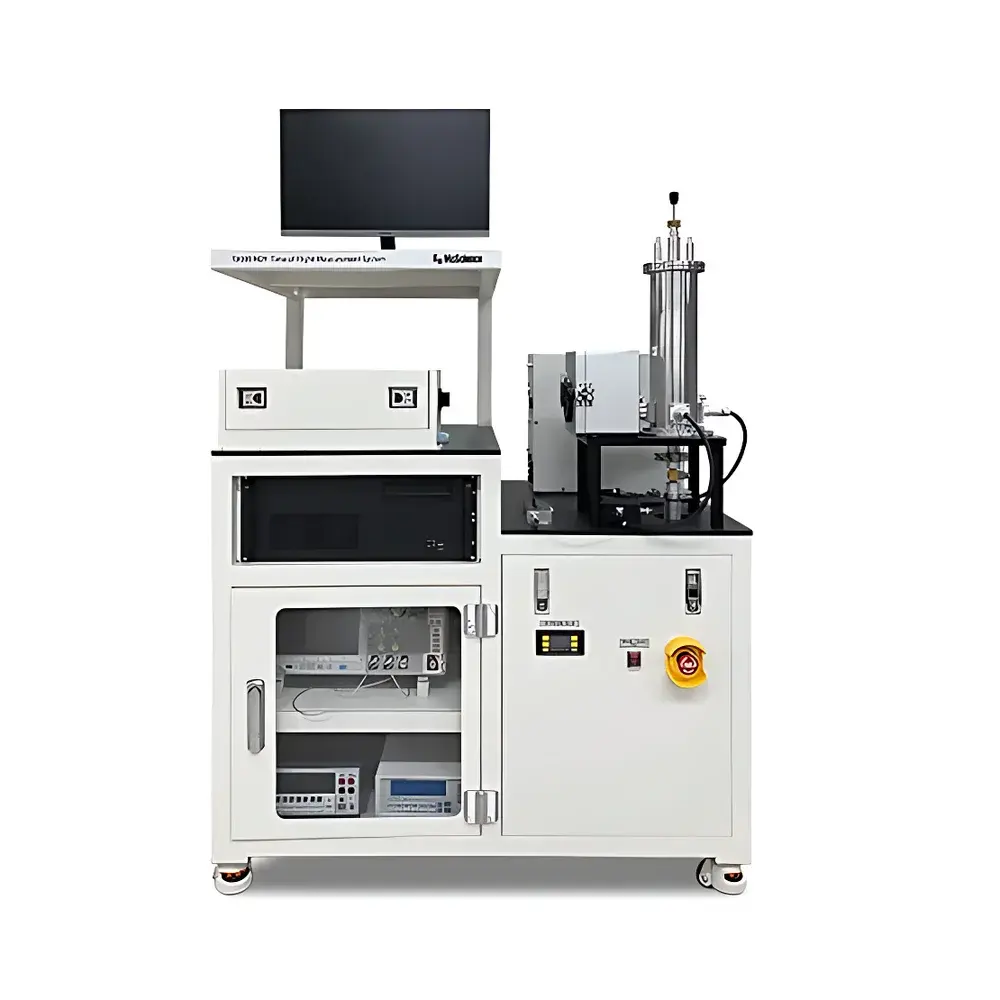
McScience T3000 Time-of-Flight (TOF) Mobility Measurement System for Organic Semiconductors
| Brand | McScience |
|---|---|
| Origin | South Korea |
| Model | T3000 |
| Type | Time-of-Flight Carrier Mobility Characterization System |
| Application Domain | Organic Light-Emitting Diode (OLED) Materials & Thin-Film Semiconductor Research |
| Temperature Range | 10 K to 350 K (with optional cryostat integration) |
| Excitation Source | Pulsed UV–Vis Laser (e.g., 355 nm or 405 nm, <10 ns pulse width) |
| Detection Bandwidth | ≥500 MHz transient current acquisition |
| Measurement Modes | Standard TOF, Dark Injection Transient (DIT), Charge Extraction by Linearly Increasing Voltage (CELIV) |
Overview
The McScience T3000 Time-of-Flight (TOF) Mobility Measurement System is a dedicated instrumentation platform engineered for quantitative characterization of charge carrier transport properties in organic semiconductor thin films—particularly those used in OLED device architectures, organic photovoltaics (OPVs), and perovskite optoelectronic layers. It operates on the fundamental principle of time-resolved photocurrent transient analysis: a short-pulse laser generates a sheet of carriers near one electrode; under an applied electric field, these carriers drift across the active layer, and their transit time is measured via high-bandwidth current detection. From the onset of the transient photocurrent and the known film thickness, electron or hole mobility (μ) is calculated using the classical relation μ = d²/(V·tₜᵣ), where d is thickness, V is bias voltage, and tₜᵣ is the carrier transit time. The system supports variable-temperature operation down to 10 K, enabling systematic investigation of thermally activated hopping transport, trap distribution, and energetic disorder—critical parameters for material optimization and device physics modeling.
Key Features
- Integrated pulsed laser excitation module with selectable wavelengths (355 nm, 405 nm, or custom options) and sub-10 ns pulse duration for spatially confined carrier generation.
- High-fidelity transient current acquisition with ≥500 MHz analog bandwidth and 12-bit vertical resolution, synchronized to laser trigger with <100 ps jitter.
- Programmable DC bias supply (±200 V, 0.1% accuracy) with fast voltage ramping for CELIV mode and stable bias hold for standard TOF and DIT measurements.
- Modular cryogenic interface compatible with closed-cycle helium cryostats or liquid nitrogen dewars, enabling precise temperature control from 10 K to 350 K with ±0.1 K stability.
- Electrode-compatible sample stage supporting standard ITO/PEDOT:PSS/active-layer/Al or Ca/Ag sandwich structures; accommodates substrates up to 25 mm × 25 mm.
- Low-noise preamplifier and differential signal conditioning optimized for picoampere-level transient currents in dark and illuminated conditions.
Sample Compatibility & Compliance
The T3000 is validated for use with solution-processed and vacuum-deposited organic semiconductors including small molecules (e.g., Alq₃, NPB, TPD) and conjugated polymers (e.g., P3HT, PTB7, PVK). It supports bilayer and bulk-heterojunction configurations relevant to OLED emissive layers and charge transport interlayers. All electronic modules comply with IEC 61000-6-3 (EMI emission) and IEC 61000-6-2 (immunity) standards. Data acquisition firmware implements audit-trail logging and user-access controls aligned with GLP-compliant laboratory practices. While not FDA-certified (as a research instrument), the system architecture supports 21 CFR Part 11 readiness when deployed with validated third-party LIMS or ELN platforms.
Software & Data Management
The T3000 is operated via McScience’s proprietary TOF-Analyzer software suite (Windows 10/11, 64-bit), which provides real-time oscilloscope-style waveform display, automated transit time extraction (first-derivative peak or inflection-point methods), mobility calculation with error propagation, and batch-mode temperature-dependent fitting. Raw transient data are saved in HDF5 format with embedded metadata (laser energy, bias, temperature, thickness, ambient conditions). Export options include CSV, MATLAB (.mat), and Origin-compatible XY files. Software includes built-in models for dispersive vs. non-dispersive transport analysis and supports custom scripting via Python API (pyT3000) for advanced statistical fitting (e.g., Gaussian disorder model, multiple trapping-detrapping simulations).
Applications
- Quantification of electron/hole mobility anisotropy in multilayer OLED stacks under operational bias conditions.
- Correlation of thermal activation energy (Eₐ) with molecular packing order via Arrhenius analysis of μ(T) across 10–300 K.
- Distinguishing between trap-limited and band-like transport mechanisms through dispersion exponent (α) evaluation in TOF transients.
- Interfacial trap density estimation using Dark Injection Transient (DIT) analysis in electron-only or hole-only devices.
- Charge extraction efficiency mapping in low-mobility systems (e.g., mixed halide perovskites) via CELIV-derived mobility and recombination lifetime coupling.
- Validation of computational material screening outputs (e.g., DFT-predicted transfer integrals) against experimentally derived mobility values.
FAQ
What film thickness range is suitable for reliable TOF mobility extraction?
For standard TOF analysis, active layer thickness should be 100 nm to 2 µm—sufficient to resolve transit time above system temporal resolution while minimizing series resistance effects.
Can the T3000 measure mobility separately for electrons and holes?
Yes—by fabricating unipolar test devices (e.g., ITO/PEDOT:PSS/organic/Al for holes; ITO/ZnO/organic/Ca for electrons) and selecting appropriate laser penetration depth and electrode work functions.
Is laser fluence calibration traceable to NIST standards?
Laser energy is measured in situ using a calibrated photodiode sensor (traceable to NPL or NIST-equivalent national metrology institutes); full calibration reports are provided with each system shipment.
Does the system support automated temperature sweeps with data synchronization?
Yes—software-controlled cryostat communication (via RS-232 or Ethernet) enables fully automated temperature ramps with synchronized TOF acquisition at user-defined setpoints and dwell times.
What level of technical support and application assistance is included post-purchase?
McScience provides 24-month hardware warranty, remote configuration support, and access to application scientists for method development—including protocol optimization for novel materials and collaborative data interpretation workshops.