
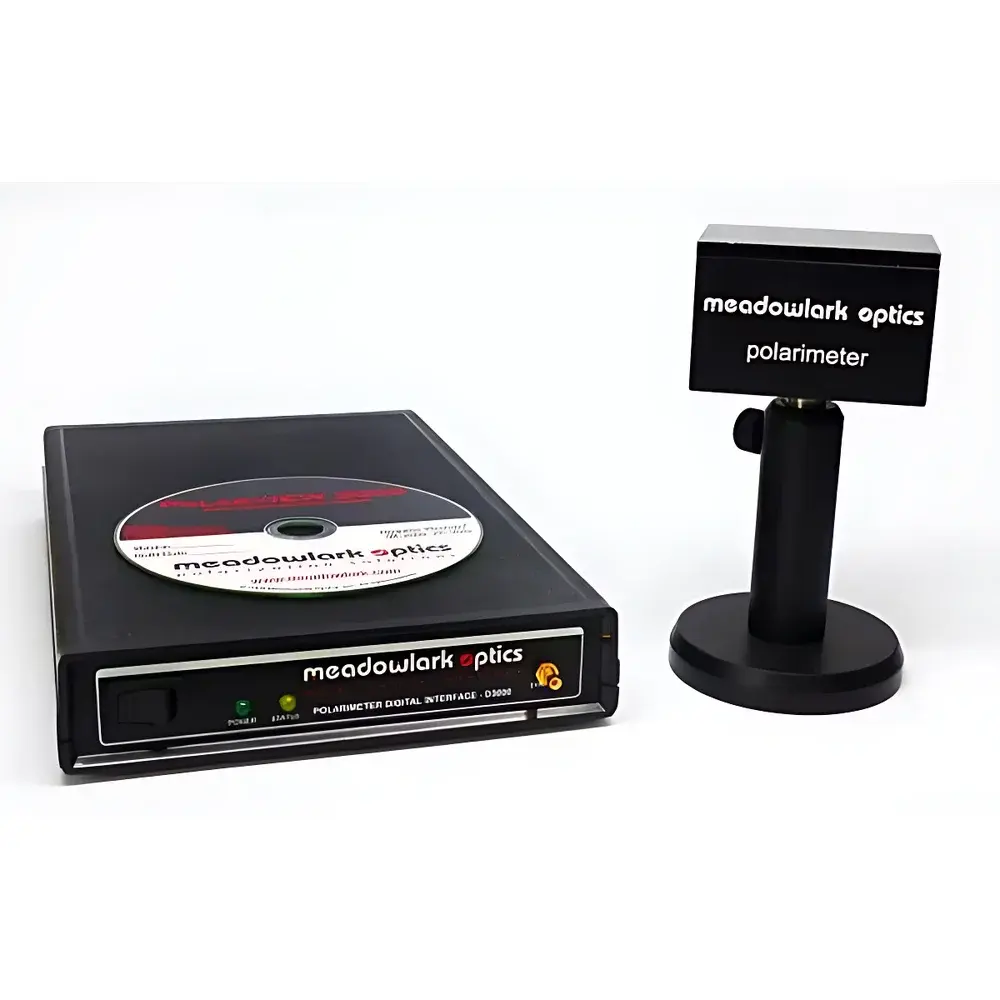
Meadowlark Optics Broadband Liquid Crystal Polarimeter
| Brand | Hinds Instruments |
|---|---|
| Origin | USA |
| Manufacturer Type | Authorized Distributor |
| Origin Category | Imported |
| Model | Broadband Polarimeter |
| Price | Upon Request |
Overview
The Meadowlark Optics Broadband Liquid Crystal Polarimeter is a high-precision, solid-state polarimetric measurement system engineered for rapid, repeatable characterization of polarization states across broad spectral ranges. Unlike traditional rotating-waveplate or photoelastic modulator (PEM)-based polarimeters, this instrument employs patented liquid crystal variable retarders (LCVRs) to perform full Stokes vector acquisition without any mechanical motion. Its measurement principle is based on time-synchronized, multi-step retardance modulation followed by intensity detection — enabling robust, vibration-insensitive determination of the four Stokes parameters (S₀, S₁, S₂, S₃) at up to 10 Hz frame rate. Designed for integration into optical test benches, laser development labs, and fiber-optic component qualification workflows, it delivers metrology-grade polarization analysis in a compact, benchtop-ready form factor.
Key Features
- Solid-state architecture with zero moving parts — eliminates mechanical wear, backlash, and vibration-induced measurement drift
- Two spectral configurations: Visible (450–1100 nm) and Near-Infrared (900–1700 nm), each calibrated for wavelength-dependent retardance compensation
- Polarization degree (DOP) measurement accuracy ≤ ±1% (at S₀ ≥ 1 µW optical power)
- Stokes vector resolution of 0.001 (16-bit ADC with hardware-level noise suppression)
- Real-time visualization of polarization state on Poincaré sphere, polarization ellipse, and temporal trajectory plots
- Integrated thermal stabilization option ensures LCVR operational stability across ambient temperature fluctuations (±0.1 °C control precision)
- USB 2.0 interface with native LabVIEW VI library, Python API, and SCPI-compatible command set for automated system integration
Sample Compatibility & Compliance
This polarimeter supports both free-space and fiber-coupled input configurations, accommodating collimated beams (Ø1–5 mm) and standard single-mode or multimode fibers (FC/PC, FC/APC). It is compatible with CW and pulsed sources (repetition rates >1 kHz), provided average power remains within the 1 µW–10 mW dynamic range. The instrument complies with ISO 10110-6 (optical element polarization specifications), adheres to NIST-traceable calibration practices, and supports audit-ready data logging required under GLP and GMP environments. Optional firmware enables timestamped, user-annotated measurement records compliant with FDA 21 CFR Part 11 when used with validated software platforms.
Software & Data Management
The included PolarView™ control software provides real-time parameter display, live Poincaré sphere rendering, and export of raw Stokes vectors in CSV, HDF5, and MATLAB .mat formats. Advanced features include automated baseline correction, multi-wavelength calibration mapping, and SOP (State-of-Polarization) drift trending over time. All calibration matrices are stored onboard non-volatile memory and can be reloaded without recalibration. For OEM integration, the SDK includes C/C++, .NET, and Python bindings, along with detailed documentation for embedding into custom test sequences or CI/CD-controlled optical alignment systems.
Applications
- Characterization of polarization-maintaining (PM) fibers and fiber optic components (isolators, circulators, couplers)
- Monitoring SOP drift in interferometric sensors and coherent communication systems
- Calibration and verification of waveplates, polarization rotators, and electro-optic modulators
- Material birefringence mapping in thin-film coatings, liquid crystals, and photonic crystals
- Validation of polarization purity in ultrafast laser systems and quantum optics setups
- In-line polarization monitoring during semiconductor lithography tool alignment
FAQ
What wavelength ranges does this polarimeter support?
It offers two interchangeable models: visible (450–1100 nm) and near-infrared (900–1700 nm), each factory-calibrated across its full band.
Can it measure low-power signals?
Yes — minimum detectable power is 1 µW (for S₀ ≥ 1 µW, DOP uncertainty remains ≤1%).
Is thermal stabilization mandatory?
Not mandatory, but strongly recommended for applications requiring long-term stability (>1 hour) or operation outside 20–25 °C ambient conditions.
Does it support automated data export for QA/QC reporting?
Yes — all measurements include UTC timestamps, user-defined metadata fields, and configurable export templates compatible with LIMS and MES systems.
How is calibration maintained over time?
The system stores wavelength-specific calibration matrices in EEPROM; periodic verification using NIST-traceable reference standards is advised every 12 months per ISO/IEC 17025 guidelines.



