
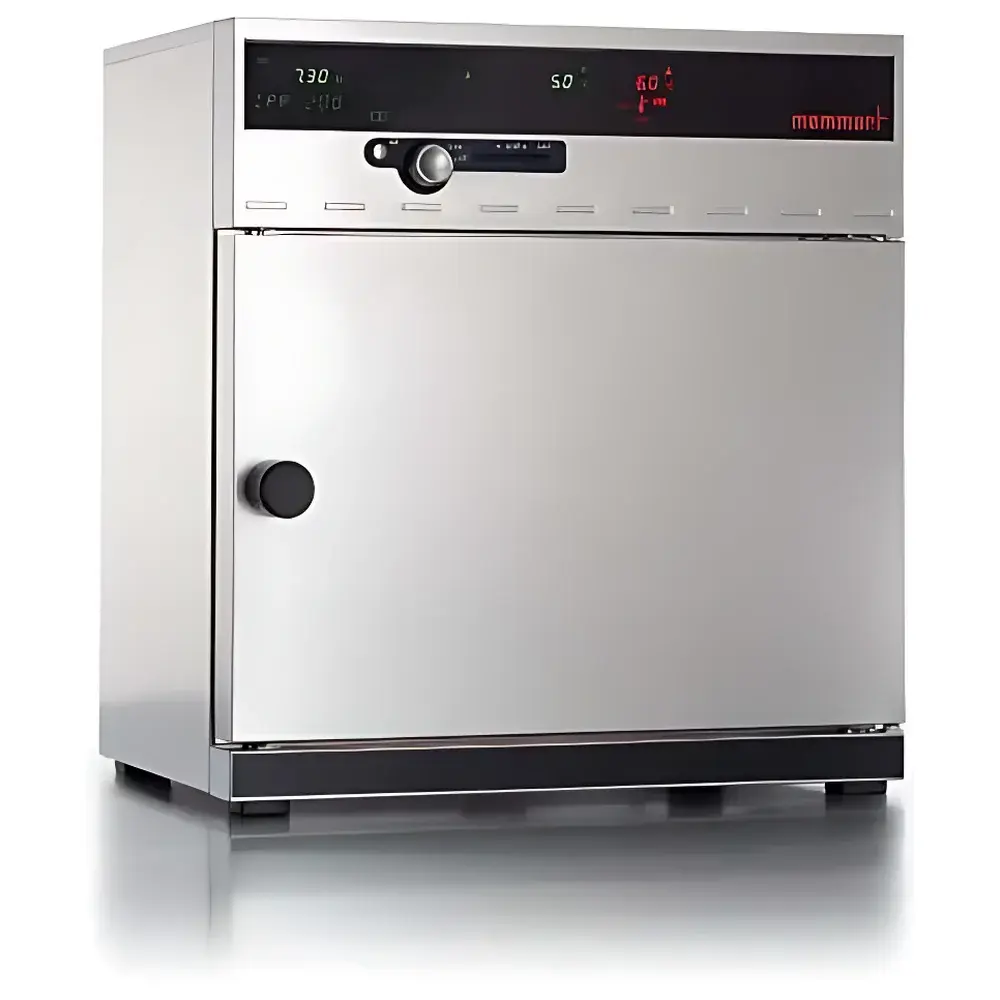
MEMMERT HPP Series Temperature and Humidity Controlled Chamber
| Brand | MEMMERT |
|---|---|
| Origin | Germany |
| Model | HPP110 / HPP260 / HPP750 |
| Chamber Type | Upright |
| Temperature Range (no light) | 0 °C to +70 °C |
| Temperature Range (with LED lighting) | +10 °C to +40 °C |
| Humidity Range (no light) | 10 %rh to 90 %rh |
| Humidity Range (with LED lighting) | 10 %rh to 85 %rh |
| Temperature Setting Resolution | 0.1 K |
| Humidity Setting Resolution | 1 %rh |
| Power Consumption (approx.) | 350 W (HPP110) / 525 W (HPP260) / 1050 W (HPP750) |
| Internal Volume | 108 L / 256 L / 749 L |
| Construction | Stainless Steel Interior |
| Compliance | ICH Q1A, GLP/GMP-ready, FDA 21 CFR Part 11 compatible (with optional software package) |
Overview
The MEMMERT HPP Series Temperature and Humidity Controlled Chambers are precision-engineered environmental test systems designed specifically for long-term stability testing of pharmaceuticals, biologics, medical devices, and advanced materials in accordance with ICH Q1A(R3) guidelines. Unlike conventional compressor-based chambers, the HPP utilizes solid-state thermoelectric (Peltier) technology for both heating and cooling—enabling exceptional thermal and hygrometric stability without refrigerants, mechanical compressors, or oil-lubricated components. This architecture eliminates vibration, reduces acoustic emissions to <35 dB(A), and delivers uniform temperature distribution (±0.3 K) and humidity homogeneity (±2 %rh) across the entire working volume. The system operates within a validated range of 0 °C to +70 °C and 10–90 %rh (non-illuminated), with reduced operational envelopes (+10 °C to +40 °C; 10–85 %rh) when equipped with optional LED illumination modules. Its energy efficiency—up to 90% lower power draw compared to equivalent compressor-driven units—supports sustainable laboratory operations while maintaining full compliance with ISO 17025, ASTM E2737, and EU GMP Annex 15 requirements for qualification.
Key Features
- Solid-state Peltier temperature control: No refrigerants, no moving parts, zero maintenance over extended service intervals
- Triple-point programmable IQ/OQ/PQ validation support: Independent setpoint selection for three user-defined calibration points directly via touchscreen interface
- Stainless steel interior (1.4301/AISI 304) with seamless welded corners and electropolished finish for corrosion resistance and cleanability
- Modular LED illumination system (optional): Dual-color (2700 K + 5500 K) or single-spectrum (5500 K) arrays, programmable brightness (0–100% in 10% increments), 10,000 Lux intensity at sample level
- Integrated Pt100 sensors (3 configurable positions) and 4–20 mA analog outputs for external monitoring of temperature (V3), humidity (V6), and chamber status (V4 calibration certificate option)
- Standard 23 mm access ports (F0–F6) with silicone plugs and optional 40 mm rear port (F7); all penetrations sealed to IP54-rated integrity
- Configurable internal power outlets (R3): 230 V / 2.2 A, thermostatically isolated, controllable via chamber software
Sample Compatibility & Compliance
The HPP series accommodates diverse sample formats—including vials, trays, blister packs, syringes, and stability study kits—on adjustable stainless steel grid shelves (standard load capacity: 30 kg/shelf; reinforced options up to 60 kg available). All models meet ICH Q1A(R3) accelerated and intermediate storage conditions (e.g., 40 °C/75 %rh, 30 °C/65 %rh, 25 °C/60 %rh) with documented uncertainty budgets traceable to national standards. Optional accessories—including calibrated humidity sensors (V4), central water management (B04359), and bottom drip trays (E02073)—support GLP-compliant workflows. Full qualification documentation (DQ/IQ/OQ/PQ templates), 21 CFR Part 11–compliant audit trails (via optional software), and factory-issued calibration certificates ensure readiness for regulatory inspections by FDA, EMA, PMDA, and Health Canada.
Software & Data Management
MEMMERT’s proprietary *chamberControl* software (Windows-based, optional) provides real-time monitoring, multi-parameter logging (temperature, humidity, LED intensity, door status), and automated report generation compliant with ALCOA+ principles. Data export is supported in CSV, PDF, and XML formats; raw logs include timestamps with millisecond resolution and digital signatures. The system supports networked deployment across lab-wide installations via Ethernet or RS485, with role-based user access control (administrator, operator, reviewer). Optional *chamberConnect* cloud module enables remote access, alarm notifications (email/SMS), and centralized fleet management for multi-unit environments.
Applications
- ICH-compliant stability studies (long-term, accelerated, intermediate) for drug substances and products
- Accelerated aging of polymer-based medical devices per ISO 11607 and ASTM F1980
- Humidity-dependent material characterization (e.g., moisture sorption isotherms, hygroscopicity testing)
- Photostability testing under controlled irradiance (per ICH Q5C and Q1B) using integrated LED modules
- Reference standard storage under defined climatic conditions (e.g., USP , Ph. Eur. 2.2.47)
- Environmental preconditioning prior to mechanical, electrical, or chemical testing
FAQ
Does the HPP series require refrigerant servicing or compressor maintenance?
No. The solid-state Peltier system contains no refrigerants, oils, or mechanical compressors—eliminating scheduled maintenance and associated downtime.
Can the HPP be qualified for GMP environments?
Yes. With optional *chamberControl* software, IQ/OQ/PQ protocols, V4 calibration certificates, and 21 CFR Part 11–enabled audit trails, the HPP meets core GMP data integrity requirements.
What is the maximum allowable load per shelf, and how many shelves can be installed?
Standard configuration includes 2 shelves (30 kg each); up to 5 (HPP110), 9 (HPP260), or 14 (HPP750) shelves may be installed. Reinforced shelves (E29767/B00328) support 60 kg per shelf when used with K1 illumination upgrade.
Is LED illumination spectrally matched to ICH Q1B photostability requirements?
The 5500 K cold-white LED module approximates daylight spectral distribution (D65) and is suitable for preliminary photostability screening; full ICH Q1B compliance requires supplemental UV exposure using dedicated photostability chambers.
How is temperature and humidity uniformity verified across the chamber volume?
Uniformity is validated per ISO 16730 and ASTM E2737 using ≥9 calibrated Pt100 probes placed on a 3×3 grid at center height; results are documented in the factory OQ report and user-specific PQ protocols.



