
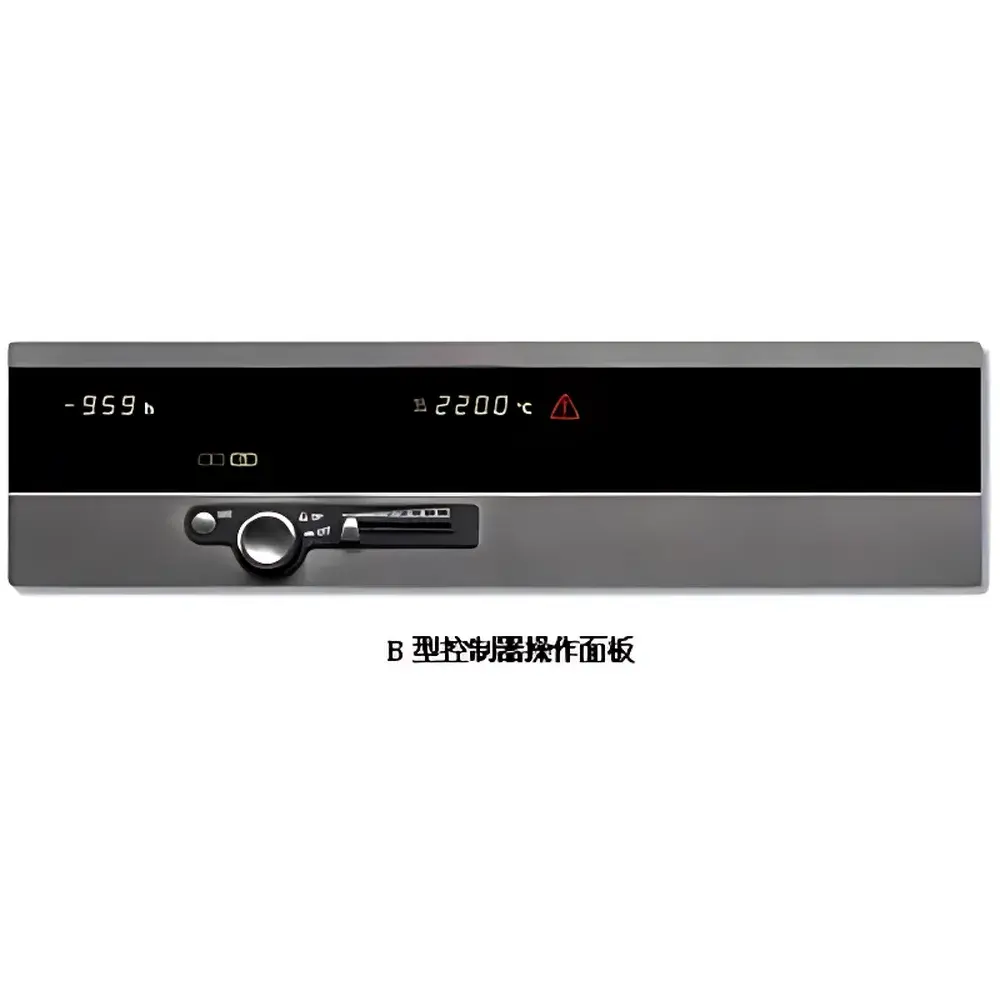
Memmert B-Series Temperature Controller for Drying Ovens
| Brand | MEMMERT |
|---|---|
| Origin | Germany |
| Model | B-Series |
| Temperature Range | 30–250 °C (min. operating temp. ≥5–10 °C above ambient) |
| Control Accuracy | ±0.25 °C at 150 °C |
| Sensor | Dual A-class PT100 (4-wire configuration) |
| Overtemperature Protection | Quadruple (electronic + adjustable TWW/TWB + ASF + mechanical TB) |
| Programmability | 40-segment ramp-soak profiles, weekly scheduling, minute-level resolution |
| Ventilation | Motorized air inlet control, 10% step fan speed adjustment (off-capable) |
| Data Logging | Internal 1024 KB memory (1-min resolution), removable XL memory card (32 KB, up to 40 programs) |
| Connectivity | RS-232 with Celsius software support, PCL-3-compatible printer interface |
| Display & UI | Multilingual (D/UK/E/F/I), real-time parameter visualization (temp, time, fan speed, vent position, active segment), status-specific LED signaling |
| Compliance | Designed to support GLP/GMP workflows, audit-trail-ready data logging per FDA 21 CFR Part 11 principles when used with validated Celsius software configuration |
Overview
The Memmert B-Series Temperature Controller is an advanced, microprocessor-based control system engineered exclusively for integration with MEMMERT drying ovens and heating cabinets. It operates on a closed-loop proportional-integral-derivative (PID) control architecture, utilizing dual high-stability A-class PT100 platinum resistance thermometers in a 4-wire configuration to eliminate lead-wire resistance errors and ensure long-term signal fidelity. The controller maintains precise thermal regulation across a wide operational range of 30 °C to 250 °C — with minimum operating temperature constrained to 5–10 °C above ambient — making it suitable for applications requiring stable, repeatable drying, conditioning, or preheating under controlled atmospheric conditions. Its design reflects MEMMERT’s adherence to German engineering standards for laboratory-grade thermal instrumentation, emphasizing deterministic response, minimal hysteresis, and traceable calibration pathways.
Key Features
- Quadruple overtemperature protection architecture: electronic safety cutoff (ΔT = +10 °C above setpoint), adjustable overtemperature protector TWW (Class 3.1) or TWB (Class 2), Automatic Safety Function (ASF) with user-defined deviation thresholds (± configurable), and fail-safe mechanical thermal breaker TB (permanent cut-off at +10 °C above chamber max rating).
- Dual redundant A-class PT100 sensors with 4-wire measurement — certified per DIN EN 60751 — enabling continuous cross-verification and uninterrupted temperature regulation during extended unattended operation.
- Full programmability: up to 40 independent ramp-soak segments with minute-level temporal resolution; weekly scheduling capability; servo-controlled motorized air inlet for precise fresh-air exchange management.
- Fan speed adjustable in 10% increments (0–100%), including full deactivation mode; optimized heating energy distribution ensures uniform temperature distribution (per DIN 12880 and VDI/VDE 2655 guidelines).
- Real-time multilingual display (German, English, French, Italian, Spanish) showing simultaneous readouts of current temperature, date/time, fan speed %, vent aperture position, and active program segment number.
- Status-specific visual signaling: distinct LED indicators for standby, heating, steady-state, and overtemperature conditions — enhancing operational awareness without requiring menu navigation.
Sample Compatibility & Compliance
The B-Series controller is compatible with all MEMMERT UF, HCP, and VO series drying ovens, supporting both inert and ambient-air drying protocols. Its dual-sensor redundancy and ASF functionality align with ISO/IEC 17025 requirements for measurement uncertainty management in accredited laboratories. When deployed with validated Celsius software (v5.0+), the system supports electronic record integrity per FDA 21 CFR Part 11 — including user authentication, audit trails, and electronic signatures — facilitating compliance in pharmaceutical QC, medical device sterilization validation, and materials testing environments governed by USP , ASTM E145, or EN 61000-4-30. Mechanical protection elements (TB, TWW) are certified to VDE 0620 and meet IP20 enclosure requirements.
Software & Data Management
Data acquisition and remote operation are enabled via RS-232 serial interface using MEMMERT’s Celsius software — a Windows-based application qualified for GxP environments. The controller logs temperature values and system error states at 1-minute intervals into its internal 1024 KB non-volatile memory. An optional XL memory card (32 KB) provides portable program storage (up to 40 segments) and facilitates secure data transfer between instruments. Logged datasets can be exported in CSV or PDF format; PCL-3-compatible printers connected via the parallel port generate hard-copy audit logs compliant with GLP documentation standards. All timestamps are synchronized to system clock with battery-backed RTC.
Applications
- Pharmaceutical stability testing (ICH Q1A–Q1E), including accelerated and long-term storage condition simulation.
- Moisture content determination per AOAC 950.46 and USP <<731>.
- Pre-drying of reference standards, filter membranes, and gravimetric sample holders prior to weighing.
- Thermal aging studies of polymers, composites, and electronic components under defined air-exchange regimes.
- Residue-on-ignition (ROI) and loss-on-drying (LOD) procedures in food, environmental, and clinical chemistry labs.
- Calibration lab oven qualification (IQ/OQ/PQ) where documented temperature uniformity and repeatability are mandatory.
FAQ
What is the minimum ambient temperature required for reliable operation?
The controller requires ambient temperatures between 15 °C and 30 °C for optimal performance; minimum operating temperature is always 5–10 °C above ambient.
Can the B-Series controller be retrofitted into older MEMMERT oven models?
Retrofitting is only supported for UF75, UF110, and HCP110 units manufactured after 2008; compatibility must be verified using the oven’s serial number and firmware revision.
Does the ASF function require external configuration?
Yes — deviation thresholds (e.g., ±0.5 °C, ±1.0 °C) and alarm activation modes (visual only, audible only, or both) are configured via the front-panel menu or Celsius software.
Is the RS-232 interface optically isolated?
No — the interface uses standard TTL-level signaling; use of an externally powered USB-to-RS232 adapter with galvanic isolation is recommended in electrically noisy environments.
How often should the PT100 sensors be recalibrated?
MEMMERT recommends annual verification against a NIST-traceable reference thermometer; dual-sensor comparison allows in-situ drift detection between scheduled calibrations.



