
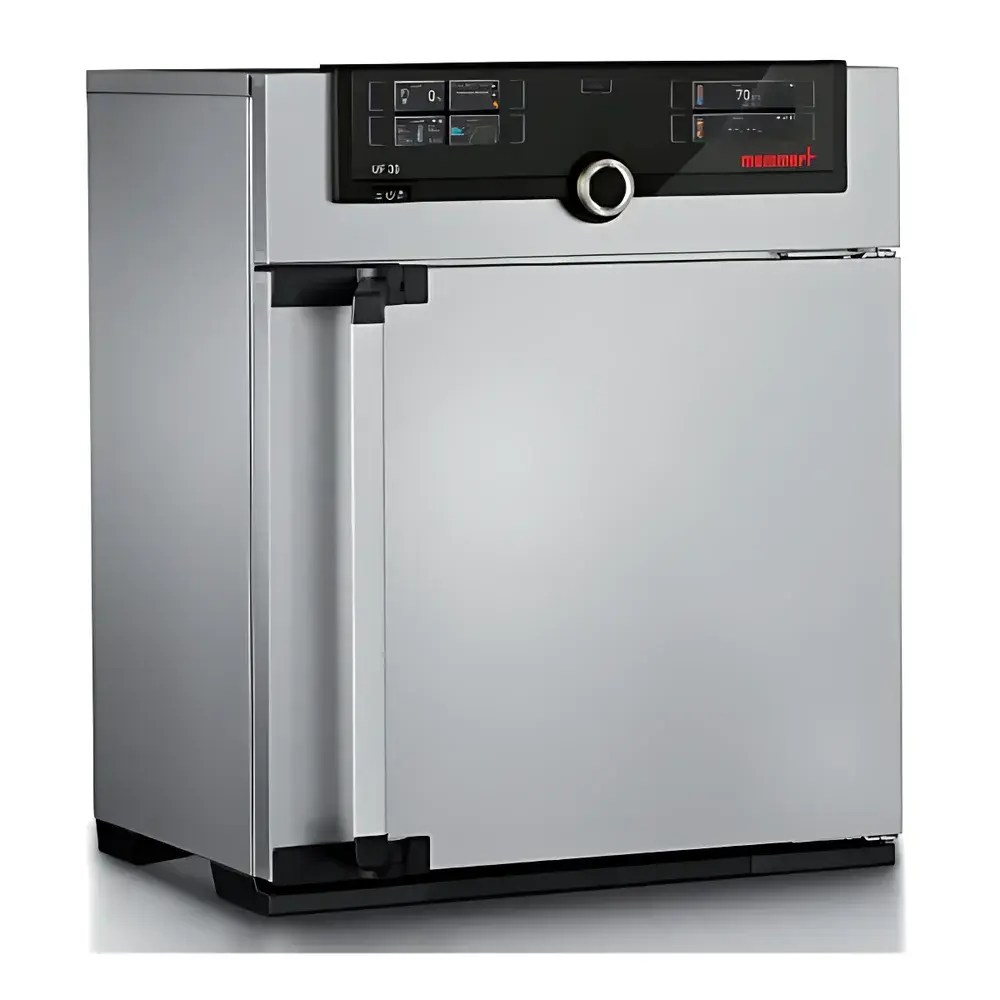
Memmert UNpa Paraffin Oven
| Brand | Memmert |
|---|---|
| Origin | Germany |
| Model Series | UNpa 30 / UNpa 55 / UNpa 75 / UNpa 110 / UNpa 160 |
| Temperature Range | +20 °C to +80 °C |
| Chamber Volume | 30 L / 55 L / 75 L / 110 L / 160 L |
| Heating Principle | Quadruple-wall conduction heating with passive thermal homogenization |
| Safety | Dual independent overtemperature protection (mechanical + electronic), hermetically sealed chamber design |
| Compliance | IEC 61010-1, EN 61326-1 (EMC), CE-marked for laboratory use |
Overview
The Memmert UNpa Paraffin Oven is a precision-engineered laboratory oven specifically designed for the safe, uniform, and contamination-free melting, holding, and conditioning of paraffin wax used in histological tissue processing. Unlike conventional forced-air ovens, the UNpa operates on a passive conduction-based heating principle—featuring quadruple-walled stainless steel chamber construction with integrated heating elements distributed across all four interior walls. This architecture eliminates air circulation entirely, thereby preventing oxidation, evaporation, or aerosolization of molten paraffin while eliminating convective temperature gradients. The sealed chamber environment ensures zero exchange with ambient air, enabling exceptional thermal stability (±0.3 °C typical deviation across full volume at 60 °C) and spatial uniformity (< ±0.5 °C max deviation per ASTM E2209–22 guidelines for static-heat ovens). Its operational range of +20 °C to +80 °C aligns precisely with standard paraffin phase-transition requirements (melting point: 52–58 °C; optimal infiltration: 56–60 °C), making it suitable for routine histopathology labs, core facilities, and GLP-compliant research environments.
Key Features
- Hermetically sealed stainless steel inner chamber—prevents paraffin vapor ingress into control electronics and eliminates risk of oil residue ignition or sensor fouling
- Quadruple-wall conduction heating system—ensures uniform thermal energy distribution without airflow-induced turbulence or localized hot spots
- Dual-stage overtemperature protection: independent mechanical safety thermostat (DIN 12880-compliant) plus microprocessor-controlled electronic limiter
- High-stability Pt100 Class A temperature sensor with direct wall-mounting for minimal thermal lag and long-term calibration retention
- Intuitive membrane keypad interface with real-time temperature display, setpoint memory, and power-on default retention
- Five scalable chamber volumes (30 L to 160 L) supporting workflow flexibility—from small research groups to high-throughput pathology departments
- No internal fans, filters, or moving parts—reducing maintenance intervals and extending service life beyond 15 years under normal lab use
Sample Compatibility & Compliance
The UNpa oven accommodates standard histology paraffin formulations—including saturated hydrocarbon blends, low-odor variants, and polymer-modified waxes—without degradation or carbonization. Its inert chamber surface (electropolished 1.4301 stainless steel) resists chemical attack from trace solvents or residual xylene carryover. The device conforms to IEC 61010-1 (Safety Requirements for Electrical Equipment for Measurement, Control, and Laboratory Use) and EN 61326-1 (EMC for Laboratory Instruments). It supports audit readiness for ISO 15189-accredited medical laboratories and satisfies essential operational criteria referenced in CLSI GP42-A5 (Laboratory Equipment Management) and CAP checklist ANP.42320 (Paraffin Processing Equipment Validation).
Software & Data Management
While the UNpa series operates via embedded firmware without external PC connectivity, its control logic incorporates built-in data integrity safeguards: automatic logging of temperature deviations exceeding ±1.0 °C (stored in non-volatile memory for ≥10,000 cycles), time-stamped power-on/power-off events, and continuous self-diagnostic checks of sensor continuity and heater resistance. Optional analog output (0–10 V) enables integration into centralized BMS or LIMS platforms for passive monitoring. All units ship with a factory-verified calibration certificate traceable to DKD/DAkkS-accredited standards, including as-found/as-left data per ISO/IEC 17025 requirements.
Applications
- Primary and secondary paraffin embedding in automated and manual tissue processors
- Pre-warming of paraffin-impregnated molds and metal cassette trays prior to infiltration
- Stabilization of wax blocks during microtome sectioning preparation
- Long-term holding of molten paraffin at precise setpoints for multi-shift histology workflows
- Temperature-sensitive reagent conditioning where airflow-induced evaporation must be avoided (e.g., lipid-rich embedding media)
- Research applications requiring inert, static-heat environments—for polymer melt rheology pre-conditioning or low-viscosity thermoplastic annealing
FAQ
Does the UNpa oven support validation protocols required by FDA or ISO 13485?
Yes—the oven’s design, documentation package (including IQ/OQ templates), and calibration traceability meet foundational requirements for equipment qualification in regulated diagnostics and IVD manufacturing environments.
Can it be used with low-melting-point waxes (e.g., 45 °C formulations)?
Absolutely—the +20 °C lower limit and fine-resolution setpoint control (0.1 °C increments) ensure stable operation across extended low-temperature ranges without thermal overshoot.
Is chamber cleaning compatible with common lab disinfectants?
The electropolished stainless steel interior tolerates routine wiping with 70% ethanol, isopropanol, or diluted hydrogen peroxide; avoid chloride-containing cleaners to preserve surface passivation.
What is the expected recalibration interval under GLP conditions?
Annual verification is recommended; however, due to thermal mass stability and sensor drift <0.05 °C/year, many CAP-accredited labs extend to 18 months with documented trend analysis.
How does the UNpa compare to fan-assisted paraffin ovens in terms of energy consumption?
It consumes 30–40% less power during steady-state operation—eliminating fan motor load and reducing thermal cycling losses associated with air exchange.



