
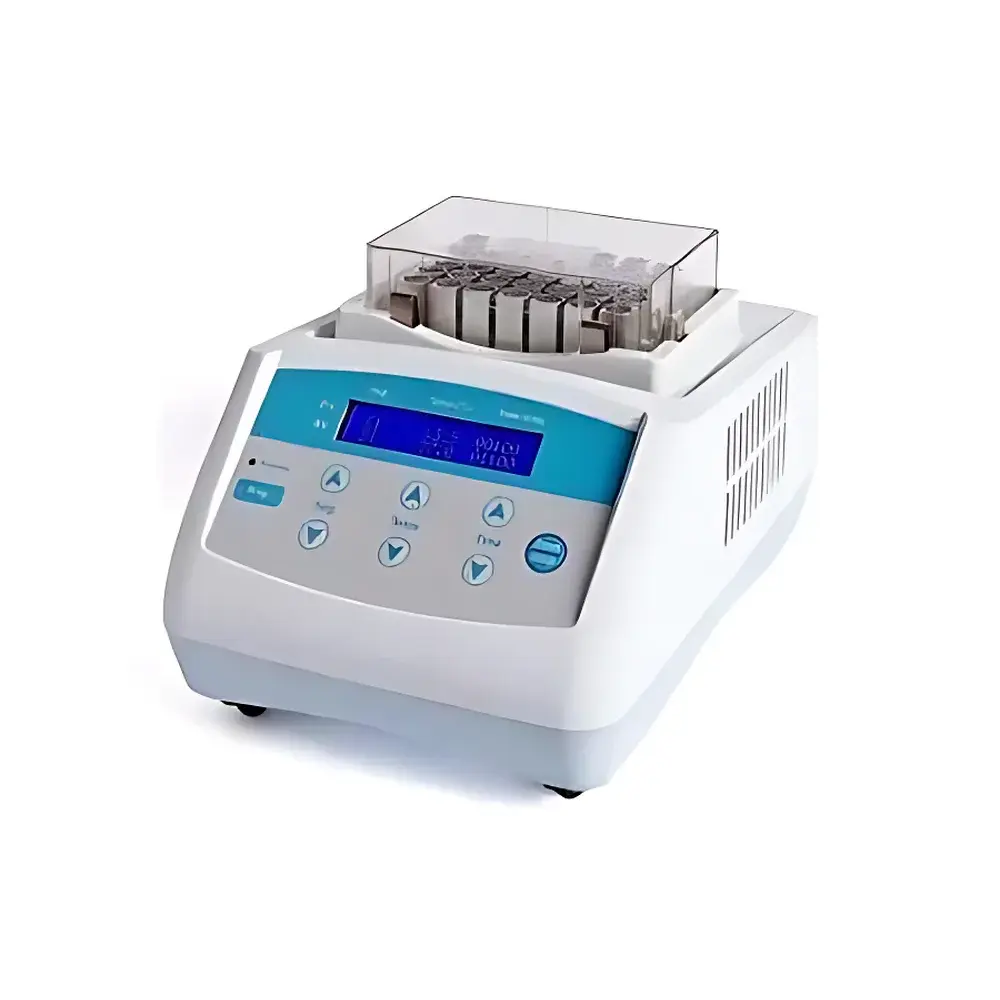
MENTS MK-20 Refrigerated Dry Block Heater
| Brand | MENTS |
|---|---|
| Origin | Beijing, China |
| Manufacturer Type | Direct Manufacturer |
| Product Category | Domestic |
| Model | MK-20 |
| Price | USD 1,150 (FOB) |
| Temperature Range | −10 °C to 100 °C |
| Temperature Accuracy | ≤ ±0.5 °C |
| Heating Time | ≤ 15 min (20 °C → 100 °C) |
| Cooling Time | ≤ 30 min (ΔT = −30 °C, ambient ≤ 26 °C) |
| Temperature Uniformity | ≤ ±0.3 °C @ 40 °C |
| Block Temperature Stability @ 100 °C | ≤ ±0.5 °C |
| Display Resolution | 0.1 °C |
| Max Timer Setting | 99 h 59 min |
| Power Consumption | 150 W |
| Dimensions (W×D×H) | 270 × 190 × 170 mm |
| Net Weight | 2.2 kg |
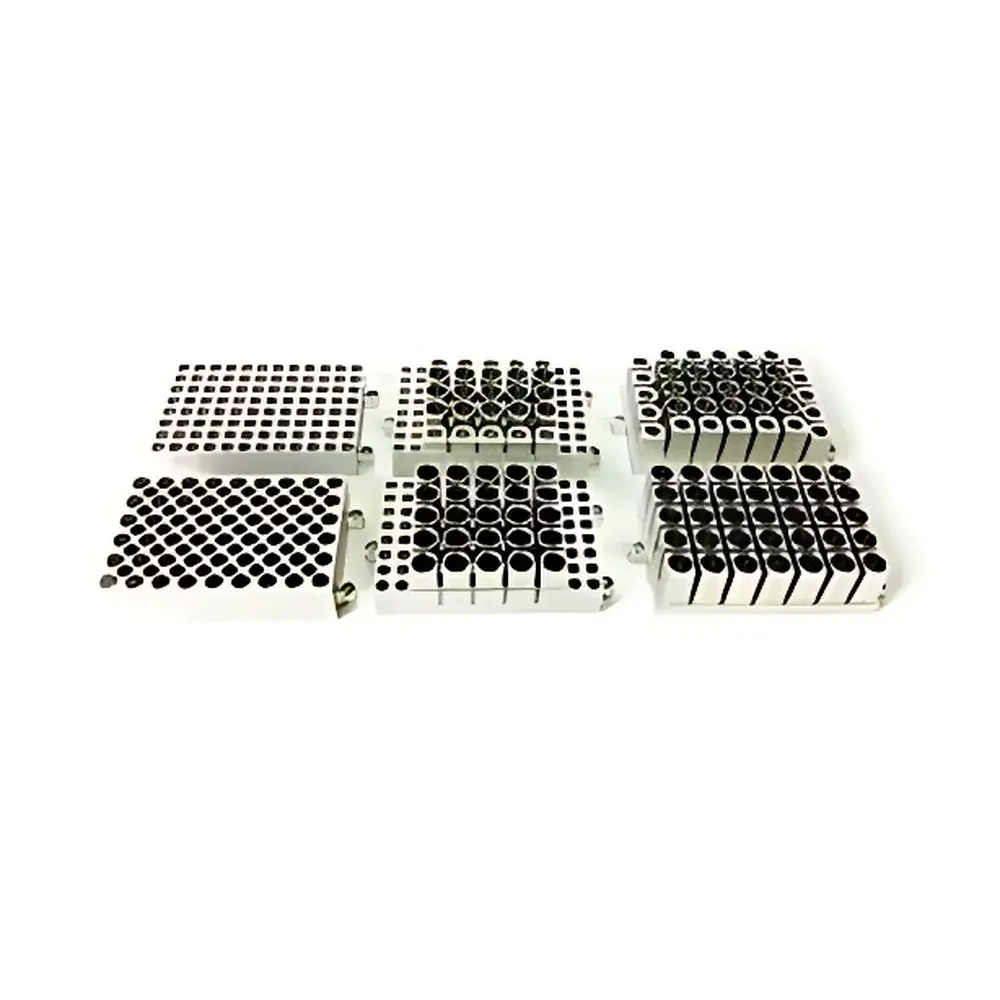
| Compatible Modules | A–N (including 96-well PCR plates, 0.2–50 mL tube formats, and custom square wells) |
Overview
The MENTS MK-20 Refrigerated Dry Block Heater is a microprocessor-controlled thermal management system engineered for precise, rapid, and stable temperature regulation across a wide operational range (−10 °C to 100 °C). Unlike conventional water baths—prone to evaporation, contamination, and inconsistent heat transfer—the MK-20 employs a solid aluminum heating/cooling block with optimized thermal mass and Peltier-based active refrigeration. This architecture enables bidirectional thermal control without fluid media, eliminating cross-contamination risks and supporting sterile, low-maintenance operation in regulated laboratory environments. Its design targets applications requiring strict thermal reproducibility: enzymatic reactions, nucleic acid denaturation (e.g., pre-PCR heat activation), serum coagulation assays, and stability testing of biologics under defined thermal stress conditions.
Key Features
- High-resolution blue LCD interface with dual independent settings for temperature and time; real-time display of current block temperature and countdown timer.
- Rapid thermal response: heats from 20 °C to 100 °C in ≤15 minutes and cools down by 30 °C from ambient (≤26 °C) in ≤30 minutes—enabled by integrated thermoelectric (Peltier) cooling and high-efficiency resistive heating elements.
- Advanced thermal uniformity: ≤±0.3 °C variation across the block surface at 40 °C, verified per ISO/IEC 17025-compliant calibration protocols; block stability maintained at ≤±0.5 °C even at maximum setpoint (100 °C).
- Built-in self-diagnostic system with audible alarm and on-screen fault indication; automatic overtemperature cut-off circuitry compliant with IEC 61010-1 safety standards.
- User-accessible temperature offset calibration function, allowing traceable adjustment to match reference thermometry (e.g., NIST-traceable RTD probes).
- Compact footprint (270 × 190 × 170 mm) and lightweight construction (2.2 kg) facilitate benchtop integration in space-constrained QC labs, clinical diagnostics workstations, or mobile field laboratories.
Sample Compatibility & Compliance
The MK-20 accepts interchangeable aluminum modules (A–N) designed for standardized tube geometries and microplate formats—including 96-well PCR plates (flat-bottom), 0.2 mL to 50 mL centrifuge tubes, and custom square-well blocks. All modules are precision-machined to ensure consistent thermal coupling and mechanical retention. Module surfaces are anodized for chemical resistance and ease of decontamination (autoclavable up to 121 °C for non-refrigerated use only). The instrument meets CE marking requirements under the Low Voltage Directive (2014/35/EU) and Electromagnetic Compatibility Directive (2014/30/EU). It supports GLP/GMP workflows through repeatable, documented thermal profiles—no proprietary software required for basic operation, though optional data logging accessories enable 21 CFR Part 11–compliant audit trails when paired with validated PC interfaces.
Software & Data Management
The MK-20 operates as a standalone unit with no mandatory software dependency. All critical parameters—including setpoint, dwell time, ramp rate (fixed), and real-time block temperature—are accessible via the front-panel interface. For laboratories requiring electronic recordkeeping, optional RS-232 or USB-to-serial adapters permit connection to LIMS or ELN platforms. When used with compliant third-party software (e.g., LabVIEW™ or custom Python scripts), the device transmits ASCII-formatted temperature/time streams at 1 Hz resolution, enabling time-series export for statistical process control (SPC) analysis. Firmware supports user-defined calibration offsets stored in non-volatile memory, ensuring continuity across instrument reboots and power cycles.
Applications
- Molecular biology: DNA denaturation prior to electrophoresis, enzyme inactivation steps, and restriction digest incubation at defined temperatures.
- Clinical diagnostics: Serum clotting assays (e.g., prothrombin time validation), antigen-antibody binding kinetics, and cold-chain sample equilibration.
- Pharmaceutical QA/QC: Excipient thermal stability screening, dissolution test sample conditioning, and lyophilization intermediate hold-step verification.
- Food & environmental testing: Pathogen enrichment media pre-warming, pesticide residue extraction optimization, and mycotoxin assay standard curve preparation.
- Academic research: Teaching labs requiring robust, low-risk thermal platforms for undergraduate biochemistry experiments and materials science sample annealing trials.
FAQ
Does the MK-20 support programmable ramp-and-hold temperature profiles?
No—the MK-20 implements fixed-setpoint operation with timer-based dwell only. Multi-step gradients require external controller integration via serial command protocol.
Can modules be autoclaved?
Yes—aluminum modules (A–I, J) are autoclavable at 121 °C for 20 minutes; refrigeration functionality must be disabled during sterilization, and condensation must fully dissipate before reinstallation.
What is the recommended recalibration interval?
Annual verification against a NIST-traceable reference thermometer is advised per ISO/IEC 17025 Clause 6.5; internal offset calibration may be performed more frequently using certified secondary standards.
Is the cooling performance affected by ambient temperature?
Yes—rated cooling time (≤30 min for −30 °C ΔT) assumes ambient ≤26 °C and still-air conditions; performance degrades above 30 °C ambient due to reduced Peltier efficiency.
Are module interchange procedures validated for cross-contamination prevention?
Module swaps are operator-performed mechanical actions; no formal validation is embedded, but surface wipe-down with 70% ethanol between uses is documented in the user manual as a best practice for biosafety compliance.



