
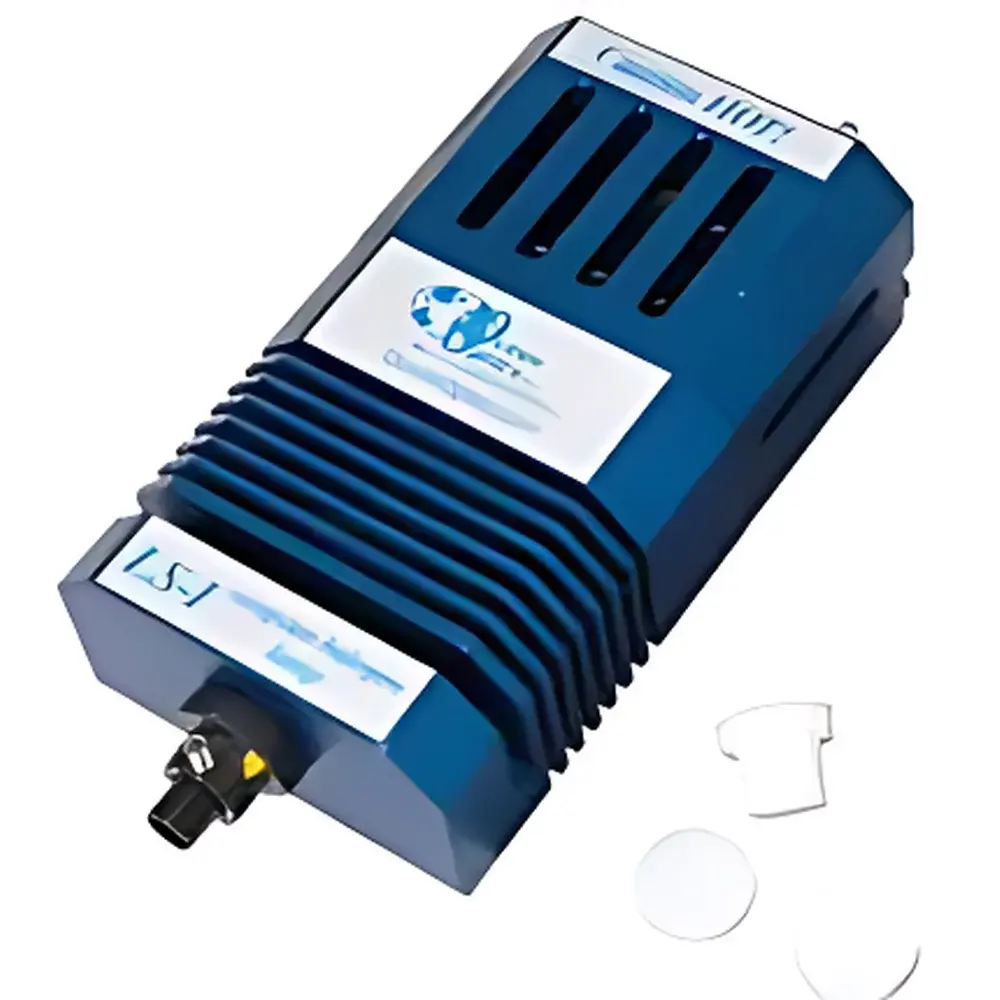
Ocean Optics LS-1 Tungsten-Halogen Light Source
| Brand | Ocean Optics |
|---|---|
| Origin | USA |
| Model | LS-1 |
| Light Source Type | Tungsten-Halogen |
| Spectral Range | 360–2500 nm |
| Output Stability | ~0.1% per hour |
| Warm-up Time | ~20 min |
| Lamp Life | 900 h (3100 K) or 10,000 h (2800 K) |
| Input Power | 12 VDC / 800 mA (7–20 VDC / 0.4–2 A compatible) |
| Output Power | 6.5 W |
| Lamp Voltage/Current | 5 V / 1.3 A |
| Color Temperature | 3100 K (standard), 2800 K (long-life) |
| Illumination Geometry | Internal illumination |
| Connector | SMA 905 |
| Filter Mount | Integrated 3 mm slot for BG-34 glass filter (½" OD) |
| Attenuation Options | PTFE-based neutral density filters providing ~50%, ~75%, and ~99% attenuation |
| Physical Dimensions | 9.0 × 5.0 × 3.2 cm (3.5 × 2.0 × 1.25 in) |
| Luminous Intensity | 7400 foot-candles (7.4 MSCP) |
Overview
The Ocean Optics LS-1 Tungsten-Halogen Light Source is a compact, stable, and spectrally broad illumination system engineered for quantitative optical measurements across the visible and near-infrared (VIS-NIR) spectral region. Operating on the principle of incandescent thermal emission from a tungsten filament under halogen regenerative cycle, the LS-1 delivers continuous spectral output from 360 nm to 2500 nm—though practical detection is constrained by the responsivity and cutoff limits of downstream detectors (e.g., Si-based CCDs limit usable range to ~1100 nm; InGaAs detectors extend coverage into the SWIR). Its design prioritizes radiometric stability, repeatability, and mechanical interoperability with fiber-optic spectroscopy platforms. The source integrates a regulated DC power supply (12 VDC nominal, 7–20 VDC compatible), internal thermal management, and a precision-machined SMA 905 receptacle for low-loss coupling to Ocean Insight’s family of spectrometers, sampling accessories (e.g., cuvette holders, reflectance probes), and calibrated reference standards.
Key Features
- Stable broadband VIS-NIR output (360–2500 nm) with <0.1% intensity drift per hour after thermal equilibrium (~20 min warm-up)
- Two lamp options: standard 900-hour lamp (3100 K color temperature) and extended-life 10,000-hour lamp (2800 K), enabling trade-offs between spectral brightness and operational longevity
- Integrated 3 mm-thick slot accommodating a ½” OD Schott BG-34 glass filter for spectral shaping—enhancing blue/NIR balance and correcting for inherent red/NIR over-emission typical of tungsten sources
- Three user-installable PTFE-based neutral density attenuators offering calibrated attenuation levels of ~50%, ~75%, and ~99%—critical for preventing detector saturation without altering integration time or dynamic range settings
- SMA 905 interface ensures repeatable, low-back-reflection coupling to multimode silica fibers (core diameters 50–1000 µm), minimizing alignment sensitivity and modal noise
- Compact footprint (9.0 × 5.0 × 3.2 cm) and low-power consumption (6.5 W optical output, 12 VDC/800 mA input) support benchtop, portable, and OEM-integrated deployments
Sample Compatibility & Compliance
The LS-1 is routinely deployed in reflectance, transmittance, absorbance, and colorimetric applications involving solid, liquid, and powder samples. Its internal illumination geometry supports direct coupling to integrating spheres (e.g., ISP-REF, FOIS-1), bifurcated fiber probes, and custom sample cells. The source complies with general laboratory electrical safety standards (IEC 61010-1) and operates within Class I laser product safety guidelines when used with passive optical components. While not inherently GLP/GMP-certified, its stable output and documented warm-up behavior enable traceable calibration workflows aligned with ASTM E308 (computing tristimulus values), ISO/CIE colorimetry protocols, and USP spectrophotometric system suitability requirements. All spectral data generated using the LS-1 are fully compatible with Ocean Insight’s OceanView software for compliance-ready reporting—including audit trails, metadata logging, and export to CSV, XML, or HDF5 formats.
Software & Data Management
When paired with Ocean Insight spectrometers (e.g., USB2000+, QE Pro, Flame series), the LS-1 is fully controllable via OceanView software v2.0+. The software enables synchronized acquisition, real-time intensity monitoring, automated dark/baseline correction, and spectral ratioing (e.g., sample/reference, reflectance = R/Rref). All hardware parameters—including lamp status, power supply voltage, and optional filter/attenuator configuration—are logged alongside spectral data. OceanView supports FDA 21 CFR Part 11-compliant operation when configured with electronic signatures, role-based access control, and immutable audit trails—making it suitable for regulated QC environments. Raw A/D counts, calibrated irradiance (µW/cm²/nm), and photometric units (e.g., lux, foot-candles) can be exported with full metadata for third-party analysis in MATLAB, Python (via seabreeze API), or LabVIEW.
Applications
- Quantitative reflectance spectroscopy of paints, coatings, textiles, and biological tissues
- Color measurement and quality control in manufacturing (CIE L*a*b*, ΔE calculations)
- In-line process monitoring of pharmaceutical tablet coating uniformity and dissolution kinetics
- Benchmarking and validation of NIR spectrometers and chemometric models
- Calibration of reference materials (e.g., NIST-traceable ceramic tiles, Spectralon® standards)
- Teaching laboratories for fundamental optics experiments—interference, dispersion, Beer-Lambert law verification
FAQ
What is the effective spectral range when using the LS-1 with a USB2000+ spectrometer?
The USB2000+ employs a silicon CCD detector with a typical response cutoff near 1100 nm; thus, usable output is limited to ~360–1100 nm despite the LS-1’s intrinsic 2500 nm capability.
Can the LS-1 be used for UV measurements below 360 nm?
No—the fused silica envelope and internal optics block radiation below ~360 nm; for UV-VIS applications, consider the PX-2 pulsed xenon source or DH-mini deuterium-halogen combination source.
How does the BG-34 filter affect spectral output?
The BG-34 glass attenuates longer wavelengths (>600 nm) relative to shorter ones, improving spectral balance and reducing NIR dominance—particularly beneficial for colorimetric accuracy and CCD linearity.
Is the LS-1 compliant with electromagnetic compatibility (EMC) directives for EU deployment?
Yes—the unit meets CE marking requirements per EN 61326-1 (measurement/control lab equipment) and includes built-in EMI suppression for stable operation in shared instrumentation racks.
Can attenuation filters be used simultaneously with the BG-34 filter?
Yes—the internal 3 mm filter slot accommodates the BG-34, while external ND filters mount directly onto the SMA 905 ferrule—enabling compound spectral and intensity control without optical realignment.




