
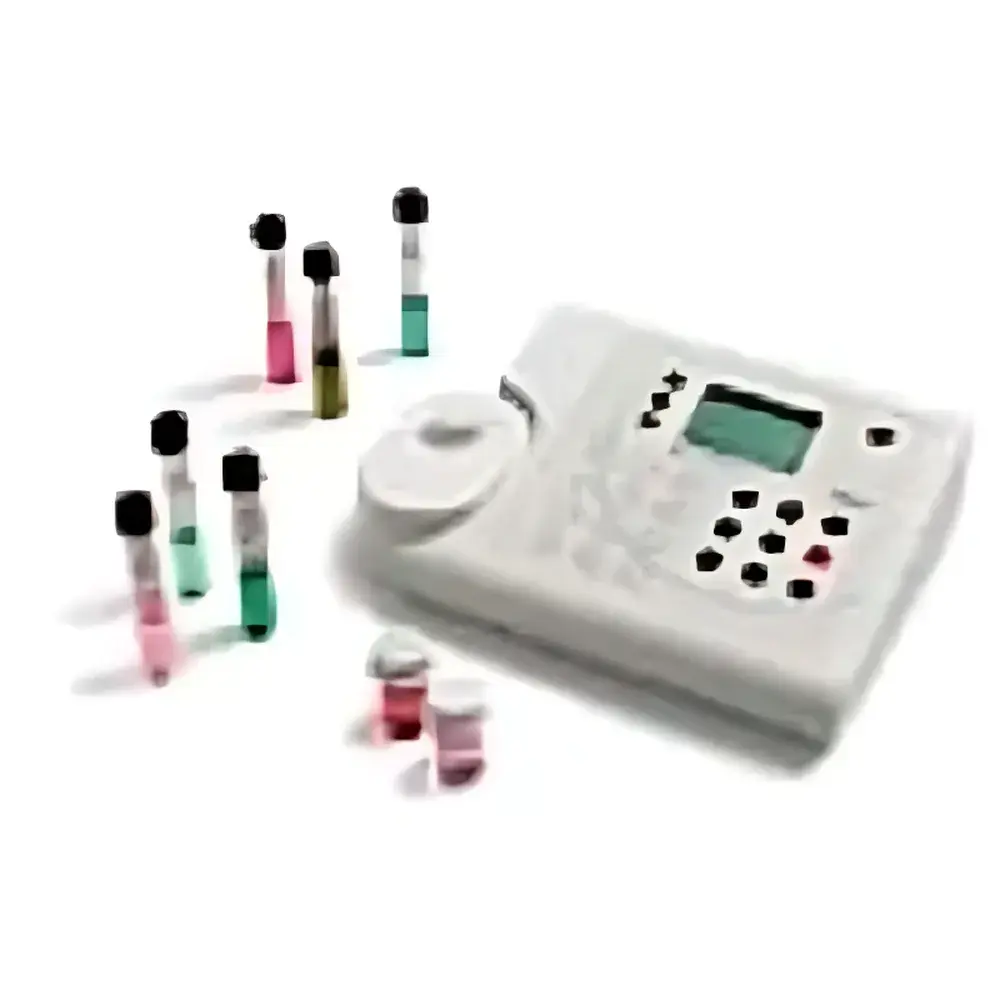
Merck Spectroquant Multy Multi-Parameter Photometer
| Brand | Merck |
|---|---|
| Origin | Germany |
| Manufacturer Type | Original Equipment Manufacturer (OEM) |
| Import Status | Imported |
| Model | Spectroquant Multy |
| Price | Upon Request |
| Display | 6-digit LCD with backlight |
| Wavelengths | 430 nm, 530 nm, 560 nm, 580 nm, 610 nm, 660 nm (fixed LED sources) |
| Optical Technology | Dual-beam photometry with interference filter compensation |
| Temperature Compensation | 6-point automatic |
| Sample Holders | 16 mm and 24 mm round cuvettes (included) |
| Dimensions (instrument) | 265 × 195 × 70 mm |
| Dimensions (carrying case) | 440 × 370 × 140 mm |
| Interface | RS232 serial port |
| Power Supply | Rechargeable NiCd battery pack (7 cells) |
| Operating Conditions | 0–50 °C, <90% RH (non-condensing) |
| Data Storage | 1000 measurement records with timestamp, parameter ID, and user-defined sample ID |
| Keypad | Chemical-resistant capacitive touch keys |
| Self-Test | Automatic power-on diagnostic routine |
| Compliance | Designed to support ISO 7027, ISO 8466-1, ASTM D1253, EPA 180.1, and EN ISO 15704 for colorimetric water analysis |
Overview
The Merck Spectroquant Multy Multi-Parameter Photometer is a field-deployable, dual-beam colorimeter engineered for reliable, traceable, and standardized water quality analysis in environmental monitoring, wastewater treatment, drinking water distribution, and industrial process control laboratories. It operates on the principle of absorbance photometry—measuring light attenuation at six fixed, high-stability LED wavelengths (430, 530, 560, 580, 610, and 660 nm) after reaction with Merck’s proprietary Spectroquant® reagent kits. Each wavelength corresponds to validated, chemistry-specific test methods developed in accordance with international standards including ISO 7027 (turbidity), ISO 8466-1 (calibration functions), ASTM D1253 (residual chlorine), and EPA Method 180.1 (nitrate). The instrument’s dual-beam architecture compensates for source drift and ambient light interference in real time, ensuring high reproducibility across variable environmental conditions. Its compact footprint, integrated rechargeable battery, and ruggedized design enable uninterrupted operation during extended field campaigns—without reliance on mains power or external calibration hardware.
Key Features
- Dual-beam optical system with built-in interference filter compensation for stable baseline performance under fluctuating ambient lighting and temperature gradients
- Six pre-aligned, narrow-band LED light sources eliminating need for manual wavelength selection or grating alignment
- Chemical-resistant capacitive touch keypad rated for repeated exposure to acids, oxidants, and organic solvents common in wet chemistry workflows
- Onboard storage for up to 1000 measurements—including date/time stamp, method ID, operator code, and custom sample identifier—supporting audit-ready data integrity
- Automatic power-on self-diagnostic sequence verifying photometric linearity, battery health, and memory integrity prior to each use
- RS232 interface compliant with standard terminal emulation protocols, enabling direct connection to laboratory printers or legacy LIMS systems without driver installation
- Integrated temperature compensation algorithm (6-point reference) correcting for thermal effects on reaction kinetics and dye stability per ISO 8466-1 Annex B
Sample Compatibility & Compliance
The Spectroquant Multy accepts standard 16 mm and 24 mm round glass or plastic cuvettes—compatible with over 110 pre-programmed Spectroquant® test kits covering critical parameters such as nitrate, phosphate, ammonia, total hardness, COD, free and total chlorine, iron, manganese, silica, sulfate, and turbidity. All methods are validated against ISO/IEC 17025 requirements for analytical competence and aligned with regulatory frameworks including EU Drinking Water Directive (98/83/EC), US EPA Clean Water Act reporting guidelines, and WHO Guidelines for Drinking-water Quality. The instrument supports Good Laboratory Practice (GLP) documentation through mandatory entry fields for analyst ID, batch number, and reagent lot tracking. While not FDA 21 CFR Part 11 certified out-of-the-box, its data export structure (ASCII-delimited .txt files) facilitates integration into validated electronic lab notebook (ELN) or LIMS environments requiring ALCOA+ principles.
Software & Data Management
No proprietary software installation is required for basic operation or data transfer. Measurement results are exported via RS232 as plain-text files containing timestamp, method name, concentration value, unit, and cuvette pathlength—structured for direct import into Excel, LabArchives, or custom SQL databases. Firmware updates and new method downloads are performed using Merck’s publicly accessible Spectroquant® Online Portal—a secure HTTPS-based repository requiring only a registered user account. Updates retain full backward compatibility and preserve existing calibration coefficients and stored datasets. The device does not feature wireless connectivity or cloud synchronization; all firmware and method files reside locally post-download, satisfying air-gapped network policies common in municipal utility and defense-sector applications.
Applications
- Field verification of compliance with discharge limits under national wastewater permits (e.g., NPDES in the U.S., IPPC in the EU)
- Routine screening of raw and finished drinking water at remote pumping stations or distribution reservoirs
- Process control in decentralized wastewater treatment plants lacking centralized lab infrastructure
- Educational use in university environmental science labs where robustness, ease of maintenance, and curriculum-aligned method libraries are prioritized
- Emergency response testing during flood events or chemical spills, leveraging rapid (<5 min) colorimetric assays with minimal consumables
- Third-party verification audits supporting ISO 14001 environmental management system certification
FAQ
Does the Spectroquant Multy support custom method programming?
No. The instrument is factory-configured with fixed-wavelength, reagent-coupled methods only. Custom wavelength selection or user-defined calibration curves are not supported.
Can the rechargeable NiCd battery be replaced in the field?
Yes—the battery pack is user-serviceable using standard Torx T10 tools; replacement kits (P/N 1.09001.0001) are available through Merck authorized distributors.
Is calibration traceable to NIST or PTB standards?
Yes. Each instrument ships with a Certificate of Conformance referencing Merck’s internal photometric calibration standards, which are periodically verified against PTB-traceable reference filters (DIN EN ISO/IEC 17025 accredited calibration lab).
What is the expected lifetime of the LED light sources?
LEDs are rated for ≥50,000 hours of operational life under typical intermittent usage patterns—exceeding the service life of the instrument chassis.
Are there any limitations on humidity or altitude for field deployment?
Operation is specified up to 90% relative humidity (non-condensing) and 3000 m above sea level. Condensation inside the optical chamber must be avoided; instrument should be acclimatized for 30 minutes before use after rapid temperature transitions.
Related Products







