
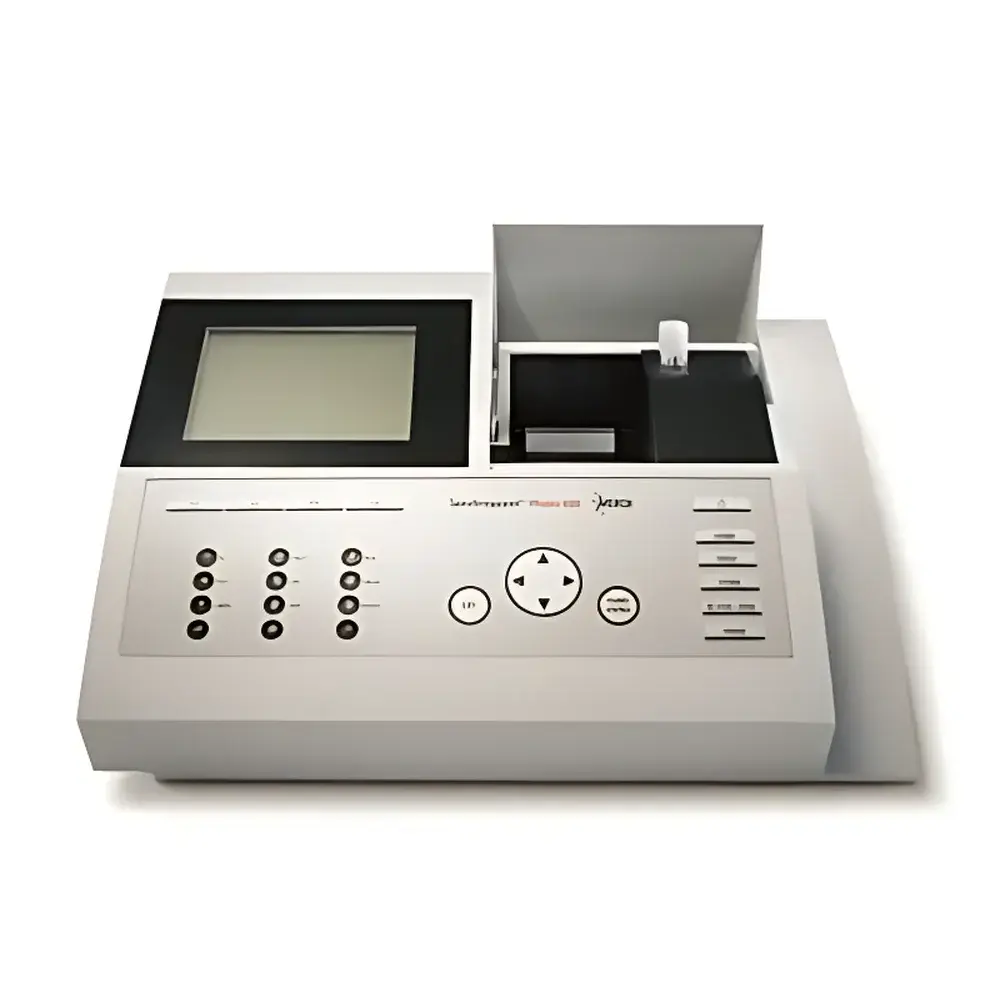
Merck Spectroquant® Pharo 300 UV-Vis Multifunctional Water Quality Analyzer
| Brand | Merck |
|---|---|
| Origin | Germany |
| Manufacturer Type | Original Equipment Manufacturer (OEM) |
| Product Category | Imported Laboratory Water Quality Analyzer |
| Model | Pharo 300 |
| Instrument Type | Benchtop UV-Vis Spectrophotometer for Water Analysis |
| Wavelength Range | 190–1100 nm |
| Light Source | Xenon Flash Lamp |
| Optical Design | Stabilized Single-Beam |
| Spectral Bandwidth | 4 nm |
| Wavelength Resolution | 1 nm |
| Wavelength Accuracy | ±1 nm |
| Absorbance Range | ±3.3 A |
| Absorbance Resolution | 0.001 A |
| Absorbance Accuracy | ±0.003 A (for A < 0.600 A), ±0.5 % (for 0.600 ≤ A ≤ 2.000 A), ±1.0 % (for A > 2.000 A) |
| Cuvette Compatibility | 16 mm round, and 10/20/50 mm square cuvettes with automatic recognition |
| Measurement Modes | Concentration, Absorbance, Transmittance, Multi-Wavelength, Full Spectrum Scan (1 nm increment), Kinetic Assays |
| AQA Levels | AQA1 (PhotoCheck/CertiPUR® wavelength verification), AQA2 (CombiCheck/CertiPUR® system verification), AQA3 (MatrixCheck interference assessment) |
| Data Storage | 1000 measurement results |
| Connectivity | 1× USB-A, 1× USB-B, 1× RS-232 |
| Compliance | DIN, US EPA, GLP-compliant audit trail, 21 CFR Part 11 ready (with optional software configuration) |
| Enclosure Rating | IP31 |
| Operating Temperature | +10 °C to +35 °C |
| Dimensions | 404 × 197 × 314 mm (L × H × W) |
| Weight | 3.7 kg (without battery) |
Overview
The Merck Spectroquant® Pharo 300 UV-Vis Multifunctional Water Quality Analyzer is a benchtop double-purpose spectrophotometric platform engineered for regulatory-grade water and wastewater analysis in accredited laboratories. Based on stabilized single-beam UV-Vis spectroscopy with a pulsed xenon flash lamp, it delivers high photometric stability across the full 190–1100 nm spectral range—enabling both standardized compliance testing and method development workflows. Unlike dedicated photometers, the Pharo 300 operates as a validated analytical instrument capable of absorbance quantification, multi-wavelength ratio analysis, time-resolved kinetic assays, and full-spectrum scanning at 1 nm resolution. Its design adheres to core principles of metrological traceability: wavelength accuracy (±1 nm), photometric linearity (±0.003 A up to 0.6 A), and reproducible cuvette positioning via automatic geometry recognition. The system integrates seamlessly into quality-controlled environments through built-in Analytical Quality Assurance (AQA) protocols aligned with ISO/IEC 17025 implementation frameworks.
Key Features
- Triple-tier AQA program: AQA1 verifies optical alignment using PhotoCheck or CertiPUR® UV/VIS reference standards; AQA2 validates entire assay performance with CombiCheck solutions; AQA3 applies MatrixCheck to detect matrix-induced interferences in real samples.
- Barcode-driven workflow: Automatic recognition of all Spectroquant® pre-filled test vials and reagent kits eliminates manual method selection errors and ensures version-controlled assay execution.
- Intelligent cuvette management: Simultaneous support for 16 mm round and 10/20/50 mm square cuvettes with automatic dimension detection—enabling dynamic range optimization without user intervention.
- Regulatory-ready data integrity: Internal storage retains 1000 measurement records with timestamps, plus 4 MB of non-volatile memory for spectral and kinetic datasets; exportable via USB-A to external drives in CSV or proprietary .spc format.
- Firmware and method extensibility: Free updates delivered via USB stick or PC connection; supports up to 100 user-defined methods and 20 custom scan/kinetic protocols—ensuring long-term adaptability to evolving standard methods (e.g., DIN 38405, EPA 4500 series).
Sample Compatibility & Compliance
The Pharo 300 accommodates aqueous matrices ranging from potable water and surface water to industrial effluents and digested sludge extracts. It complies with over 50 DIN and US EPA-approved test procedures—including nitrate (EPA 353.2), phosphate (DIN EN ISO 6878), COD (DIN 38409 H41), and heavy metals via colorimetric chelation (e.g., Cu, Fe, Mn). All preprogrammed methods include factory-calibrated blank subtraction and certified reference material (CRM)-traceable calibration curves. The instrument’s IP31-rated enclosure and integrated spill containment channels meet GLP laboratory infrastructure requirements, while its audit-trail-capable firmware architecture supports validation under FDA 21 CFR Part 11 when paired with Merck’s optional Spectroquant® LabStation software.
Software & Data Management
Data acquisition and reporting are governed by an embedded operating system supporting six display languages (including English and simplified Chinese) and graphical LCD feedback with backlighting. Each measurement event logs instrument parameters, cuvette ID, reagent lot number (via barcode), operator ID, and environmental conditions (temperature/humidity if externally sensed). Raw spectral data (300–900 nm at 1 nm steps) and kinetic time-series (up to 150 points per curve) are stored with metadata tags compliant with ISO 14155 Annex B. USB-B port enables direct connection to LIMS systems; RS-232 allows integration into legacy SCADA or PLC-based monitoring networks. Optional Spectroquant® LabStation software provides advanced curve fitting, outlier detection, and electronic signature functionality for 21 CFR Part 11 compliance.
Applications
- Drinking water compliance testing per WHO guidelines and EU Directive 98/83/EC (e.g., residual chlorine, fluoride, nitrite).
- Wastewater treatment plant process control: ammonium (Nessler), total phosphorus (ascorbic acid reduction), turbidity (formazin equivalence).
- Environmental monitoring labs performing DIN 38405-27 (total organic carbon estimation via persulfate oxidation), DIN EN ISO 15586 (arsenic speciation), and EPA Method 365.3 (phosphorus).
- Research applications requiring spectral deconvolution of overlapping chromophores (e.g., humic/fulvic acid characterization) or enzyme kinetics (e.g., peroxidase-coupled assays).
- Education and training: modular method library serves as pedagogical tool for teaching Beer-Lambert law fundamentals, calibration strategy, and QA/QC best practices.
FAQ
Does the Pharo 300 require warm-up time before operation?
No. The xenon flash lamp emits stable pulses without thermal drift, enabling immediate measurements after power-on.
Can I validate the instrument’s wavelength accuracy in-house?
Yes—AQA1 includes PhotoCheck wavelength verification using a built-in holmium oxide filter, or CertiPUR® UV/VIS reference standards traceable to NIST SRM 2035.
Is method validation documentation available for regulatory submissions?
Merck provides IQ/OQ/PQ protocol templates, uncertainty budgets per ISO/IEC 17025, and traceable CRM certificates for all Spectroquant® reagents.
How does MatrixCheck identify spectral interference?
It compares sample absorbance profiles against reference spectra of known interferents (e.g., turbidity, color quenching agents) and flags deviations exceeding predefined thresholds.
What happens if a cuvette is inserted incorrectly?
The optical sensor detects misalignment and displays a corrective prompt; mechanical guides prevent physical damage during insertion.







