
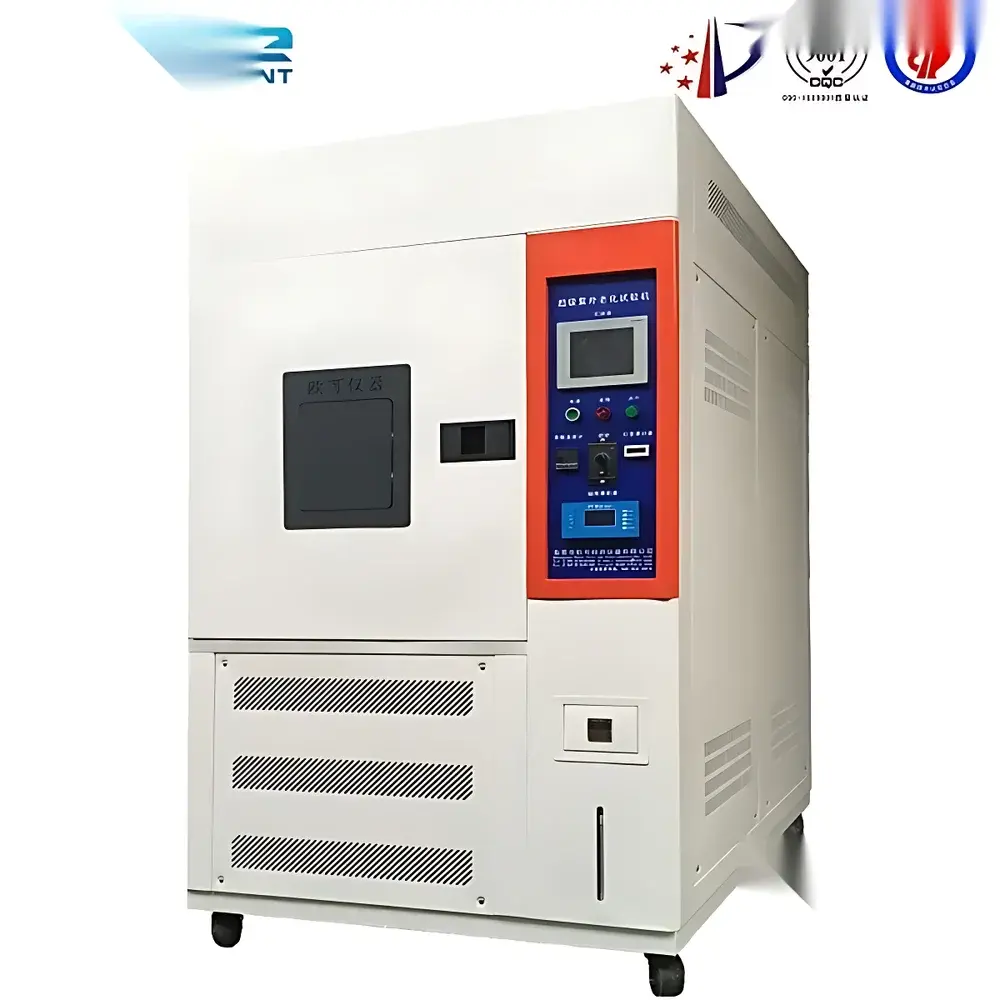
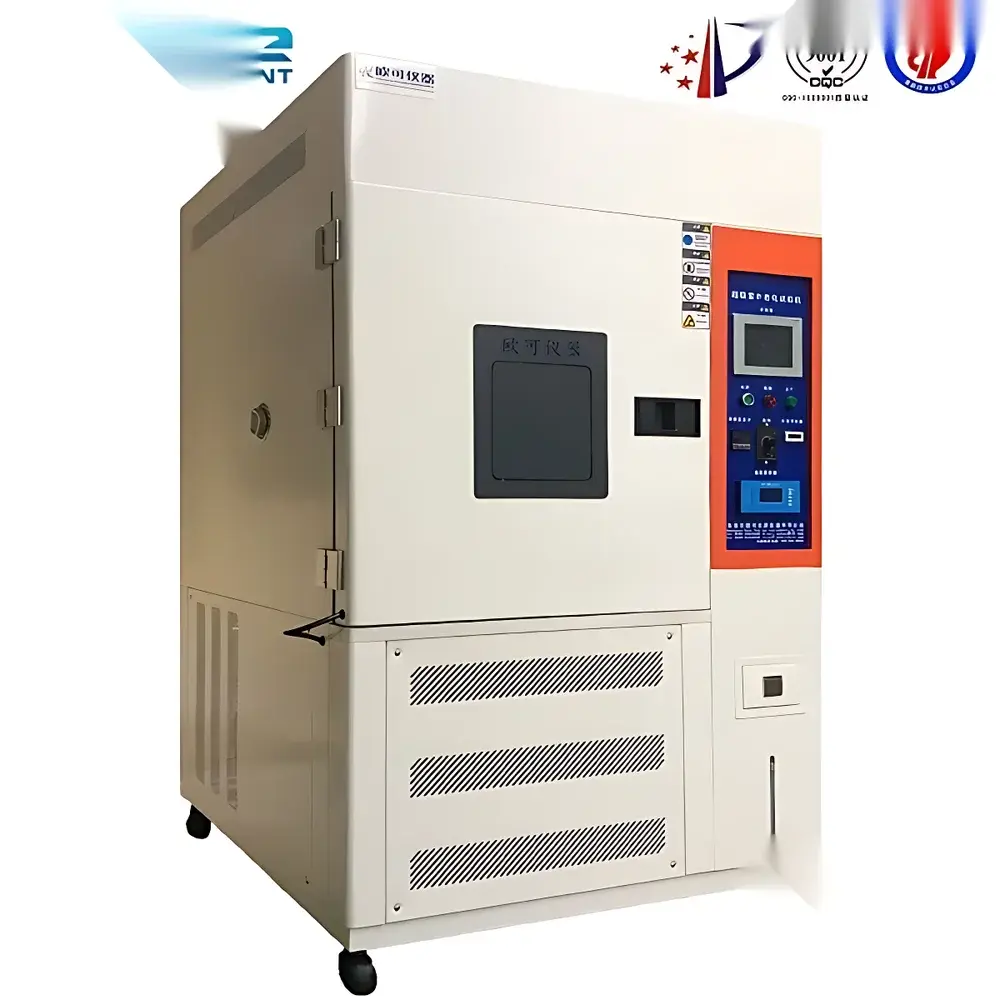
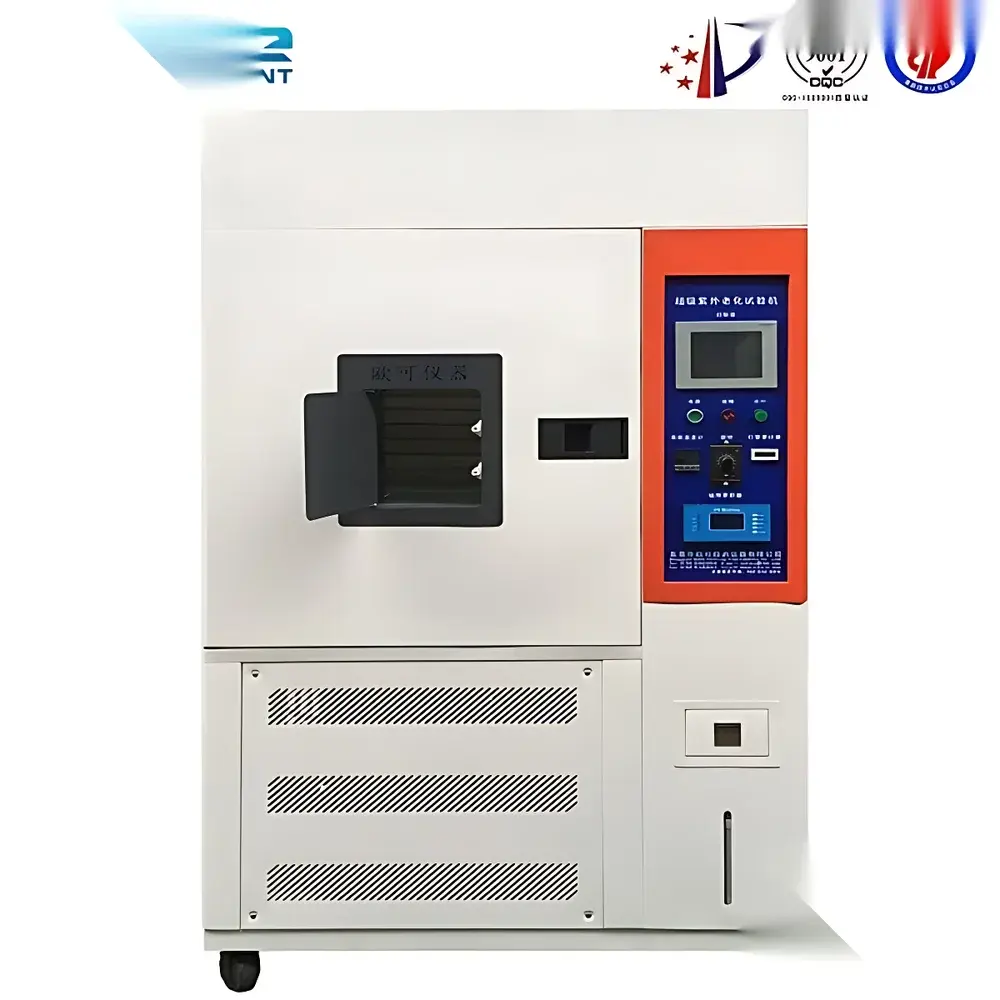
Metal Halide Solar Radiation Aging Test Chamber
| Brand | OEM / Custom Brand |
|---|---|
| Origin | Imported |
| Supplier Type | Authorized Distributor |
| Price | USD 21,500 (FOB) |
| Spectral Range | 295–450 nm |
| Irradiance Control | Yes |
| Cooling Method | Air-cooled |
| Compliance | ASTM G155, ISO 4892-2, SAE J2527, IEC 61215 |
Overview
The Metal Halide Solar Radiation Aging Test Chamber is an engineered environmental simulation system designed to accelerate material degradation under controlled solar spectral irradiance, thermal cycling, and moisture exposure. Unlike conventional UV fluorescent lamp-based chambers, this system employs air-cooled metal halide lamps whose unfiltered output spans 295–450 nm — closely matching the terrestrial solar ultraviolet and visible spectrum after atmospheric transmission and 3-mm borosilicate glass filtration. This spectral fidelity enables high-fidelity replication of real-world photodegradation mechanisms, including photooxidation, chain scission, and chromophore bleaching. The chamber integrates programmable temperature control (ambient to 80 °C), condensation humidity cycles (via chilled mirror surface), and calibrated water spray functionality (per IEC 60529 IPX3/IPX4), allowing full compliance with multi-stress accelerated aging protocols for automotive, photovoltaic, and electronic enclosures.
Key Features
- High-fidelity solar simulation using stabilized metal halide arc lamps with integrated quartz envelope and dichroic reflectors for uniform irradiance distribution across specimen plane
- Real-time irradiance monitoring via NIST-traceable broadband UV radiometer (295–400 nm), with closed-loop feedback control maintaining ±3% irradiance stability over time
- Programmable thermal profile management: independent control of black panel temperature (BPT) and chamber air temperature, supporting ASTM G155 Cycle 1–4 and SAE J2527 Class A/B conditions
- Condensation cycle generation through refrigerated specimen mounting surface (chilled to dew point), enabling realistic moisture absorption/desorption kinetics without internal humidification systems
- Automated water spray module with adjustable frequency, duration, and droplet size distribution compliant with ISO 4892-2 Annex C for wetting simulation
- Rugged stainless-steel interior with removable specimen racks accommodating up to 12 standard 75 × 150 mm test panels or custom fixtures for large-format automotive trim components
Sample Compatibility & Compliance
This chamber accommodates flat-sheet specimens, molded polymer parts, coated substrates, laminated glass assemblies, and full-scale solar module frames. Specimen holders are compatible with industry-standard mounting hardware per ASTM D7869 and IEC 61215-2 MQT 10. The system meets requirements for GLP-compliant testing environments, with audit-ready calibration logs traceable to national metrology institutes. It supports regulatory validation per FDA 21 CFR Part 11 when paired with optional validated software packages. All operational parameters — irradiance, temperature, spray timing, and condensation duration — are recorded with timestamped digital logs meeting ISO/IEC 17025 data integrity criteria.
Software & Data Management
The embedded controller runs on a real-time Linux OS with dual-channel Ethernet connectivity. The optional PC-based software suite provides full test sequence programming, live irradiance mapping visualization, and automated report generation in PDF/CSV formats. Audit trail functionality records all user actions, parameter changes, and calibration events with immutable timestamps. Data export complies with ASTM E2911 for long-term archival and third-party review. Optional integration with LIMS platforms (e.g., LabWare, Thermo Fisher SampleManager) supports enterprise-level traceability and electronic signature workflows aligned with 21 CFR Part 11 Annex 11 requirements.
Applications
Primary applications include accelerated weathering validation of automotive exterior plastics (PP, TPO, PC/ABS), PV module encapsulant yellowing resistance (EVA, POE), aerospace polymer composites, architectural coatings, and outdoor LED housing materials. It is widely specified in OEM engineering standards such as Ford WERCS-2023, GMW14872, and Toyota TSL-0001. Research labs utilize the chamber for mechanistic studies correlating spectral irradiance profiles with FTIR-measured carbonyl index growth or gel permeation chromatography (GPC)-tracked molecular weight reduction.
FAQ
What standards does this chamber support for automotive component testing?
ASTM G155 (Cycle 1–4), SAE J2527 (Class A/B), ISO 4892-2, and OEM-specific protocols including VW TL 226 and BMW GS 95024.
Can the chamber operate without water spray functionality?
Yes — all stress modules (irradiance, temperature, condensation, spray) are independently programmable and can be deactivated per test requirement.
Is spectral irradiance recalibration required between test campaigns?
Per ISO/IEC 17025, radiometer calibration must be performed annually by an accredited lab; in-house verification using reference sensors is recommended before each high-criticality test series.
What is the maximum specimen thickness supported on standard racks?
Standard racks accept specimens up to 35 mm thick; custom rack configurations are available for deeper assemblies upon request.
Does the system include UV filter maintenance documentation?
Yes — comprehensive lamp and filter replacement schedules, spectral degradation curves, and cleaning protocols are provided in the technical manual and validated SOPs.



