
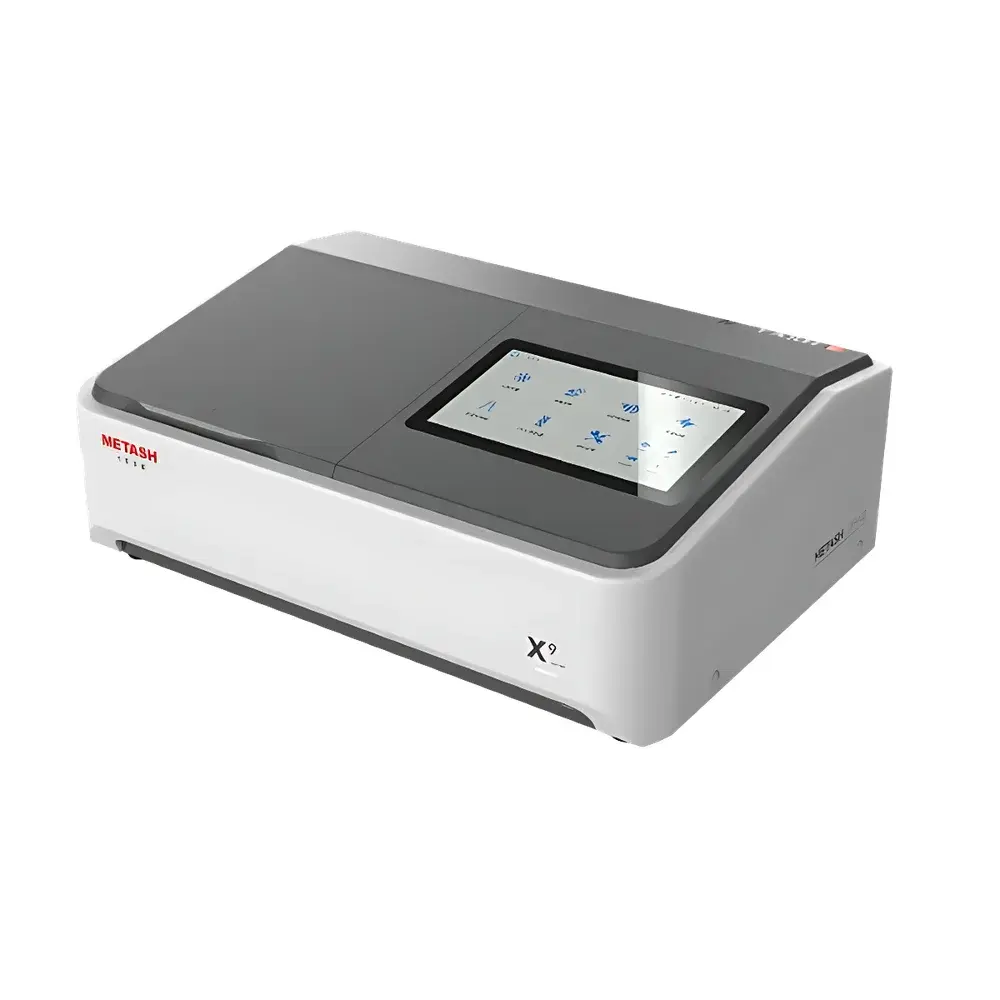
Metash X-9DS Dual-Beam UV-Vis Spectrophotometer
| Brand | Metash Instruments |
|---|---|
| Origin | Shanghai, China |
| Manufacturer Type | Original Equipment Manufacturer (OEM) |
| Model | X-9DS |
| Optical System | Dual-Beam |
| Detector Type | Photocell |
| Wavelength Range | 190–1100 nm |
| Wavelength Scanning Mode | Automatic |
| Spectral Bandwidth | 0.1 / 0.2 / 0.5 / 1.0 / 2.0 / 4.0 nm |
| Wavelength Accuracy | ±0.3 nm |
| Wavelength Repeatability | ≤0.1 nm |
| Stray Light | ≤0.01%T |
Overview
The Metash X-9DS is a high-performance dual-beam ultraviolet-visible (UV-Vis) spectrophotometer engineered for precision quantitative and qualitative analysis in research laboratories, quality control environments, and educational institutions. Based on the fundamental principle of Beer-Lambert law absorption spectroscopy, the instrument measures sample absorbance, transmittance, or reflectance across a broad spectral range (190–1100 nm), enabling characterization of organic compounds, biomolecules, nanoparticles, dyes, pharmaceuticals, and industrial formulations. Its dual-beam optical architecture continuously compares sample and reference beam intensities in real time, effectively compensating for source drift, detector instability, and environmental fluctuations—thereby delivering superior baseline stability and measurement reproducibility over extended operation periods.
Key Features
- Dual-beam optical design with independently suspended optical path mounted on a 20 mm thick milled aluminum baseplate—mechanically decoupled from chassis vibrations and thermal expansion effects to ensure long-term photometric integrity.
- 10-inch high-resolution capacitive touch display with intuitive GUI, supporting gesture-based navigation, real-time spectrum visualization, and on-device data annotation without external computing resources.
- Six-step adjustable spectral bandwidth (0.1–4.0 nm) optimized for resolution/sensitivity trade-off: narrow bandwidths (0.1–0.5 nm) for high-resolution peak deconvolution; wider settings (1.0–4.0 nm) for improved signal-to-noise ratio in low-concentration assays.
- Integrated photometric accuracy of ±0.3%T (0–100%T) and repeatability of ≤0.1%T, validated per ISO 6223 and ASTM E275 standards for routine compliance testing.
- Stray light performance ≤0.01%T at 220 nm and 340 nm—critical for accurate quantification of highly absorbing samples and UV-sensitive analytes such as nucleic acids and aromatic compounds.
- Modular hardware interface supporting USB host/device, Bluetooth (optional), and direct A4 thermal or inkjet printing (HP DeskJet 1100/1200 series compatible) for GLP-compliant hardcopy reporting.
Sample Compatibility & Compliance
The X-9DS accommodates standard 10 mm pathlength cuvettes (quartz, glass, or plastic), microvolume cells (down to 50 µL), and solid samples via optional accessories—including rotating solid sample holders, integrating spheres (for diffuse reflectance), temperature-controlled autosamplers (±0.1 °C stability), and multi-cell changers (up to 8 positions). All optical components comply with IEC 61000-4 electromagnetic compatibility requirements. The system meets essential regulatory expectations for analytical instrumentation used in GxP environments: full audit trail support, user role-based access control (admin/operator/guest), electronic signature readiness, and timestamped log retention—all aligned with FDA 21 CFR Part 11 and EU Annex 11 principles when operated with the included MetaSpectra software.
Software & Data Management
The bundled MetaSpectra PC software extends standalone functionality to advanced spectral processing: derivative spectroscopy, peak integration with baseline correction algorithms, multi-component linear regression, kinetic curve fitting (zero-/first-/second-order models), and DNA/protein concentration calculation using built-in extinction coefficient libraries (e.g., A260/A280 ratios). Data files are stored in vendor-neutral CSV and XML formats; raw spectra include metadata headers (wavelength step, bandwidth, date/time, operator ID, instrument serial number). Internal storage capacity exceeds 10,000 spectra—equivalent to typical desktop workstation usage—and supports bulk export to USB mass storage devices. Software validation documentation (IQ/OQ protocols) is available upon request for regulated laboratory deployment.
Applications
- Pharmaceutical QC: Assay of active pharmaceutical ingredients (APIs), excipient purity screening, dissolution profile monitoring per USP & EP monographs.
- Biochemistry: Quantification of nucleic acids (dsDNA, ssDNA, RNA) and proteins (Bradford, BCA, Lowry); enzyme kinetics (NADH/NADPH oxidation at 340 nm).
- Environmental analysis: Nitrate/nitrite detection (via diazotization), COD determination, heavy metal complexation studies (e.g., Fe-phenanthroline at 510 nm).
- Materials science: Bandgap estimation of semiconductor nanomaterials, dye degradation kinetics under UV irradiation, thin-film optical thickness modeling.
- Educational use: Teaching core spectroscopic concepts including Lambert-Beer law verification, solvent polarity effects on π→π* transitions, and calibration curve linearity assessment.
FAQ
What wavelength calibration standards are recommended for routine verification?
Certified holmium oxide and didymium filters (NIST-traceable) are recommended for wavelength accuracy checks at 241.1, 279.4, 287.5, 333.7, 360.9, 418.5, 460.0, 484.5, 536.2, and 637.5 nm.
Is the instrument compliant with ISO/IEC 17025 requirements for accredited testing labs?
Yes—the X-9DS supports traceable calibration, documented uncertainty budgets (available in technical manual), and full data integrity controls required for ISO/IEC 17025:2017 Clause 7.7 implementation.
Can the touch interface be locked during unattended operation?
Yes—screen lock mode disables all touch inputs while preserving real-time data acquisition and scheduled auto-sampling sequences.
What is the maximum scan speed achievable at 1.0 nm bandwidth?
Up to 3000 nm/min in rapid scan mode, with interpolation resolution of 0.1 nm per data point.
Does the system support third-party LIMS integration?
Via ASCII-based RS-232 or TCP/IP protocols, with customizable delimiter-separated output formats compatible with major LIMS platforms (e.g., LabVantage, Thermo SampleManager).



