
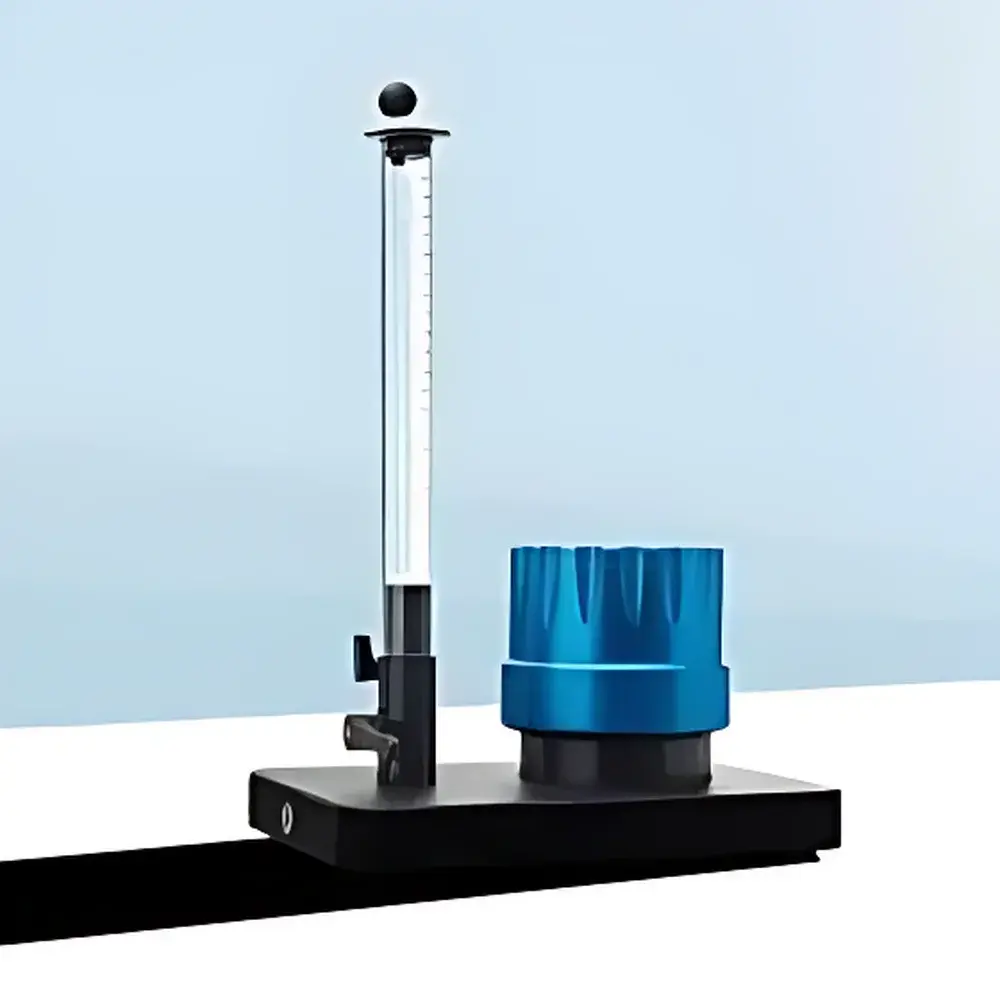
METER KSAT Laboratory Saturation Hydraulic Conductivity Analyzer
| Brand | METER |
|---|---|
| Origin | USA |
| Manufacturer Type | Authorized Distributor |
| Origin Category | Imported |
| Model | KSAT |
| Instrument Type | Soil Water Potential & Moisture Analyzer |
| Measurement Range | 0.01–5,000 cm/d |
| Porous Plate Hydraulic Conductivity (Ks) | 14,000 cm/d |
| Pressure Sensor Accuracy | ±1 Pa (0.01 cm H₂O) |
| Temperature Sensor Accuracy | ±0.2 °C |
| Sample Ring Volume | 250 mL (Ø80 mm × H50 mm), with optional 100 mL adapter |
| Typical Statistical Error under Constant Head/Constant Flow Conditions | ~2% |
| Software Requirements | Windows 7 or later, Microsoft .NET Framework 3.5 |
Overview
The METER KSAT Laboratory Saturation Hydraulic Conductivity Analyzer is a precision-engineered instrument designed for the accurate and repeatable determination of saturated hydraulic conductivity (Ksat) in soil samples under controlled laboratory conditions. It operates on the fundamental principles of Darcy’s Law, quantifying the volumetric flow rate of water through a fully saturated soil column under either falling-head or constant-head boundary conditions. Unlike conventional manual permeameters requiring iterative gravimetric measurements and manual timing, the KSAT integrates high-resolution pressure transducers, temperature-compensated flow monitoring, and automated data acquisition to eliminate operator-dependent variability. Its compact benchtop architecture—occupying less than 0.15 m²—enables seamless integration into regulated laboratory environments, including those supporting ISO 11274, ASTM D5084, and USDA NRCS soil physics protocols. As a core component of the LABROS measurement ecosystem, the KSAT shares mechanical and dimensional compatibility with the METER HYPROP system, enabling sequential saturation and unsaturated hydraulic property characterization using identical sample rings—a critical advantage for generating complete soil water retention and hydraulic conductivity functions (i.e., van Genuchten parameterization).
Key Features
- Two validated measurement modes: automated falling-head (ASTM D5084-compliant) and manual constant-head operation, both traceable to primary hydraulic standards
- Integrated dual-sensor system: high-stability pressure transducer (±1 Pa resolution) and calibrated platinum RTD (±0.2 °C) for real-time temperature correction of dynamic viscosity effects on Ksat calculation
- Wide dynamic range: 0.01–5,000 cm/d, covering clayey soils to highly permeable sands and gravels without hardware modification
- Standardized 250 mL sample ring (80 mm diameter × 50 mm height) compliant with ISO 11274 geometry requirements; optional 100 mL ring available for small-volume or high-density samples
- USB 2.0 interface with deterministic data logging: all raw sensor outputs—including head loss vs. time, temperature, and calculated Ksat—are timestamped and stored locally with audit-trail metadata
- Fully automated Ksat computation per ISO 11274 Annex A, including automatic application of temperature-dependent water viscosity correction (based on IAPWS-95 formulation)
Sample Compatibility & Compliance
The KSAT accepts intact or repacked soil cores conforming to standard sampling protocols (e.g., ASTM D1557, ISO 25177). Its modular ring design accommodates soils ranging from fine silts (with appropriate pre-saturation conditioning) to coarse gravelly matrices (using graded porous plates). All measurements are performed under constant environmental conditions (20 ± 2 °C ambient, non-condensing humidity), ensuring compliance with GLP documentation requirements. The system supports full traceability: each data file includes instrument serial number, calibration certificate IDs (pressure and temperature sensors), operator ID, and timestamped start/end of test. When used within a validated LABROS workflow—including co-calibrated HYPROP units—the complete dataset satisfies FDA 21 CFR Part 11 electronic record integrity criteria when paired with appropriate lab information management system (LIMS) integration.
Software & Data Management
The KSAT Control Software (v4.2+) runs natively on Windows 7–11 platforms with .NET Framework 3.5. It provides real-time visualization of hydraulic head decay curves, live Ksat convergence plots, and automated pass/fail assessment against user-defined statistical thresholds (e.g., coefficient of variation < 3%). Export formats include CSV (for Excel/Python analysis), PDF test reports with embedded metadata, and XML files compatible with FAIR-aligned soil databases (e.g., ISRIC WoSIS, EU Soil Atlas). Audit logs record all user actions—including parameter edits, calibration updates, and report generation—with immutable timestamps. Software validation packages—including IQ/OQ documentation templates—are available upon request for GxP-regulated laboratories.
Applications
- Quantification of Ksat for irrigation scheduling models and drainage design (FAO Irrigation and Drainage Paper No. 56)
- Parameterization of vadose zone flow simulators (HYDRUS-1D, STANMOD, PFLOTRAN)
- Soil health assessment in long-term agronomic trials (e.g., USDA LTAR network protocols)
- Regulatory compliance testing for landfill liner performance (EPA Method 1312) and constructed wetland substrate evaluation
- Calibration of pedotransfer functions (PTFs) linking texture, organic carbon, and bulk density to Ksat
FAQ
Does the KSAT require external water baths or climate chambers for temperature control?
No—the KSAT is designed for stable-room-temperature operation (20 ± 2 °C). Its built-in temperature sensor continuously corrects for water viscosity changes; active thermal regulation is unnecessary for standard use.
Can KSAT data be directly imported into HYDRUS software?
Yes—CSV exports include column headers compatible with HYDRUS-1D’s “Ksat” input format. Optional Python API scripts (provided with software) automate batch conversion and error-checking.
Is the 250 mL sample ring compatible with standard soil coring equipment?
Yes—it matches the inner diameter and height specifications of widely used AMS or Giddings stainless-steel samplers, enabling direct transfer without remolding.
How often must the pressure sensor be recalibrated?
METER recommends annual recalibration against NIST-traceable dead-weight testers; field verification using distilled water column checks can be performed quarterly.
Does the system support multi-sample sequential testing without manual intervention?
Not autonomously—the KSAT processes one sample per run. However, its rapid setup (< 5 min/sample) and shared ring geometry with HYPROP enable efficient manual batch processing across 6–12 samples per day.







