
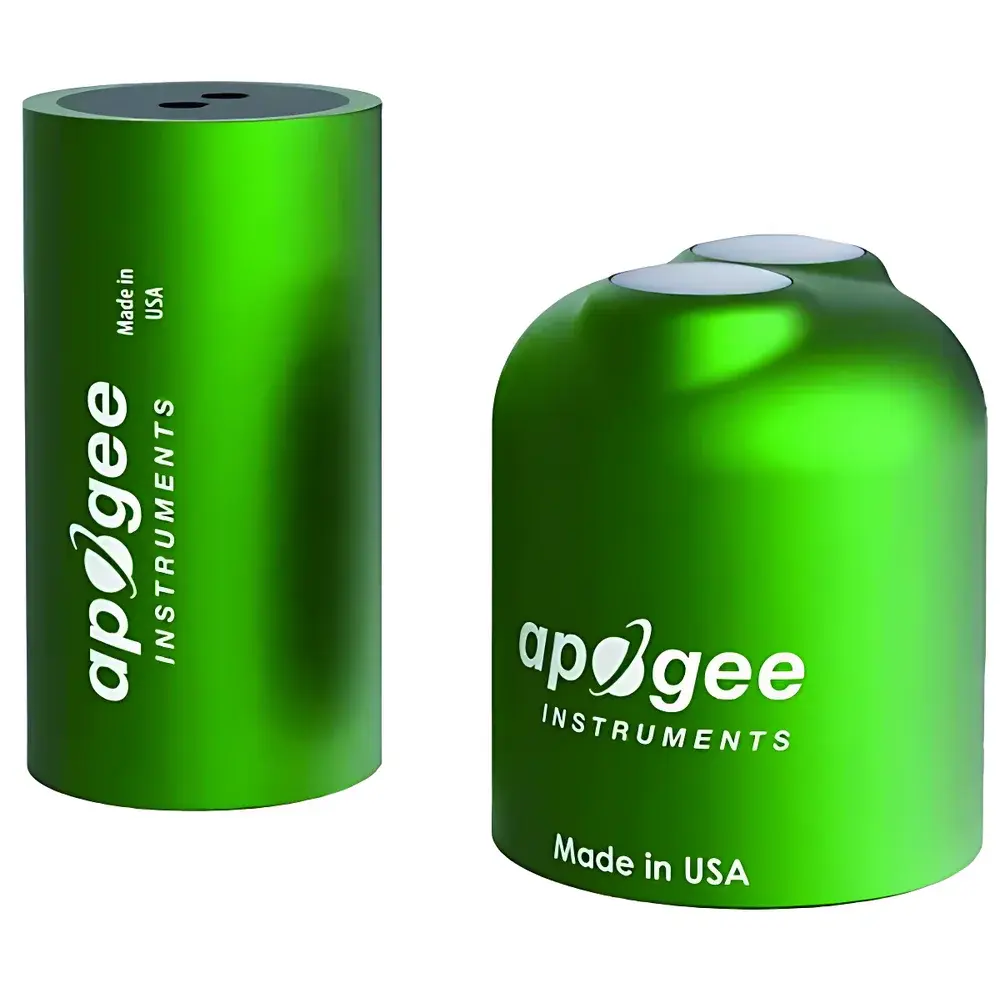
METER S2-421-SS & S2-422-SS Portable PRI Sensors (Upward- and Downward-Looking)
| Brand | METER |
|---|---|
| Origin | USA |
| Model | S2-421-SS (upward), S2-422-SS (downward) |
| Principle | Effective photosynthetically active radiation (PAR)-weighted reflectance measurement |
| Type | Portable canopy-mounted optical sensor |
| Spectral peaks | 532 ± 2 nm and 570 ± 2 nm |
| FWHM | 10 nm per channel |
| Field of view | 180° (S2-421-SS), 35° (S2-422-SS) |
| Cosine response error | ±2% @ 45°, ±5% @ 75° zenith angle |
| Calibration uncertainty | ±5% |
| Measurement repeatability | <1% |
| Long-term drift | <2% per year |
| Response time | <0.6 s |
| Operating temperature | −40 to +70 °C |
| Relative humidity range | 0–100% RH |
| IP rating | IP68 |
| Power supply | 5.5–24 V DC |
| Output | SDI-12 |
| Housing | Anodized aluminum with acrylic diffuser |
| Cable | 5 m shielded twisted pair, TPR jacket, stainless steel (316) strain relief |
| Weight (incl. cable) | 140 g (S2-421-SS), 110 g (S2-422-SS) |
| Dimensions | Ø30.5 × 37 mm (S2-421-SS), Ø23.5 × 43 mm (S2-422-SS) |
Overview
The METER S2-421-SS and S2-422-SS are paired, field-deployable optical sensors engineered for continuous, in situ measurement of the Photochemical Reflectance Index (PRI) at the plant canopy level. PRI is a dimensionless spectral index calculated as (R532 − R570) / (R532 + R570), where R532 and R570 represent canopy-reflected radiance at 532 nm and 570 nm, respectively. These wavelengths correspond to absorption minima of xanthophyll pigments—particularly violaxanthin and zeaxanthin—whose interconversion modulates non-photochemical quenching (NPQ) in response to light stress and photosynthetic activity. The S2-421-SS (upward-looking) measures incident irradiance under hemispherical cosine-corrected optics; the S2-422-SS (downward-looking) captures directional reflectance within a narrow 35° field of view, minimizing soil background contamination and ensuring spatial specificity to target vegetation. Together, they provide high-temporal-resolution PRI data essential for linking leaf-level photophysiology to ecosystem-scale carbon and energy fluxes.
Key Features
- Optimized dual-wavelength detection: Independent photodiode channels centered precisely at 532 ± 2 nm and 570 ± 2 nm, each with 10 nm full-width-at-half-maximum (FWHM) bandwidth—engineered to isolate xanthophyll-cycle–sensitive spectral regions without cross-talk.
- Ruggedized field architecture: IP68-rated anodized aluminum housing with UV-stable acrylic diffuser (S2-421-SS) or precision-aperture baffle (S2-422-SS); epoxy-sealed electronics ensure long-term reliability across −40 to +70 °C and 0–100% RH.
- Low-power SDI-12 interface: Enables integration into distributed environmental monitoring networks using industry-standard protocol; firmware-embedded calibration coefficients eliminate post-processing correction steps.
- Traceable metrology: Each sensor undergoes individual spectral responsivity calibration; uncertainty quantified at ±5% (k=2) against NIST-traceable standards, supporting GLP-compliant data collection.
- Minimal maintenance deployment: No moving parts, no consumables, and self-contained firmware calibration reduce operational overhead in remote or unattended sites.
Sample Compatibility & Compliance
The S2 sensor pair is compatible with a wide range of vegetation types—including broadleaf deciduous forests, coniferous canopies, grasslands, agricultural crops, and managed horticultural systems—provided the downward sensor’s 35° field of view is fully occupied by homogeneous target canopy. It is not intended for point measurements on individual leaves or highly heterogeneous surfaces without spatial averaging. The sensors comply with ISO 9060:2018 Class C specifications for spectral irradiance instrumentation and meet ASTM E2629-22 requirements for field-deployable PAR-related optical sensors. When integrated with METER ZL6 or EM60-series data loggers, the system supports audit-trail functionality and timestamped metadata logging aligned with FDA 21 CFR Part 11 principles for regulated ecological research.
Software & Data Management
Raw voltage outputs from both sensors are converted to calibrated irradiance (µmol·m−2·s−1) via embedded SDI-12 commands referencing factory-determined sensitivity coefficients stored in non-volatile memory. PRI calculation is performed externally in post-processing or real-time on compatible loggers (e.g., ZL6 with custom script support). METER’s ZENTRA Cloud platform enables secure remote access, automated QA/QC flagging (e.g., saturation detection, temperature-compensated validity thresholds), and export to NetCDF or CSV formats compatible with FluxNet, AmeriFlux, and ICOS metadata standards. Firmware updates and configuration changes are executed via serial command line or ZENTRA mobile app—no physical reprogramming required.
Applications
- Quantifying diurnal and seasonal dynamics of photosynthetic light-use efficiency (LUE) across biomes.
- Supporting eddy covariance-based estimation of gross primary productivity (GPP) through empirical and mechanistic upscaling models.
- Early detection of abiotic stress—including drought, ozone exposure, and nutrient limitation—prior to visible symptom development.
- Validating satellite-derived PRI products (e.g., from Sentinel-3 OLCI or NASA MODIS) at ground-truth resolution.
- Calibrating terrestrial biosphere models that incorporate dynamic photoprotective pigment pools.
FAQ
How is PRI calculated from raw sensor outputs?
PRI is computed as (R532 − R570) / (R532 + R570), where R532 and R570 are the upward- and downward-measured irradiances at their respective wavelengths, normalized to incident PAR. Both sensors must be co-located and synchronized.
Can a single S2 sensor be used independently?
No. PRI requires simultaneous measurement of incident and reflected radiance at both wavelengths. The S2-421-SS and S2-422-SS are designed as a matched pair; standalone use does not yield interpretable PRI values.
What data logger compatibility is required?
SDI-12 v1.3 or later is mandatory. Fully supported platforms include METER ZL6, EM60-G, ProCheck, and Campbell Scientific CR1000X/CR6 when configured with appropriate SDI-12 firmware and power regulation.
Is temperature compensation applied internally?
Yes. Temperature-dependent responsivity drift is corrected in firmware using onboard thermistor readings; residual thermal sensitivity is <0.1% per °C across the full operating range.
How often does recalibration need to occur?
Under normal field conditions, recalibration is recommended every 24 months. Annual verification against a reference irradiance standard is advised for studies requiring traceable uncertainty budgets.





