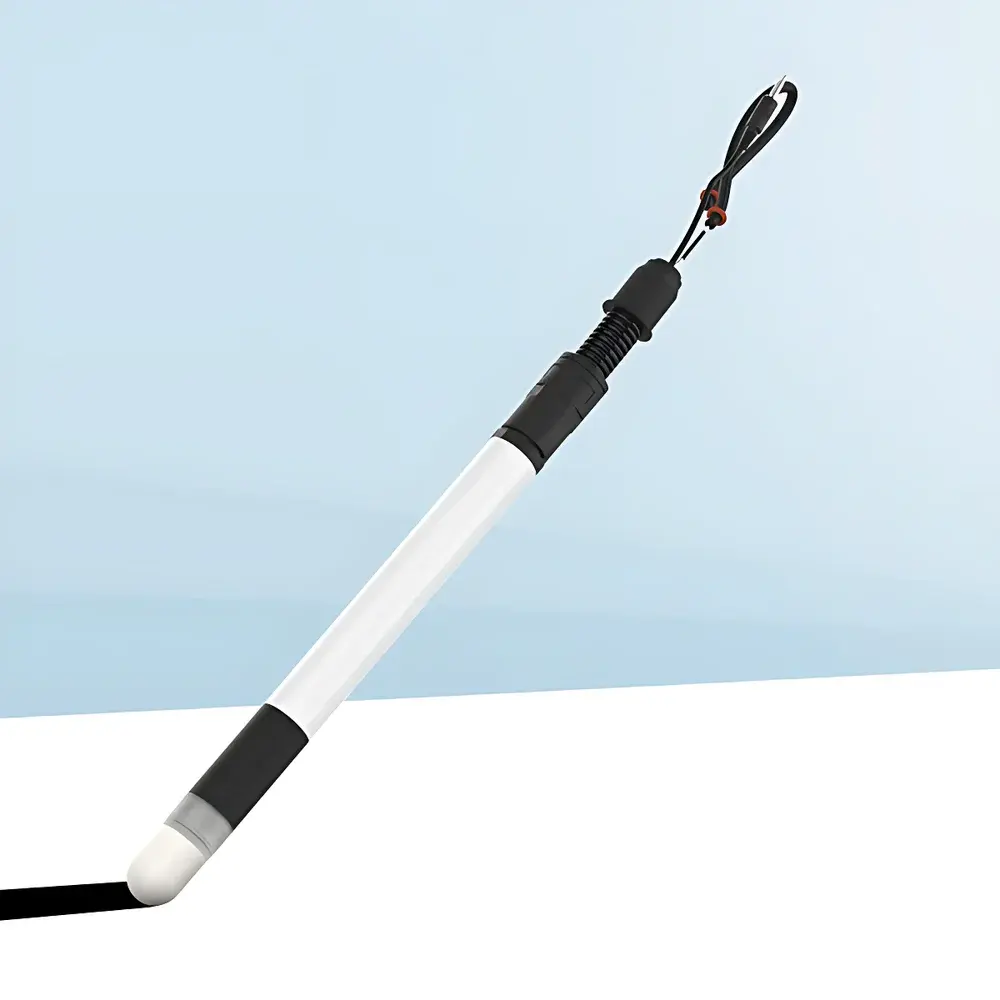
METER TEROS 32 Field-Grade High-Precision Soil Water Potential and Temperature Tensiometer
| Brand | METER |
|---|---|
| Origin | USA (Designed & Engineered in Germany) |
| Manufacturer | METER Group GmbH & Co. KG (formerly UMS) |
| Model | TEROS 32 |
| Type | Pressure-Based Tensiometer |
| Compliance | ISO 9001:2015, CE (2014/30/EU & 2011/65/EU), ISO/IEC 17050:2010 |
| Measurement Range | -85 to +50 kPa (soil water potential), -30 to +60 °C (temperature) |
| Resolution | 0.0012 kPa, ±0.01 °C |
| Accuracy | ±0.15 kPa, ±0.1 °C (-20–40 °C), ±1 °C (outside range) |
| Output Protocols | SDI-12, DDI serial, TensioLINK™, Modbus RTU |
| Power Supply | 4.0–28.0 VDC |
| Enclosure Rating | IP68 |
| Ceramic Cup Material | Al₂O₃ (AI203), Bubble Point: 1500 kPa |
| Rod Material | PMMA |
| Corpus Material | POM-GF (glass-fiber-reinforced polyoxymethylene) |
| Probe Length Options | 40 cm / 80 cm / 120 cm |
| Diameter | 2.5 cm |
| Cable Options | Standard 5 m, up to 75 m custom |
| Connector Types | 3.5 mm stereo jack (4-pin), M12 (4-pin), or tinned bare wire |
| Installation Angle | -80° to -10° (upward), +10° to +80° (downward) |
| Operating Temperature | -30 °C (dry), 0 °C (hydrated), max 50 °C |
| Ceramic Cup Warranty | 10 years |
Overview
The METER TEROS 32 is a field-deployable, high-precision tensiometer engineered for direct, continuous measurement of soil water potential (matric potential) across the wet end of the soil moisture retention curve (–85 to +50 kPa). Unlike indirect methods such as dielectric sensors (e.g., TEROS 12), the TEROS 32 operates on the fundamental physical principle of hydrostatic equilibrium—measuring the negative or positive pressure differential between pore water and atmospheric reference via a calibrated ceramic cup and integrated piezoresistive pressure transducer. This enables true thermodynamic quantification of plant-available water status under dynamic field conditions. Its design eliminates reliance on empirical calibration curves, delivering traceable, physics-based readings that comply with ISO standard methodologies for soil hydraulic characterization. The sensor is purpose-built for unattended, year-round operation in diverse agroecological and environmental monitoring contexts—including arid-zone irrigation scheduling, vadose zone hydrology studies, and climate-resilient crop water management.
Key Features
- Direct, calibration-free measurement of soil water potential with ±0.15 kPa accuracy and 0.0012 kPa resolution—enabling detection of sub-kPa dynamics during rapid infiltration or evaporation events
- Dual-parameter capability: Simultaneous acquisition of soil temperature (–30 to +60 °C; ±0.1 °C accuracy within –20–40 °C) using an embedded Pt1000-grade thermistor
- Robust mechanical architecture: AI203 alumina ceramic cup (1500 kPa bubble point), PMMA probe body, and POM-GF corpus ensure long-term stability in abrasive, saline, or freeze-thaw-prone soils
- True bidirectional pressure sensing: Capable of measuring both negative (tension) and positive (pressure head) pore water potentials without hardware reconfiguration
- Field-serviceable design: Refill or bleed operations performed in situ—no excavation or sensor removal required—minimizing site disturbance and operational downtime
- Multi-protocol digital interface: Native support for SDI-12, DDI serial, proprietary TensioLINK™, and industry-standard Modbus RTU over RS-485, ensuring seamless integration with ZL6, EM60, Campbell Scientific, Onset, or other third-party data loggers
- IP68-rated housing and 10-year ceramic cup warranty reflect rigorous validation under ISO 9001:2015 manufacturing controls and CE conformity (2014/30/EU EMC & 2011/65/EU RoHS)
Sample Compatibility & Compliance
The TEROS 32 is validated for deployment in mineral soils ranging from coarse sands to heavy clays, provided the ceramic cup achieves full hydraulic contact through proper installation (recommended depth >30 cm below surface, avoiding frost-affected layers). It is incompatible with saturated organic media (e.g., peat) where capillary continuity cannot be maintained. Regulatory compliance includes adherence to ISO 9001:2015 quality management systems and conformity with EU directives governing electromagnetic compatibility (2014/30/EU) and hazardous substances (2011/65/EU). While not explicitly certified for GxP environments, its audit-ready data output (via ZENTRA Cloud with optional 21 CFR Part 11-compliant user access controls and electronic signatures) supports GLP-aligned field trials and long-term environmental monitoring programs requiring traceability and data integrity.
Software & Data Management
Data acquisition and visualization are enabled through METER’s ZENTRA Cloud platform—a secure, role-based web application supporting real-time telemetry, automated alerts, and collaborative data sharing. Raw sensor outputs (kPa and °C) are time-stamped, logged at user-defined intervals (1 min to 24 h), and stored with immutable metadata (probe ID, location, firmware version, battery voltage). Integration with ZL6 data loggers allows local edge processing, including on-device calculation of derived metrics (e.g., soil water deficit, cumulative drainage). All communications employ TLS 1.2 encryption, and cloud archives are retained for ≥12 months with optional long-term cold storage. For laboratory or regulatory workflows, CSV exports include ISO 8601 timestamps and SI-unit annotations compatible with MATLAB, Python (Pandas), R, or LIMS systems.
Applications
- Precision irrigation scheduling: Triggering irrigation onset based on crop-specific water potential thresholds (e.g., –40 kPa for maize, –60 kPa for wheat)
- Vadose zone process studies: Quantifying infiltration rates, drainage fluxes, and capillary rise in lysimeter and catchment-scale experiments
- Soil hydraulic property derivation: Paired deployment with TEROS 12 to generate in situ soil water retention curves (SWRC) and estimate hydraulic conductivity functions
- Climatic impact assessment: Long-term monitoring of drought stress indices and soil desiccation trends across ecological gradients
- Regulatory compliance monitoring: Supporting EPA Method 9040C (soil water potential) and ASTM D4318 (liquid limit) auxiliary measurements
- Smart nursery and greenhouse management: Closed-loop control of substrate moisture in containerized horticulture systems
FAQ
How does the TEROS 32 differ from traditional mercury or vacuum-based tensiometers?
It replaces mechanical fluid columns with a solid-state piezoresistive transducer, eliminating maintenance-intensive refilling, bubble removal, and temperature-induced drift—while extending operational range into positive pressure regimes.
Can the TEROS 32 be installed vertically or horizontally?
Yes—it supports installation angles from –80° (upward-facing) to +80° (downward-facing), enabling flexible placement in trenches, boreholes, or slope profiles.
Is frost heave a concern during winter deployment?
The probe must be installed below the local frost line (>30 cm typical); however, the ceramic cup remains functional at –30 °C when dry. Hydrated units require minimum ambient temperatures ≥0 °C to prevent ice formation in the pore network.
What is the expected service life in continuous field use?
With proper installation and periodic verification (e.g., zero-check against distilled water), field deployments exceeding 5 years are routinely documented; the 10-year ceramic warranty reflects accelerated lifetime testing per ISO 14644-1 protocols.
Does it require factory recalibration?
No—its absolute pressure measurement architecture and stable ceramic matrix eliminate routine recalibration; only field verification against known reference conditions (e.g., saturated salt solutions) is recommended annually for QA/QC.