
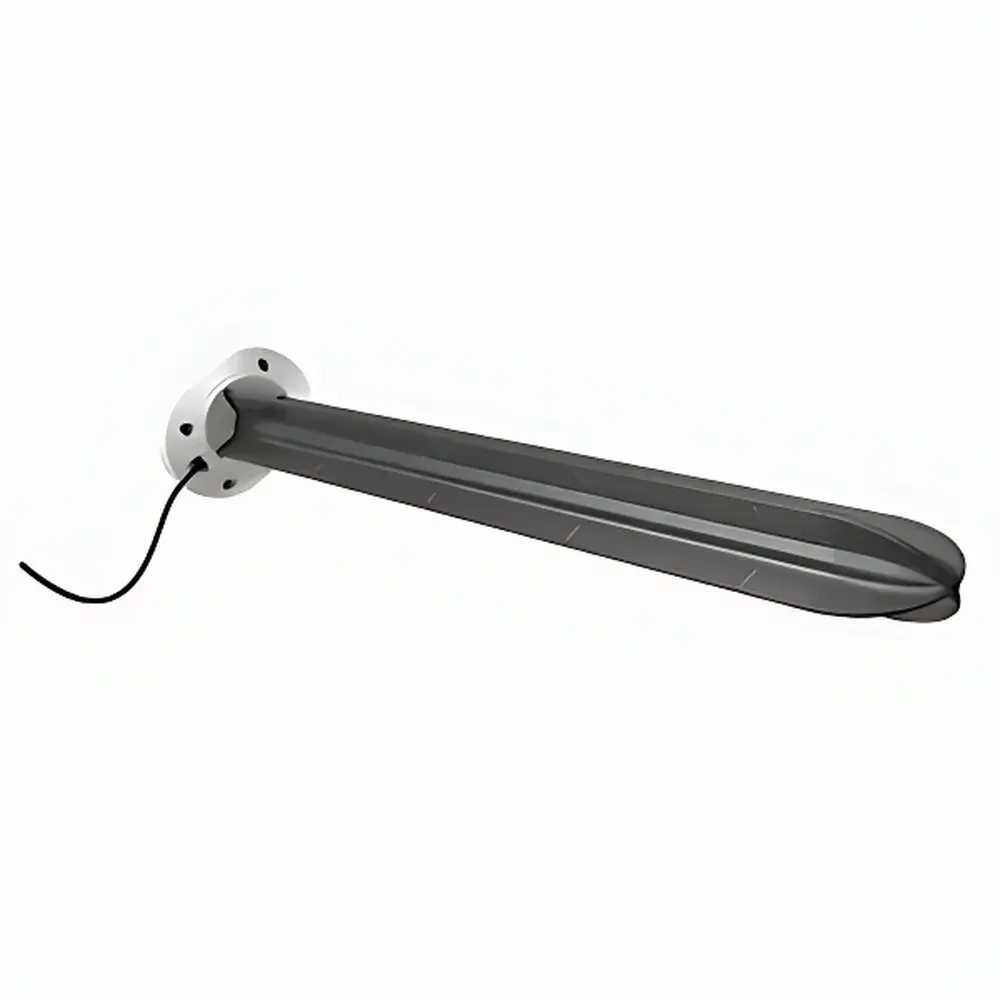
METER TEROS 54 Soil Profile Moisture and Temperature Sensor
| Brand | METER |
|---|---|
| Origin | USA |
| Model | TEROS 54 |
| Sensor Type | Volumetric Water Content (VWC) & Temperature Profiler |
| Measurement Depths | 15, 30, 45, and 60 cm |
| Output Protocols | SDI-12 (3-wire & 4-wire), DDI Serial, RS-485 Modbus RTU, tensioLINK |
| Power Supply | 4.0–24.0 VDC |
| Accuracy (VWC) | ±0.05 m³/m³ (mineral soils, EC < 8 dS/m) |
| Resolution (VWC) | 0.001 m³/m³ |
| Temperature Range | –20 to +60 °C |
| Temp. Accuracy | ±0.35 °C (–20 to 0 °C), ±0.25 °C (0 to 60 °C) |
| Frequency | 70 MHz |
| Compliance | CE-marked per EM ISO/IEC 17050:2010 |
Overview
The METER TEROS 54 Soil Profile Moisture and Temperature Sensor is an engineered solution for high-fidelity, multi-depth soil monitoring in research-grade environmental and agricultural applications. Unlike conventional cylindrical profile sensors that compromise between installation practicality, measurement volume, and long-term stability, the TEROS 54 employs a patented four-wing planar architecture to deliver simultaneous volumetric water content (VWC) and temperature measurements at 15, 30, 45, and 60 cm depths—spanning the primary root zone of most annual crops and perennial systems. Its measurement principle relies on time-domain transmission (TDT) at 70 MHz, enabling robust dielectric permittivity (εa) determination across heterogeneous soil matrices. This frequency minimizes salinity-induced signal attenuation while maintaining sensitivity to subtle changes in pore-water distribution. The sensor’s direct insertion design eliminates reliance on access tubes or excavation, reducing spatial disturbance and ensuring representative in-situ contact with native soil structure.
Key Features
- Four discrete sensing planes at standardized depths (15/30/45/60 cm) optimized for root-zone profiling
- Single 2 cm diameter pilot hole required—no guide tube, no backfilling, no trenching
- Planar four-wing geometry increases effective sampling volume by >3× compared to equivalent cylindrical probes, improving spatial representativeness
- Integrated temperature sensors co-located with each VWC measurement plane for real-time thermal compensation
- Plug-and-play compatibility with METER ZL6 and EM60 data loggers via SDI-12 or DDI serial; also supports RS-485 Modbus RTU and tensioLINK protocols
- Single-port multiplexing: one physical logger channel delivers eight independent measurements (four VWC + four temperature values)
- Field-reversible installation: dedicated extraction tool enables rapid, non-destructive removal and re-deployment—ideal for seasonal cropping systems
- Robust mechanical construction (IP68-rated housing, stainless-steel wings, UV-stabilized cable sheath) validated for long-term deployment under freeze-thaw cycles and wet-dry transitions
- Low-power operation: typical active current draw of 35 mA during 500 ms measurement cycle; sleep-mode consumption as low as 0.1 mA
Sample Compatibility & Compliance
The TEROS 54 is calibrated for mineral soils (VWC range: 0.00–0.70 m³/m³) and supports media-specific calibration for engineered substrates, potting mixes, and hydroponic media (VWC range: 0.0–1.0 m³/m³). Its 70 MHz TDT methodology maintains accuracy in soils with electrical conductivity up to 8 dS/m without requiring empirical correction. All firmware and calibration coefficients are traceable to NIST-traceable reference standards. The device complies with CE marking requirements under EM ISO/IEC 17050:2010 and meets IEC 61326-1:2013 for electromagnetic compatibility in field instrumentation environments. While not inherently GLP/GMP-certified, its stable output, audit-ready calibration logs, and deterministic communication protocols support integration into regulated workflows requiring data integrity per FDA 21 CFR Part 11 when paired with compliant data acquisition platforms (e.g., ZENTRA Cloud with role-based access control and immutable audit trails).
Software & Data Management
Data from the TEROS 54 is natively supported by METER’s ZENTRA Cloud platform—a secure, browser-accessible SaaS environment designed for environmental sensor networks. ZENTRA Cloud provides automated ingestion of SDI-12 and Modbus RTU streams, configurable alerting (e.g., drought stress thresholds, frost detection), and export-ready CSV/JSON outputs compatible with R, Python, and MATLAB workflows. Time-series visualizations include depth-resolved contour plots, temporal heatmaps, and anomaly detection using rolling standard deviation filters. Raw sensor metadata—including firmware version, calibration date, and individual probe serial numbers—is embedded in every data packet. For offline deployments, local storage on ZL6 loggers supports microSD card logging with timestamped binary archives, recoverable via USB-C interface. All cloud-side processing adheres to ISO/IEC 27001 information security standards.
Applications
- Irrigation scheduling and deficit irrigation trials in row-crop agriculture (e.g., maize, soybean, cotton)
- Root-zone water dynamics studies in controlled-environment phenotyping platforms
- Soil moisture response modeling for climate change impact assessments
- Validation of satellite-derived soil moisture products (e.g., SMAP, Sentinel-1)
- Long-term eddy covariance site calibration for evapotranspiration partitioning
- Green infrastructure monitoring (bioswales, rain gardens, permeable pavements)
- Ecological restoration projects tracking infiltration and deep drainage patterns
FAQ
Can the TEROS 54 be installed in rocky or compacted soils?
Yes—its rigid stainless-steel wings and tapered leading edge enable installation in soils with up to 30% gravel content or bulk densities ≤1.6 g/cm³. Pre-drilling with a soil auger is recommended for layers exceeding 2 MPa cone resistance.
Is media-specific calibration required for non-mineral substrates?
For quantitative accuracy in peat, perlite, or coconut coir, METER recommends performing a two-point calibration using gravimetric samples collected at field capacity and permanent wilting point.
How does the TEROS 54 handle saline conditions?
The 70 MHz operating frequency reduces polarization effects in high-EC soils. Accuracy remains within ±0.05 m³/m³ for EC ≤ 8 dS/m; above this threshold, apparent permittivity drift may occur and requires salinity-corrected calibration models.
What is the maximum cable length supported for SDI-12 communication?
Standard 5 m cables are supplied; custom lengths up to 75 m are available with shielded, twisted-pair construction and inline voltage drop compensation. Signal integrity testing is performed per SDI-12 specification Rev. 1.3.
Does the sensor require periodic recalibration in the field?
No—factory calibration is stable over the sensor’s operational lifetime (≥5 years). Drift verification can be conducted annually using in-situ dry-down curves or paired with neutron probe validation points.
Related Products







