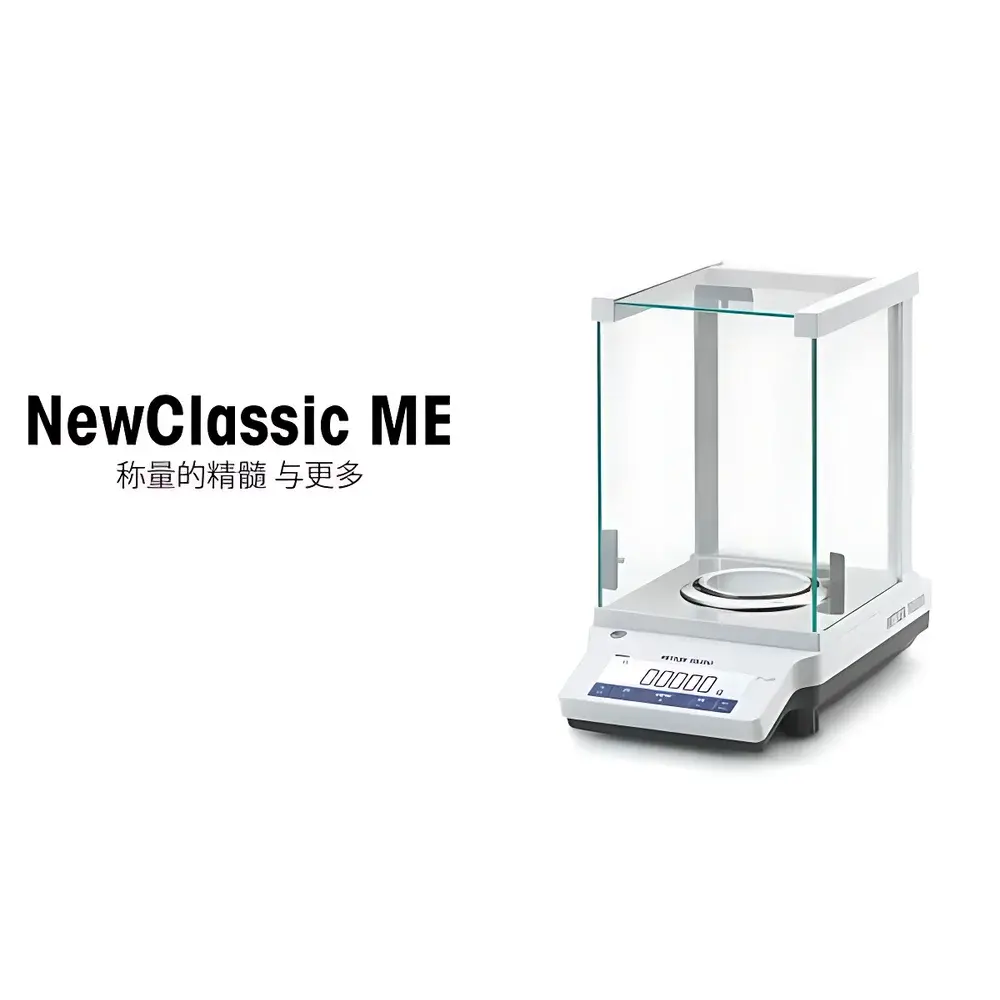
Metler Toledo NewClassic ME103 Precision Balance
| Origin | Switzerland |
|---|---|
| Manufacturer Type | Authorized Distributor |
| Origin Category | Imported |
| Model | ME103 |
| Instrument Type | Precision Balance |
| Maximum Capacity | 120 g |
| Readability | 0.001 g |
| Calibration | Internal |
| Repeatability | 0.001 g |
| Linearity Error | ±0.002 g |
| Stabilization Time | 1.5 s |
| Sensitivity to Temperature Drift | 3.0 ppm/°C |
| Pan Diameter | Ø120 mm |
| Net Weight | 4.6 kg |
Overview
The Mettler Toledo NewClassic ME103 Precision Balance is an entry-level analytical-grade instrument engineered for routine laboratory and quality control environments where reproducibility, regulatory compliance, and operational robustness are essential. Built on Mettler Toledo’s proven electromagnetic force compensation (EMFC) transduction principle, the ME103 delivers high-stability mass measurement across its 120 g maximum capacity with a consistent readability of 0.001 g. Its monolithic metal frame, reinforced housing, and overload protection rated up to 100 kg ensure mechanical resilience under daily use in industrial labs, pharmaceutical production support areas, and academic teaching laboratories. Designed in accordance with ISO 9001 manufacturing standards and compliant with GLP and ISO/IEC 17025 documentation requirements, the ME103 supports traceable, auditable weighing workflows — including automatic date/time stamping of results per ISO/GLP data integrity guidelines.
Key Features
- Internal calibration system activated via single-button press — eliminates dependency on external weights and reduces calibration drift risk between scheduled maintenance intervals
- Ergonomic front-panel interface with intuitive icon-driven navigation and tactile feedback keys optimized for gloved operation and repetitive task efficiency
- 10 preprogrammed application modes: formulation weighing, summation, dynamic (moving object) weighing, piece counting, density determination, percentage weighing, checkweighing, statistical analysis, and free-factor calculation
- Smooth, rounded edges and seamless stainless-steel pan surface (Ø120 mm) facilitate rapid decontamination and meet hygiene requirements for regulated environments
- Front-access leveling feet with integrated bubble level ensure rapid setup and long-term stability without requiring specialized tools or technician intervention
- Robust aluminum-alloy chassis and reinforced base structure provide vibration damping and resistance to mechanical shock during transport or benchtop relocation
Sample Compatibility & Compliance
The ME103 accommodates standard laboratory vessels, crucibles, weighing boats, and small-volume containers within its 120 g capacity limit. Its compact footprint (210 × 320 × 310 mm H×W×D) allows integration into fume hoods, laminar flow cabinets, and controlled-environment workstations. The balance meets key international metrological standards, including OIML R76-1 (Class II), EN 45501, and USP requirements for repeatability and linearity in non-automatic weighing instruments. All internal calibration events are automatically logged with timestamp, operator ID (if connected to LabX software), and environmental metadata — supporting FDA 21 CFR Part 11-compliant audit trails when deployed with validated connectivity solutions.
Software & Data Management
While the ME103 operates as a standalone instrument, it features RS232 and optional USB interfaces for seamless integration into laboratory information management systems (LIMS) or enterprise-quality management platforms. When paired with Mettler Toledo’s LabX Lite software (freely downloadable), users gain automated report generation, electronic signature support, and customizable export templates for CSV, PDF, or XML formats. All weighing data—including intermediate values from multi-step applications like density or statistical weighing—are retained in non-volatile memory and can be retrieved post-session for retrospective review. Built-in GLP/GMP data integrity safeguards include tamper-resistant timestamps, user-access levels, and mandatory calibration event logging.
Applications
The ME103 serves critical functions across multiple regulated and research domains: precise formulation of active pharmaceutical ingredients (APIs) and excipients in compounding labs; piece-count verification of micro-components in electronics assembly QA; density determination of polymers and ceramics using Archimedes’ principle; statistical process control (SPC) sampling in food packaging lines; and educational demonstrations of mass conservation and stoichiometric calculations. Its fast stabilization time (≤1.5 s) and low temperature sensitivity (3.0 ppm/°C) make it suitable for ambient-lab environments without climate-controlled enclosures — reducing infrastructure dependencies while maintaining metrological confidence.
FAQ
What is the difference between internal and external calibration for the ME103?
Internal calibration uses an integrated motorized weight mechanism actuated by a single front-panel button. External calibration requires manual placement of certified test weights and is supported on E-series models (e.g., ME103E).
Does the ME103 comply with FDA 21 CFR Part 11 requirements?
Standalone operation does not fulfill Part 11 requirements; however, full electronic record and signature compliance is achievable when connected to validated LabX software with user authentication, audit trail, and data encryption enabled.
Can the ME103 be used in a cleanroom environment?
Yes — its sealed keypad, smooth surfaces, and absence of crevices meet ISO 14644-1 Class 7 (10,000) particulate cleanliness criteria when operated with appropriate gowning and handling protocols.
Is the ME103 suitable for density determination of solid samples?
Yes — the built-in density application supports both air- and liquid-based methods using a density kit (sold separately), enabling direct calculation of sample density based on mass in air and mass submerged in fluid.
What environmental conditions affect the ME103’s performance?
Operation is specified for temperatures between 10–30 °C and relative humidity ≤80 % non-condensing. Drafts, vibrations, and static charge accumulation must be mitigated through proper bench placement and anti-static accessories.